Donatien, a gesture at five-thirty in the morning in late-summer Paris, asks me with which animal I most identify,
Definitely whales, responds the most cetacean of my selves, he gets up and disappears down the hallway, he returns with something swathed in newspaper, and as I unwrap my gift, fragments of headlines leap from the page: the president of, the privatization of the state telephone company in, at 6:45 in the morning a terrorist attack attributed to, destroyed buildings belonging to, seventy-one wounded in, an airplane crash outside, one hundred seventy fatalities after, a unilateral ceasefire to facilitate dialogue between, a cabinet proposed by, the first non-communist government since, a deadly hurricane in the South of, and there, somewhere adrift in the sea of news, a black ceramic whale with red lips, the thirst of whales, how can it be quenched,
bombs across the Atlantic and how far away I am and is it possible I’ve become indifferent, how should it make me feel if it wasn’t anyone I know, but then again it could have been, but then again it wasn’t, and how close must we be to a catastrophe for it to feel like ours, Donatien said in the taxi that he comes from a country at war, though perhaps he should say he comes from a country that starts wars, and in which wars once took place, but very long ago; the country at war is mine, and yet I, so far from it now, want to ask what he meant when he said that about his country being at war, if he was talking about his childhood in Belleville or something else, but I let it go, too weak to talk through something so complex, I leave him be, blue-gazed Donatien, making coffee,
There’s a whale exhibit at the Natural History Museum, he says, holding out a mug, I take it from him, Say thank you, he says, I look at him, blow him a kiss, and say, Thank you, my hands sparing me for a moment, and I, in the tranquility of the postburn,
Donatien and I crossing the Pont des Arts, hand in hand, how I’ve loved this bridge, so close to where we used to live, I always had to cross it, like when I’d go to my cinemas, my little old cinemas, to see my Jean Gabin and Claudette Colbert movies, I had to cross this bridge and I loved it so much, such lovely things to see on either side, like the Pont Neuf, and if one happened to be tired, one could rest a little while on a little bench and say I’m so happy, it just slipped out so easily,
and maybe it’s because of the bandages, or in spite of the bandages, that I start to feel one hand turning to heat, and why has Donatien not asked about my hands, and his hands squeezing and releasing mine in a gesture that was once common between us but now feels painful, though I don’t stop him, how must my bandages feel to his hands? could it be that we’re bound by invisible threads? can anyone see them? And he still hasn’t asked about my hands. I accept that he’s not going to say anything, he’s so measured all of a sudden, and I’m left wondering if deep down there’s a kind of pattern,
the depths or an egg-shaped sperm whale that grows and grows until it forms a spiderweb
it breaks and falls to threads that ascend to my eyes
the link between our hands clasping and releasing
between my bandages and the ceramic whale swaddled in news
and whales of the ocean and of Parisian museums and bridges
and this walking in slow step
slow, if only everything could be so slow,
we pause before the grayish, hulking image, spread between two columns, of a humpback breaching in a sea upset by the animal’s magnitude; how can you make this kind of immensity break through a painting, how does a painter make that same sea churn in me, and where does he get the energy to make a mural of mating whales, I settle for a breakfast of stale brown bread and a glass of beer, and watermelon, too, seedless, its color and crunch so fresh it seems it will last forever, just like that, in my watermelon trance, my nostrils take in a wave of musk
and in my mouth a word or an ice cube,
Odradek, I burp, What does it mean?
Donatien shrugs and smiles, An enigma,
Let’s go to the country, I beg Donatien,
Let’s, he replies, We can visit my grandparents in Pleudihen-sur-Rance,
Where? I ask,
Brittany, he replies,
You’ve never mentioned them,
Sure I have, you just never listen, they make cider,
Do you think they’d pay us to help with the apples?
No, he says, Your hands,
true, my hands, he mentions them, yet he doesn’t ask,
And we can stop to visit my friends in Bordeaux, Beny and Leika, you’ll love them,
Let’s visit your friends in Bordeaux, Beny and Leika, I’m sure I’ll love them,
The countryside, France, the non-chaos, hands working the earth, here, there; a different kind of hands than mine, hands touched by labor, a history of contact with the land, their dryness can be excused; unlike Paz María, how she suffers from the dryness of her hands, so rough you’d think she’d toiled all day with them buried in dirt, covered in cement, carrying corrosive materials with no gloves; Paz María, there’s no excuse for her dryness, illness, ah, of course, illness, and what about my hands, smooth but without nails, smooth but wrapped in these bandages, I can’t bear to explore what’s beneath them, what would it be like to live a life of working with my hands, of real manual labor, I’m incapable of building things, I haven’t done anything in ages; maybe it’s painting that does that to Paz María’s hands, her hands and something else, her head,
the train chugging toward Brittany, Donatien is keeping something from me, I’m not sure what, anxiety appears there, on his forehead, rays of light streaming through the window, illuminating the red of his hair and his eyebrows and his beard, his freckles suddenly so pronounced, he looks so young; I don’t want to disturb him, I gaze out and I concentrate, the passing vineyards, may time stand still, may it soothe what it drags; the wind lets up from time to time, so why can’t time, which is also physical? but physical in what sense? Easy, the seasons; people here live with the inevitability of change; and their hands, it would seem, have no older left to grow, and could it be that when you plant something, and when you wait for it to grow, that time begins to march more slowly, to the rhythm of harvests, anticipation, how their crops grow seed by seed and sprout by sprout; these people grow their food and they grow their homes and I can’t shake my astonishment at such a simple thing, my wonder in the face of what’s elemental, that hammering nails into wood, nail by nail, one can build a home in which to live; the bond people have with spaces they’ve built with their own two hands, but even these people are dealt blows now and again, by time and by the weather, the north winds lash them, their children get sick and their children die, and sometimes they can’t make ends meet, but in Colombia, they’d be rich,
They’re rich, I tell Donatien,
Donatien says that for France this is poor,
Then you and I must be destitute, or maybe just me, at least you could build a house with your own hands,
Donatien sketches triangles within triangles, he doesn’t have such pale hands for a redhead; my hands bound up tight, the bandages now dark yellow and fraying,
My friends think we’re together, he says, eyes more closed than open, holding back tears, though I know he doesn’t cry, I don’t think he has ever cried,
I guess we are, in a way, I say,
no response,
I try to stay awake, to take in the landscape of Brittany, and a deer if I’m lucky, at least one, but why would there be only one if close behind every deer is a family of deer, and the joy I feel watching them, their skinny hooves, their agility, the tenderness of a deer in his pack, I don’t idealize innocence, of course I don’t, but the innocence of a deer, a raven, a fawn, that ease of an animal so easily trampled and yet such fear contained in that cervine body, and you have to wonder: of what use is a deer’s constant alertness if not to protect him from getting run over, and this, inevitable, is what I see in myself when I cross a street, my reactionless body, my cervine body, paralyzed deerlike in the face of a car, or a bicycle, a motorcycle, a bus, a train, any wheeled thing, and just in the nick of time the yellow sign appears, as though I’d conjured it myself, deer crossing, to protect drivers from danger, and also to protect deer? The silhouette on the yellow rhombus sign, deer and traffic signs,
animals and traffic signs, does the fact that their innocence is a danger to drivers make them less innocent? There aren’t moose here but I’d give anything to see one; I read once that people in New England die every year from collisions with moose, that woodland colossus, Donatien and I still aren’t speaking,
Moose don’t exist here, I say, and Donatien ignores this and very slowly, with that air he sometimes has of a history teacher in a French school, he tells me about his grandparents’ village in Brittany, and how he and his mom and his little siblings would only visit them in the summer, because of some irreconcilable feud they’d had since his mom had left home at seventeen, apparently one of her uncles had been molesting her since she was little and she hated her mother for either refusing to believe her or playing dumb, and even though it’s the sort of thing families tend to sweep under the rug, I can’t believe Donatien could have failed to mention this village of his with its thermal baths, medieval in its sloping slate roofs and walls like stone fortresses, narrow streets where pirates roamed and dukes battled counts and barons, and where agricultural trade with England and the north of Europe have boomed since time immemorial,
immemorial, I ruminate on the word,
Interesting, but I want to know about your grandparents, tell me about them,
and Donatien says, Be patient, you’ll meet them soon enough,
he wants me to form my own opinions,
Tell me, he says, What else do you know about Brittany?
Let’s see, it rains a lot, and they invented that shirt with the black and white stripes, I think you’re the one who told me that, oh, and salted caramel, and they have a reputation for being grumpy, just like you, but I’m not sure if that’s a Breton thing or a redhead thing, people say lots of things about redheads, do you know if there’s going to be any kind of sailors’ show in your grandparents’ village?
Not that I know of, Lorenzo, we’re going to spend time with my grandparents, let’s worry about the sailors later, all right?
Later, I say, and I think of the pus man with no lips using his beard to skin warm bodies in the Bois de Boulogne,
I do have a nom de guerre, you know, Donatien says suddenly,
Let’s hear it,
Miz Brittany,
__________________________________
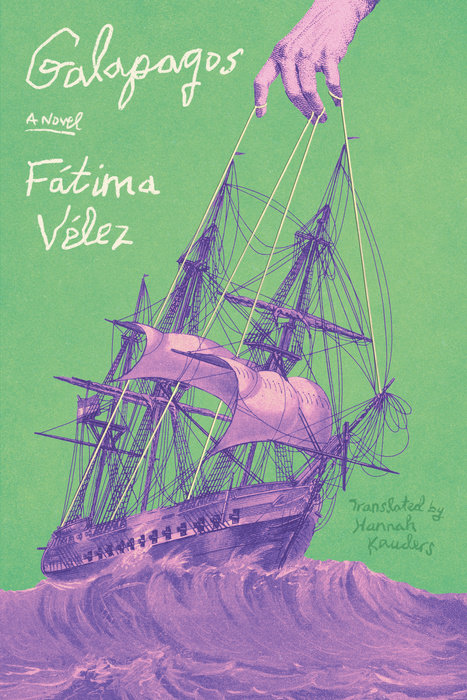
From Galapagos by Fátima Vélez, translated from the Spanish by Hannah Kauders. Published by Astra House. Text copyright © 2025 by Fátima Vélez. Translation copyright © 2025 by Hannah Kauders. All rights reserved.