From Glasnost to Silence: The Collapse of Literary Freedom in Russia
Svetlana Satchkova on the Logic of Authoritarianism
In 1985, when a relatively young party functionary Mikhail Gorbachev became the leader of the Soviet Union, a new era began. Gorbachev started reforms that eventually led to the dissolution of the state and introduced a politics of glasnost (“openness”). Suddenly, things that had long been off-limits could be talked about: Stalinist terror, political prisons, and other unspoken parts of history. Publishers began printing literature that had been banned or heavily cut by censors, like Bulgakov’s The Master and Margarita and Pasternak’s Doctor Zhivago.
The end of the USSR in 1991 accelerated this expansion of public speech. The book market of a new country—Russia—was flooded with memoirs of repression and camp testimony, along with émigré and avant-garde writing, much of it never published before. For a brief moment, under pressure from progressive politicians and activist groups, even parts of the KGB archives were opened to the public.
It was an exhilarating time for many people: despite the hardships brought on by economic reforms, they could discuss and read almost anything they wanted—and they did, voraciously. A big part of that sense of liberation came from talking openly about sex, something that had been an almost complete taboo in Soviet times. As one woman famously said during a live TV link between Leningrad and Boston in 1986, “We don’t have sex here in the USSR.”
And yet by the late 1980s, at least in Moscow, sex education was making its way into high schools. Magazines and newspapers appeared that were devoted to the many forms human sexuality could take. I must’ve been sixteen or seventeen when I first learned that gay people existed. Soon, pop singers and TV personalities whose flamboyant style and mannerisms clearly marked them as queer began showing up on television. Like me, many people believed that a new democratic Russia was emerging, and that there was only one direction to go: forward. That was why, in 1997, after getting my bachelor’s in the U.S., I returned to Moscow.
But that mood began to change in 2000, when Vladimir Putin became president. He gradually dismantled democratic institutions, reversing much of what had been done before him. For free speech, this meant restricted access to archives, tighter state control of the media, and the promotion of a new patriotic narrative in which many aspects of World War II and Soviet state crimes were no longer open to public discussion. After the mass protests of 2011–2012, when tens of thousands of people took to the streets to protest rigged elections, the crackdown intensified. A more aggressive system of control took shape, relying on website blocking, “extremism” prosecutions, and growing harassment of independent media. In 2013, the so-called “gay propaganda” law banned anything seen as promoting LGBTQ+ relationships to minors, part of a broader conservative turn.
The goal was to spread uncertainty and fear, so that people would start censoring themselves. And it worked.
I left Russia in 2016, seeing how it was speeding toward dictatorship, and wasn’t there to witness the wave of repression that followed the full-scale invasion of Ukraine in February 2022. But I kept a close eye on the news, as many people I knew were affected. On March 4, mere days after the military assault began, Russia introduced a series of censorship laws that radically narrowed what could be said in public. They made it a crime not only to oppose the war, but even to describe it in language that differed from the state’s official version.
The most ludicrous pieces of legislation were the so-called “fakes about the army” laws, which criminalized what the authorities defined as false information about the armed forces and were broad enough to be applied almost at will. You could be punished simply for calling the war a war: people were expected to refer to it as a “Special Military Operation” and to speak about it only in favorable terms. Objective reporting became impossible, and many independent media outlets shut down or left the country. The effects quickly reached the book industry. Publishers, bookstores, and libraries began avoiding anything that might attract attention. Topics involving Ukraine, the military, state violence, or contemporary politics could easily be interpreted as “discrediting” the armed forces. Authors labeled “foreign agents” for their anti-war or anti-government views, like the bestselling novelist Dmitry Glukhovsky, saw their books quietly disappear from shelves.
Another pivotal moment came in the summer of 2022. The year before, Elena Malisova and Katerina Silvanova had published a YA novel, Summer in a Pioneer Tie, about a budding romance between two boys in a Soviet Pioneer camp. After it became an unexpected and enormous bestseller, State Duma deputies condemned it as a threat to so-called family values, and it was soon pulled from bookstores. Then, in late 2022, a new “anti-gay propaganda” law was adopted, extending the ban on LGBTQ+ content to all ages and making positive portrayals of queer relationships in books, films, and media illegal.
The repercussions were far-reaching. Even before the law was passed, publishers began preemptively censoring manuscripts. Sometimes, following what they called a linguistic expertise, they cut fragments of text; in other cases, when they wanted to be transparent about censorship, they chose to black out sentences or even whole pages, so readers could see how much text was missing. One example of this practice appeared in Max Falk’s novel Shattered, published in October 2022. The book tells the story of a relationship between two gay men, and blackouts made up 3 percent of the entire text. Bookstores and publishers were also stumped about what to do with works in translation, including classics containing passages that could now be seen as problematic, such as Virginia Woolf. The laws were worded vaguely, making them open to interpretation.
It’s not hard to see that this was deliberate: the goal was to spread uncertainty and fear, so that people would start censoring themselves. And it worked. Some publishers and bookstores did everything they could to avoid trouble; others, with a higher tolerance for risk, continued to print or stock books with potentially dangerous content, hoping for the best. Then a “concerned citizen” would file a denunciation, and the authorities would show up with a fine or a warning.
This fit neatly into a wider culture of denunciation that took hold after 2022. I watched from a distance, hardly believing what I was seeing. I had read about the 1930s, about how people denounced one another on a massive scale during Stalin’s purges, informing on neighbors and even their own relatives in the hope that it might keep them safe. And now it was happening again. Even schoolchildren were denouncing their teachers for saying the wrong thing, or turning in other kids.
When seen like that, as a sequence of facts, the logic of authoritarianism becomes clear. The need to control the narrative always grows, and repressions escalate.
The Berkovich–Petriychuk trial, which took place in 2024, became, for me, a defining free-speech case, ending in prison sentences for two innocent women. Svetlana Petriychuk wrote the play Finist, the Brave Falcon, based on real events, about Russian women deceived into marrying ISIS fighters and traveling to Syria. It was staged in 2020 by theater director Evgenia Berkovich. The production was widely praised, carried a clear anti-terrorist message, and received two Golden Mask awards in 2022, Russia’s state-supported national theater prize.
After the full-scale invasion of Ukraine, Berkovich began writing openly anti-war poems on Facebook, where they were shared thousands of times. When the state moved against her, it was clear that these poems were the real reason. Petriychuk appears to have been targeted largely by association. The formal pretext was the play, which prosecutors claimed promoted terrorism. The trial lasted several months, with the prosecution maintaining this charge despite the utter absurdity of the accusation and the evidence. In July 2024, the court sentenced both women to six years in jail. On appeal, the sentences were reduced by several month, but both women still went to prison. The case demonstrated that even a semblance of truth didn’t matter: any text could be interpreted in the opposite way.
By the end of 2025, this was followed by a broad crackdown on independent publishers. Many found themselves under investigation by the security services: staff were detained and questioned, or charged in so-called “anti-extremism” cases for distributing queer literature. Some managers were placed under house arrest; others were fined. Popcorn Books, which had published Summer in a Pioneer Tie, was forced to shut down. The state now controls the book market, and the space for honest literature in Russia has collapsed. It isn’t that such literature no longer exists; it’s that it is now written, published, and circulated outside the country.
When seen like that, as a sequence of facts, the logic of authoritarianism becomes clear. The need to control the narrative always grows, and repressions escalate. That’s why resistance matters early, while it’s still possible. Book bans in the U.S. are not as extreme, nor are they as central to state power. They come in fits and starts, and there are plenty of actors—librarians, teachers, judges, and readers—who push back and try to act in good faith. Still, the overall direction is worrying. People who want to ban books almost always start by saying they’re protecting children from something harmful. But they never stop there. Soon enough, they want to “protect” the rest of us too, making sure we’re only exposed to one approved story—their own.
____________________________________
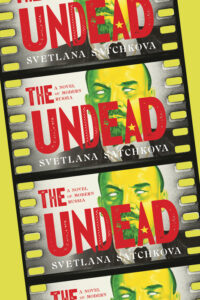 The Undead: A Novel of Modern Russia by Svetlana Satchkova is available via Melville House.
Svetlana Satchkova
Svetlana Satchkova is a Russian-born journalist and novelist who immigrated to the United States in 2016. She covers culture and politics, with bylines in the Rumpus, Newsweek, LARB, the Independent, and others. Currently a research fellow at the Jordan Center for the Advanced Study of Russia at NYU, she holds an MFA from Brooklyn College and lives in Brooklyn. Svetlana has published three novels in Russian; her English-language debut, The Undead: A Novel of Modern Russia, was released in January 2026.