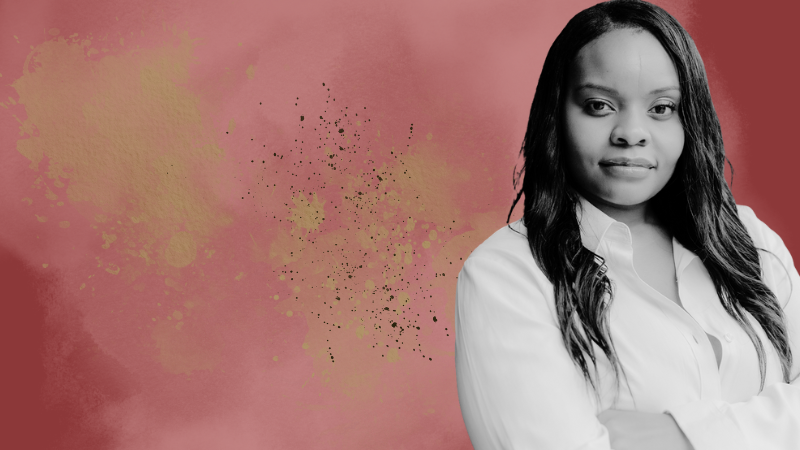
From Creative Chaos to Poetic Order: A Conversation With Poet Isabelle Baafi
Peter Mishler Talks to the Author of Chaotic Good
As part of our collaboration with Faber & Faber to interview poets from their extraordinary list, Peter Mishler corresponded with Isabelle Baafi. Isabelle Baafi is the author of Chaotic Good (Faber & Faber / Wesleyan University Press, 2025), which won the Jerwood Prize for Best First Collection and is shortlisted for the T. S. Eliot Prize. Her pamphlet Ripe (ignitionpress, 2020) won a Somerset Maugham Award and was a Poetry Book Society Pamphlet Choice. She won First Prize in the Winchester Poetry Prize 2023 and Second Prize in the London Magazine Poetry Prize 2022. Her writing has been published in Granta, the TLS, The Poetry Review, Callaloo, The London Magazine and elsewhere. She edits at Poetry London and Magma.
*
Peter Mishler: Would you be willing to share about the rituals of your writing practice?
Isabelle Baafi: I have a bunch of different approaches to writing, as I like to switch things up. If I’m working with a particular form, like a golden shovel, pantoum, or sestina, the only way to write it is to sit down and go from start to finish. But my poems often don’t emerge that way. Usually, there’ll be an uncomfortable truth or complicated idea I can’t figure out—something I want to give expression to, but which is so layered that it can only come out as a poem. Often I’ll free-write, sometimes for up to an hour, asking myself particular questions or giving myself prompts, and then I’ll pick out lines and images with the most resonance and shape the poem that way. Editing is then a process of adding, removing, deepening and moulding—which will happen during several sessions over days, weeks, months or even years.
I was thinking about chaos as a precursor to creation—like fire, which destroys but also purges and gives way to new life.
Being open to life’s fragments and allowing them to flow through me has been instrumental. That means jotting down an idea or phrase when it strikes me, and never deleting a line that has even a smidgeon of potential!
PM: Could you share your thoughts about the poems that open each section of the book, your “effect” poems (e.g., Mpemba effect, Kuleshov effect)? To what extent do you see poetry as an “effect?”
IB: As you say, each of the book’s five sections opens with a poem named after an “effect” or natural phenomenon that is an observable principle in sociology, chemistry, computing, psychology, or life in general. These effects came into the collection one by one, but what really interested me was how they zero in on dynamics and truths that may seem antithetical but are inherently true and shape how we experience the world. I suppose things like ontology, axiology, semantics and categorization have always been significant for me. This is because although I’m an artist, I’m also quite pragmatic, and as a Black woman from a working-class background, my engagement with the English language—which is so politically charged—is inherently political, inherently charged.
The first effect to find its way into the book was the Kuleshov effect. Part of my undergraduate degree included film studies, and in cinematic theory the Kuleshov effect is an editing principle whereby the meaning of a shot is derived by its proximity to other images. The effect was demonstrated by Soviet filmmaker Lev Kuleshov in the early twentieth century, who famously used a neutral shot of an actor’s face and juxtaposed it with different images to evoke different emotions in the audience.
Face + child in a coffin = sadness
Face + bowl of soup = hunger
Face + beautiful woman = lust
In such an example, the audience will read the expression differently even though it’s the same one each time. When I was writing the book, I was interested in how a child’s identity and sense of meaning is so heavily informed by their surroundings, and children are constantly looking for context clues in order to understand the world.
The next effect I came across was the Mpemba effect, which is a chemical phenomenon in which hot water freezes faster than cold water. I was really intrigued by that idea of things transforming in nonlinear ways, and in how a relationship can “cool” even as it intensifies.
At one point, I also had a poem about a friendship breakup called the Doppler effect, which is an effect where sounds moving away have a lower pitch. It made me think about the experience of someone moving towards you versus them moving away from you, and how different that is, how poignant—but at that point I thought that might be too many breakups for one book! So I let it go.
In a book that centers so much on structural violence, I knew I wanted to write about the bystander effect, which is a phenomenon in which the more witnesses there are to an atrocity or incident, the less likely each person is to intervene. Unfortunately, we’re seeing how true that is in the world today.
At that point, I knew that there should be one effect per section, and originally the effects were the titles of the sections, but the phenomena kind of occluded the core narrative, so I decided instead to make them poems within each section. I then looked for effects for the remaining sections. The butterfly effect (which is also known as chaos theory!) and the horizon effect (which is a principle in gaming) were also relevant to the book’s themes, and so they inspired the final two.
PM: How important is artistic procedure to you, as in a formal constraint or operating by a set of rules?
IB: I don’t believe in doing things just one way, but that being said, I do love working with form. As a deeply methodical person, I find that my wild and strange imagination benefits when there’s a constraint to push against. Also, I’ve found that working with form can be a great way to get started when you’re stuck. Take golden shovels for instance: at times, I perhaps didn’t know what I wanted to say, but finding a quote or lyric and then writing towards each end word made things a bit more digestible.
When you work with form, there’s a strong element of discovery and unexpectedness because you don’t know what you’re going to say or how things will come together. You end up surprising yourself. Plus, some forms really lend themselves to certain themes. A lot of the collection explores what it means to look into the past and look towards the future, as well as doubling, mirroring, repeating and breaking cycles, remembering, misremembering, and so on, and so things like the specular poem, the mirror poem, the sestina, and the contrapuntal really capture that.
PM: How important is the association between your dream life and poetry for you?
IB: Dreams are very important for me. Over the winter of 2022, I was going through a particularly tumultuous time in my life, and my mind felt very splintered. Although I wanted to write poems, I didn’t feel like I could order my thoughts well enough to get anything down. But a poet told me I should push through and make sure I do get it all down—and I’m so glad I did. That winter, I rented this little cottage on a horse farm in Wiltshire, and for about a month every day I would free-write for fifteen minutes first thing when I woke up. That was my writing for the day.
Often I’d be describing my dreams, and even when I wasn’t, I was catching myself in a preconscious, prelogical state, and so I was writing the most radical and honest things. I got the idea from Nuar Alsadir’s essay “The Map of Four Kisses” and also her collection Fourth Person Singular, both of which encourage writers to tap into the subconscious. When I came back to London, I assembled about a dozen poems through that, many of which ended up being in the collection, and many other poems have lines and fragments from that period too. That process also shaped my understanding of how I could write, and even live, encouraging me to give a voice to every layer of my being and to see them all as valid, as potential teachers.
I never feel like a poem is done until I’ve written something that has surprised me. Because a poem, really, is a discovery.In addition to being ways for us to tap into our subconscious and discover how we really feel about things—which I think is so important—dreams are a rich resource for writers because they’re full of symbolism. Dreams consist of the visceral, prelinguistic ideas that color our world, and so it makes sense for writers to draw from them at some point.
PM: I’m curious if the title of your collection Chaotic Good has taken on various meanings since you first titled the manuscript? Are there new resonances for you?
IB: It’s funny, but since the book came out I feel like I’ve seen and heard the word “chaos” everywhere, and each re-encounter stirs up a mix of feelings. “Chaos” is a word that’s normally attributed to people and things that are disorderly, destructive, a liability of some sort. I considered those facets as I wrote the book, mostly because women who reject oppression or patriarchal systems have historically been deemed unruly. Additionally, important revolutions typically take place during periods of upheaval, which may look like, or be called, “chaos.” But I also believe that, as Anaïs Nin wrote, “In chaos, there is fertility”; I was thinking about chaos as a precursor to creation—like fire, which destroys but also purges and gives way to new life.
PM: To what extent are you interested in first developing an idea for a poem?
IB: It’s true that at times a poet may know what they want to explore when they sit down to write, or even some degree of what they want to say. But generally, I often find that poems in which the writer appears to know exactly what they want to say from the beginning and then doesn’t divert from it at all are flat, or at least lacking something. Personally, I never feel like a poem is done until I’ve written something that has surprised me. Because a poem, really, is a discovery. If nothing changes in the poem, why does it need to exist? How is it improving on the blank page, the silence? And if the writing of it doesn’t change you, the poet, why write it at all?
PM: Could you share about when you noticed this surprise and discovery most profoundly in a particular poem?
IB: This happened many times throughout the writing of the book, but I suppose the poems that most surprised me were the ones in which logic is suspended to some extent—like “The Cottage” or “Janus”—or the ones that reflect on childhood and adolescence, such as “Turkish Delight,” “Chiaroscuro” and “Ouroboros.” With the latter, I was often conjuring the symbolism, vocabulary and perspectives of my earliest years and reflecting on my youth in order to write not necessarily what had happened exactly, but certainly how it felt.
And so I was surprised to (re)discover thoughts and observations from those periods—those versions of myself. I would wonder where they came from, how much of the events were “real”—and what “real” actually meant. The poems felt strange, even to me, but when I read them back it was like pressing my ear to a shell and hearing my own voice.
PM: To what extent do you think the effects you wrote about are unbreakable or unable to be disrupted? Do they feel constraining to you or do you see the ability to disrupt or subvert them?
IB: Overall, these effects seem to be incontrovertible principles whether we like them or not (and not just the ones that stem from physical laws). But rather than thinking about submission to or rebellion against them, I always wanted to invoke them as signposts for the pitfalls in our humanity, the risks of being alive: they offer a vocabulary for our weaknesses and fears. The choice we are left with is how we exist within and alongside these principles, and what we learn from them.
For instance, to me, the Mpemba effect is a reminder of how our lives can defy the “natural” or predictable order of their progression and become something unexpected. I choose to see that in a positive light—as an argument against essentialism and its imposed limits. Likewise, the horizon effect and the butterfly effect are, for me, reminders that the daily choices I make can and will have massive reverberations further down the line, and so it is important to be mindful and intentional in everything I do.
The world we live in is so full of brutality and apathy, and so I think about the bystander effect a lot these days, and I’m always encouraging myself to do more, speak up, and find important, impactful ways to be brave and make a difference. And I’d say that the Kuleshov effect is a reminder to us all to be cognizant of where our frameworks for the truth come from, and how they shape our understanding.
PM: The effects you’ve chosen are incontrovertible, like you said. I wondered if during the creation of these poems there was a tension for you between exploring the incontrovertible with an artform that is perhaps oriented in discovery or flexibility?
IB: That’s a great question! The answer is: definitely. Although I was invoking these scientific laws and psychological tenets, and writing about them through the lens of my own experiences, my goal was never simply to retell them, but to understand the world through them. One of my wider goals for the book was to dramatize retrospect, memory, regret; for the speaker to reflect on the past and to retrace and re-examine their steps—hence the first section (“Marriage”) being set during adulthood and the second (“Childhood”) occurring decades earlier.
But I also wanted the poems to be as visceral and as immediate as possible. I wanted the reader to feel like they’re experiencing things in real time, even as they are outside of time, knowing what’s going to happen. That is the central tension of the book: the codependent relationship between inevitability (or predestination) and free will (the agency to buck against it). The effects were a way for me to lean into and explore inevitability whilst also dramatizing agency and free will (and their hazards).
But the most gratifying part of writing the book was the act of exploration through lyricism. To truly discover, for instance, that although one small action can take you down a path that leads to a dead end or a trap, you can always imagine your way out.

Peter Mishler
Peter Mishler is the author of two collections of poetry, Fludde (winner of Sarabande Books' Kathryn A. Morton Prize) and Children in Tactical Gear (winner of the Iowa Poetry Prize, forthcoming from the University of Iowa Press in Spring 2024). His newest poems appear in The Paris Review, American Poetry Review, Poetry London, The Iowa Review, and Granta. He is also the author of a book of meditative reflections for public school educators from Andrews McMeel Publishing.