Frederick Jackson Turner’s Groundbreaking Frontier Thesis Was a Flop When He First Read It
Megan Kate Nelson on the History of the American Frontier
Chicago. July 1893.
It was already warm when Mae Turner left the University of Chicago campus and joined some friends to spend the day at the Columbian Exposition (known more popularly as the World’s Fair). She and her husband, Frederick Jackson Turner, had left their two toddlers back home in Wisconsin, so this trip to Chicago was a vacation for Mae—but not for Turner. He was in the “final agonies” of finishing a paper he was giving to an audience of his fellow history professors at the American Historical Association meeting in two days’ time. So, his wife went to the fair without him.
When Mae and her friends arrived at the exposition, there were already tens of thousands of people roaming the grounds: 630 acres of bright white Beaux Arts buildings, stuffed with the evidence of American achievement in mining, electricity, manufacturing, and agriculture; and a system of lagoons designed by the famous landscape architect Frederick Law Olmsted. Hawkers offered hot food and souvenirs along the Midway Plaisance, a carnival promenade on the west side of the grounds displaying “living villages” of African and American Indigenous peoples. A 264-foot-high Ferris wheel towered above it all, a feat of engineering that provided visitors with a spectacular view of Lake Michigan.
All the states and territories in the Union were represented at the fair. Colorado’s pavilion boasted a re-creation of Mesa Verde, a collection of Ancestral Puebloan cliff ruins in the southwestern part of the state, and a larger-than-life sculpture of an Indigenous hunter, standing upon the body of a buffalo he had just slain. The sculpture was titled “The Closing Era,” but most journalists called it “The Last of His Race.”
Turner would have liked to see this sculpture, along with Buffalo Bill’s Wild West Show, which was set up outside the fairgrounds. The ten-year-old show was immensely popular across the United States, depicting a West in which white pioneers conquered both Indigenous peoples and the “wilderness.” Turner had been studying American expansion and con-quest across the continent; it was the subject of the talk he had to finish.
The American Historical Association was less than a decade old and had been incorporated in 1889. Historians founded it amid the professionalization of academic disciplines in the United States, envisioning a society of trained scholars who engaged in rigorous historical research and educated future historians at the nation’s growing number of colleges and universities. Every year, members convened in Washington, D.C., to present new research and exchange ideas.
The meeting in 1893 was special, however. Association officers had decided to hold it in Chicago, in conjunction with the World’s Fair. Presenting a paper at the conference was a big moment for the thirty-one-year-old Turner. Although he had earned his PhD at Johns Hopkins University, acknowledged as one of the leading history programs in the nation, he was relatively unknown in the profession. He was hoping to make his mark with a talk that was more manifesto than research paper.
This argument about the frontier was new, and it was controversial.
Two days after Mae left him in a university dorm to go to the fair, Turner took a horse-drawn streetcar eight miles north for the association’s second session, which began at 8:00 p.m. The Art Institute, a building that had opened to the public just a few months before, was hosting a series of lectures and meetings to highlight the world’s intellectual progress since 1492. It was an imposing two-story building clad in limestone, with symmetrical wings extending out from its central hall.
Walking up a 120-foot-wide flight of steps, Turner stepped through the doorway and found himself in a broad, high-ceilinged lobby. Huge columns made of light pink and dove gray Tennessee marble shone in the evening light filtering in from the glass roof. Most of the Art Institute’s antiquities, silver objects, and musical instrument collections were still in storage, but the trustees had placed statuary, paintings, and other items in the halls. Hundreds of people milled around, looking at the work of Dutch and French masters mounted on walls painted in shades of crimson, to set off the artworks’ gilded frames.
Hall Three, where Turner was scheduled to give his paper, was a long room on the north side of the building, with five windows that had been opened to let in the breeze after a hot summer day. The hall was already filling up with more than two hundred historians, who sat in chairs in front of an elevated platform for the speakers. Electric lights gave the room a warm glow. A portion of the Art Institute’s historical cast collection was mounted on the walls: sculptural fragments, bas-reliefs, pilasters, and doors from some of Europe’s most famous architectural sites. As the sun set, the session began. Turner sat through four talks before he rose to give his own.
In college, Turner had won several awards for his oratorical skills, and he had abundant experience talking to large audiences. It was late, however—probably after 10:00 p.m.—and even the lakeshore breezes could not dispel the heat from the day in Hall Three. Turner figured he would outline the major points of his paper and skip some of the details. At this point in the program, no one would complain about a paper that was shorter than expected.
Turner began his talk by explaining the significance of the “frontier” in American history. Most of his audience members understood this term in different ways. Geographically, it was the border between nations, or the raw, unrefined edge of human civilization where countries sent armies to guard against their enemies. Metaphorically, frontiers could exist everywhere, as the furthermost limit of human understanding. To Turner, however, the frontier was a historical process of nation-making. “Up to our own day American history has been in a large degree the history of the colonization of the Great West,” Turner argued. “The existence of an area of free land, its continuous recession, and the advance of American settlement westward, explain American development.”
This argument about the frontier was new, and it was controversial. In the last decade of the nineteenth century, most historians of the United States were convinced that America’s unique social and political insti-utions had come directly from Europe. But Turner was suggesting that the heart of the nation’s history was not in England or in the American colonies along the eastern seaboard, but on the western frontier.
Turner read on, declaring that the American frontier itself was not a single place, but a line between “savagery” and “civilization” that shifted westward over time. During the colonial period, the frontier lay in the original thirteen colonies. As the forces of American politics, economics, and culture triumphed over Indigenous lifeways, the frontier moved on to the Ohio River Valley, then Kentucky and Tennessee, and Kansas and Nebraska. By the mid-nineteenth century, the frontier crossed the Great Plains and leapt over the Rocky Mountains to California.
For the previous fifty years, Turner argued, the frontier had become synonymous with the large region now known as “the American West.” There, the pioneers—practical, inventive, restless, exuberant white men—clashed with Indigenous peoples, subduing them and a wilderness filled with wild animals and abundant natural resources. They paved the way for those to come: American farmers and ranchers and, ultimately, industrialists and city dwellers. These white settlers came in successive waves. They wiped out the towns, networks, and communities that Indigenous peoples had built and established their own uniquely American institutions.
He had put forward a brazen theory of the origins of national institutions, one that rooted American exceptionalism in the frontier experience rather than European precedents.
This historical process was a series of “perennial rebirths,” Turner contended, as pioneers tamed the frontier over and over and over again, for two centuries. It was these actions, he emphasized, that “furnish the forces dominating American character.”
Sensing, perhaps, that the patience of his audience was nearing its end, Turner brought his talk to a close. The federal census of 1890, he pointed out, had determined that there were no longer any sparsely populated portions of the United States that remained in a frontier condition. This, Turner believed, was alarming news.
“Now, four centuries from the discovery of America, at the end of a hundred years of life under the Constitution,” he asked, what would happen to the “vital force” animating the country if the frontier no longer existed?
Turner gathered his papers, stepped off the platform, and walked back to his seat to a smattering of applause. There were no questions. The historians filed out of the hall and into the outer galleries, happy to stretch their legs. Turner must have been disappointed. He had put forward a brazen theory of the origins of national institutions, one that rooted American exceptionalism in the frontier experience rather than European precedents. His theory flew in the face of everything the members of the American history profession had been arguing for years. At that moment, however, it seemed that nobody cared. Turner could not have known that his manifesto would define scholarly and popular understandings of American and western history for the next one hundred years.
After he and Mae returned to Wisconsin, Frederick Jackson Turner revised his paper slightly and read it to the members of the Wisconsin Historical Society, who proved a much more receptive audience than the historians in Chicago. In 1894, they published his paper in their journal, as did the American Historical Association. Almost immediately, Turner received a note from a fellow historian of the American West.
“I have been greatly interested in your pamphlet on the frontier,” Theodore Roosevelt wrote. The future president was putting together the third volume of his own history, Winning of the West, and he found that many of Turner’s ideas about westward expansion and its pioneer heroes dovetailed with his own. “You have put definite shape to a good deal of thought,” Roosevelt added, “that has been floating around rather loosely.”
Roosevelt was right. The ideas about the frontier that Turner had articulated in his paper might have been radical in the historical field in the 1890s. But as was abundantly clear at many of the World’s Fair exhibits and at Buffalo Bill’s Wild West Show, they were already commonplace in American culture.
For almost a century, a popular image of the vast lands between the Pacific coast and the Missouri River had been taking shape. As the U.S. government acquired territory by purchase, diplomacy, and warfare, American explorers, mapmakers, and Army officers wrote vivid reports of the region. They highlighted its harsh and challenging landscapes and its possibilities for farming and ranching.
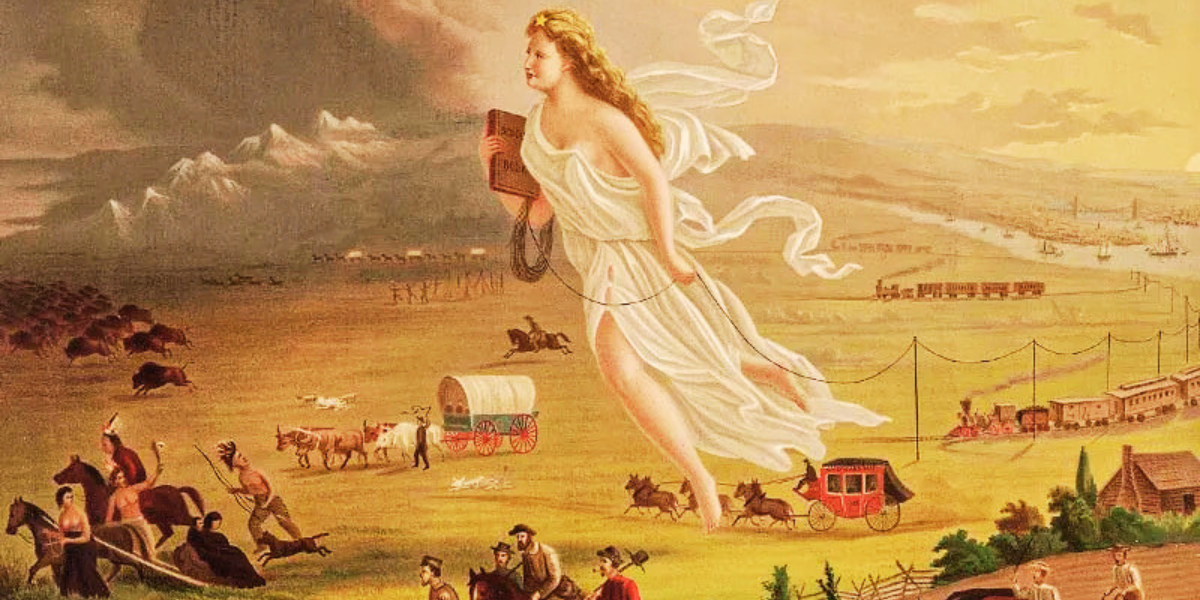
Fiction writers published cheap paperbacks called “dime novels” and ghostwritten autobiographies of men like Kit Carson, creating heroes out of Indian fighters who rescued white families from “savage” dangers. Landscape painters, lithographers, and photographers introduced Easterners to the Romantic West of sublime landscapes filled with tow-ering peaks and deep canyons and Indians who seemed to exist only in small numbers, fated to disappear as American pioneers swept westward.
The frontier myth is a fantasy that white Americans have repeated over time to create a national community.
At the same time, more and more Americans embraced Manifest Destiny, the idea that continental conquest was inevitable and that the lands stretching from the Atlantic Ocean to the Pacific (and possibly beyond) were American by divine right. Rugged, determined white men with wives and children in tow made their way west, staking their claims and living independent lives without any help from the federal government. With grit and determination, they built houses and tilled farms and built their fortunes alongside other pioneers, who were, like them, white Americans. This preordained process became the core of the American Dream, as white families envisioned themselves pursuing life, liberty, and happiness in the American West.
By the time Turner gave his paper in Chicago in 1893, the myth of the frontier already had an irresistible pull in American culture, a simple rhetorical trajectory that made white men and women feel proud of themselves and their past. Even Turner admitted that these ideas were already dominant in the zeitgeist.
“The ideas underlying my ‘Significance of the Frontier’ would have been expressed in some form or another in any case,” he reflected later. “They were part of the growing American consciousness of itself.”
In the decade after the publication of Turner’s “The Significance of the Frontier in American History,” more and more historians integrated his arguments into their own work and taught “the frontier thesis” to their students. They bestowed upon the popular vision of the frontier and its pioneer heroes the imprimatur of historical truth. By the early 1900s, the field of U.S. western history became a viable and respected area of study in the historical profession. The pioneers and their frontier adventures dominated histories of the U.S. West and the United States for more than a century. Their appeal rarely waned, even as scholars in the 1980s began to publish books and articles that challenged this vision of regional and national history. Despite their work, the frontier myth continues to influence popular histories and portrayals of the West in media, ranging from books to movies to video games.
The frontier myth is a fantasy that white Americans have repeated over time to create a national community. It has, from the beginning, marginalized, ignored, or entirely erased the actual people who explored, fought over, excavated, and built the American West in the nineteenth century. They were Indigenous peoples who had claimed this region as their homelands for thousands of years; women and men who were at first Spanish, then Mexican, then American citizens as national borders moved around them; Black Americans, who migrated with their enslavers and then claimed for themselves the freedoms the West offered; white women who rejected cultural expectations and forged paths of their own; and Asian immigrants, who arrived at Pacific ports and spread out from there to build lives in a foreign land.
The frontier myth’s erasure of their lives was no accident. Politicians, newspaper editors, surveyors, artists, writers, and historians did it deliberately. Removing people from a central national narrative effectively eliminates them from the body politic, making it easier to take their property and their civil rights away.
While the West offered opportunities and freedoms to all comers in the early nineteenth century, it became a more restrictive place in the years after the Civil War. The federal government, controlled mostly by the Republican Party, increasingly exerted its power in the West and provided incentives for white settlers to migrate to the region. The frontier myth undergirded their policies.
But it was Indigenous peoples, Hispanos, Asian immigrants, Black Americans, and women (along with men), working alongside the white pioneers, who created it. They were and are the central protagonists in U.S. western history.
Proponents of the frontier myth tried to obscure the fact that the real people who built the West had much in common with white pioneers. They had a high tolerance for risk. They traveled thousands of miles as they chased their own dreams, crossing paths in unexpected ways. They faced challenges on their journeys throughout the region and often persevered.
Unlike the pioneers of the frontier myth, however, these real people journeyed through the West not only from the East, but in many different directions. Sacajawea, for example, was born in Shoshone lands in the northern Rocky Mountains. Her first movement through what became the American West was eastward, when she was stolen from her people and taken to the Knife River Villages in the Upper Missouri River Valley, where she met Meriwether Lewis and William Clark. Her subsequent journey to the Pacific and back again traversed a vast and diverse landscape filled with Indigenous polities.
The West in the early nineteenth century was also a Spanish domain of movement and far-flung networks of exchange. Those who succeeded there, like María Gertrudis Barceló, were adept at navigating these spaces. Barceló was born in Sonora, one of the northernmost provinces of New Spain, the same year that Sacajawea was stolen from her people. She moved north with her family in 1815, ultimately making her home in Santa Fe and establishing herself as one of the most powerful business-women in Nuevo México.
The fur trader, scout, and entrepreneur Jim Beckwourth also made a name for himself in the West in the 1820s and ’30s, after migrating with his enslaver father from Virginia to lands northwest of St. Louis. As a biracial man moving through the West in the first half of the nineteenth century, Beckwourth found freedom in nascent towns and mining camps from the Rocky Mountains to the Pacific coast. Like Sacajawea and Gertrudis Barceló, he became a cultural broker, expertly traversing multiple racial worlds in the West.
The region’s transformations attracted migrants from all over the nation and the world. Ovando Hollister, a white man who appeared to be a typical pioneer, left a Shaker community in New York to make his way to the Rocky Mountains to take part in the Colorado gold rush. He arrived in 1860, just a year before the event that would change the nature of the West for the rest of the century: the American Civil War.
Hollister and his fellow U.S. soldiers helped defend Colorado and New Mexico Territory from a Confederate invasion during the Civil War, securing the larger West for the Union. The war brought thousands of soldiers into the region, who helped clear the way for hundreds of thousands of additional migrants. The federal government increasingly took an interest in controlling the West, and Hollister was happy to support this effort. After his discharge from the Army, he started a local newspaper and promoted the Republican Party’s visions for the white settlement of the West.
Like Frederick Jackson Turner, Hollister imagined the future West as a land without Indians. But Indigenous peoples who had lived in these lands for thousands of years were determined to assert their sovereignty and retain their homelands. The Northern Cheyenne chief Little Wolf exemplified this resolve in the 1860s and ’70s, leading his people in many different battles to defend the North Country of his ancestors. Until the end of the century, Little Wolf resisted removal to reservations and fought and negotiated with U.S. federal forces to ensure his people’s survival.
The Canadian immigrant Ella Watson, who entered the American West from the north, was one of the white settlers who coveted Northern Cheyenne and other Plains tribal lands. In the late 1870s and early 1880s, she worked in hotel kitchens in Kansas and Nebraska, ultimately saving enough money to travel to the windswept prairies of Wyoming and establish herself as a cattle rancher. But Watson, too, struggled to survive in a landscape increasingly dominated by white men.
The frontier myth—and its core belief that the West belonged only to white Americans—had become a national ideology by the 1880s and ’90s, ushering in an age of oppression and migration restriction. Chinese immigrants who arrived during the California gold rush and built the Central Pacific railroad were attacked and expelled from towns and mining camps across the American West. Polly Bemis, who had been trafficked from Hong Kong to San Francisco and then taken to the gold fields of Idaho in the early 1870s, did not initially experience these pressures in her remote, Chinese-majority town. The federal government ultimately found her, however, and defined Bemis as an “other” in a place she had helped create.
All seven of these women and men, and the communities to which they belonged, shaped the American West by the time Frederick Jackson Turner published his frontier thesis. Their stories prove that Turner was right about one thing: that a distinctive American culture emerged on the frontier. But it was Indigenous peoples, Hispanos, Asian immigrants, Black Americans, and women (along with men), working alongside the white pioneers, who created it. They were and are the central protagonists in U.S. western history.
__________________________________
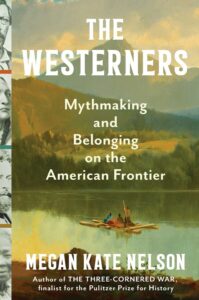
Excerpted from The Westerners: Mythmaking and Belonging on the American Frontier by Megan Kate Nelson. Copyright © 2026 by Megan Kate Nelson. Reprinted by permission of Scribner, an Imprint of Simon & Schuster, LLC.

Megan Kate Nelson
Born and raised in Colorado, Megan Kate Nelson is a writer and historian now based in Boston, Massachusetts. She has written about US western history, the Civil War, and American culture for The New York Times, The Washington Post, The Atlantic, Slate, Time, and Smithsonian Magazine. Nelson earned her BA in history and literature from Harvard University and her PhD in American studies from the University of Iowa. She is the author of Saving Yellowstone; The Three-Cornered War, a finalist for the Pulitzer Prize; Ruin Nation; and Trembling Earth.