Five Books For the Insomniac in Your Life
Ailsa Ross Recommends Byung-Chul Han, Annabel Abbs-Streets, Samantha Harvey, and More
Shakespeare called sleep “nature’s soft nurse.” But who is caring for the insomniac who has forgotten how to sleep? Some kind of cruel night minder? How nice it must be to simply get into bed and wake up rested eight or so hours later. The best the insomniac can hope for is to surrender to their fate, and accept knowing the night’s texture all too well. Yes, the best one can hope for is to be a little like Christiane Ritter, an Austrian housewife who, in the 1930s, joined her husband for a season on the Arctic island of Svalbard and who, after much lamenting, came to love the endless darkness and cold that kept her lying in her bunk for endless hours. She felt transcendent, watching the moon from inside her sleeping bag.
Of course, such a peaceful experience can seem impossible when one’s eyes and bones and skull ache deeply during another night spent in the torture chamber (aka the bed), yet surrendering to fate really is all there is. Or that’s what the amor fati-loving protagonist in my debut novel Hovel decides, as she takes on increasingly absurd projects in order to accept her life in a dishevelled mountain town. I started writing it after reading a cutting, and very funny, old review of Eat Pray Love by Rachel Cusk in The Guardian. It’s fair to say that Cusk did not love Eat Pray Love. She imagined reading a less self-centered book, one where Elizabeth Gilbert’s bathroom floor epiphany to divorce her husband “might have led her not to break the life she had but to accept it, to exercise her capacity for devotion right there.” In my novel, the narrator tries to accept her life and accept her capacity for devotion right where she is. So, no trips to Bali or Rome. Just a woman doing small and quiet, private things, in the place where she already lives, with the husband she already has. Does trying to smell like a dog make her see the world anew? Does pissing in the woods? You’ll have to read Hovel to find out. Or just read the excellent books below.
*
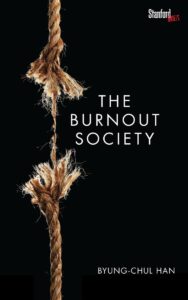
Byung-Chul Han, The Burnout Society
In the middle of the night, when my baby and husband and dog are all emitting sleep smells and sounds beside me, I blame myself for not being able to do what is meant to come naturally to us animals. But maybe I should be looking more closely at the kind of society I’m part of, and the impact that has on my psyche. After all, chronic insomnia does not beset modern hunter-gatherer societies to nearly the degree it does people in industrialized societies (1-3 percent, compared to 10-30 percent). Korean-German philosopher Byung-Chul Han writes that, in industrial societies, we are “exhausted, at war” with ourselves as we try to multitask, be productive, achieve. No wonder that, come nighttime, many of us find it impossible to then go into that “high point of bodily relaxation” known as sleep.
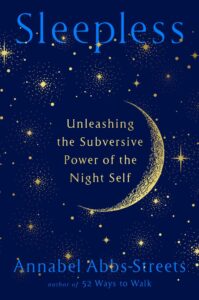
Annabel Abbs-Streets, Sleepless: Unleashing the Subversive Power of the Night Self
What does a chronic lack of sleep make me good at, I often think, besides feeling on the constant edge of a cold? Abbs-Streets argues that there’s more to it – there’s a kind of dark magic that can be felt by those who are up long after the sun has set. After a string of griefs stopped her ability to sleep, she found the darkness “fostered a sort of brain-drifting where improbable and whimsical connections were made.” In other words she could feel more deeply, and imagine more vividly. Her writing is bewitching enough that I actually came round to her way of thinking.
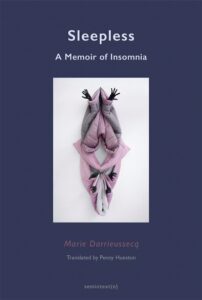
Marie Darrieussecq, Sleepless: A Memoir of Insomnia, translated by Penny Hueston
What I love best about this wry book is the feeling of kinship Darrieussecq fosters with her fellow insomniacs across time, especially that “champion of insomnia” Franz Kafka, whose diaries she keeps on her bedside table as a comfort, and Marcel Proust. I didn’t know Proust was an insomniac until I read Darrieussecq’s book – which spawned from a 2017 L’Observateur column – but given that his novels are some of the most famous studies in memory ever written, I should have guessed. After all, what is the insomniac doing in the middle of the night but going over the past again and again?
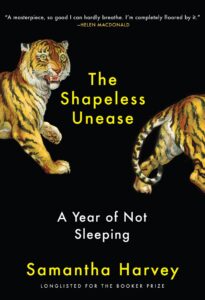
Samantha Harvey, The Shapeless Unease: A Year of Not Sleeping
There’s a real beauty to Harvey’s sentences, whether she’s writing about the physical and psychological pain of insomnia or the language of the Amazon’s Pirahã people. There’s real beauty to her thoughts, too, on the fate of the human corpse and the solace of reading Larkin’s poetry at 3 a.m. Mostly, this book is soothing because it’s funny. Take this dialogue at a doctor’s surgery, after Harvey has literally gone without any sleep for nearly a week:
“Blackout blinds are really worth thinking about. Earplugs?”
“Have I thought about earplugs?”
“If noise bothers you–”
“Maybe that’s my problem, that I don’t think enough about earplugs.”
Gallows humour, I suppose it’s called.
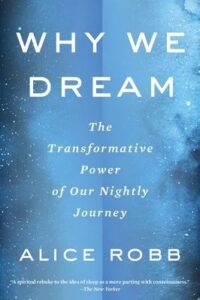
Alice Robb, Why We Dream: The Transformative Power of Our Nightly Journey
If there’s one thing Robb’s elegant science and history book conveys, it’s that we should be paying more attention to our dreams. But why would I include a book dedicated to a state only experienced during sleep in a list of literature about the inability to sleep? Insomniacs recall more of their dreams. “When someone is sleep deprived,” neurologist Mark Mahowald tells Scientific American, “we see greater sleep intensity, meaning greater brain activity during sleep; dreaming is definitely increased and likely more vivid.” I have noticed that firsthand. I’ve also noticed that the more I pay attention to my dreams, the more I get from them. For example, my first attempt to write down a dream a few years ago just said, “Karl Ove Knausgaard.” After a few weeks, though, I was writing out full paragraphs in the mornings. Doing this, I noticed just how strange my dreams were. I like that everyone is strange in their dreams.
__________________________________
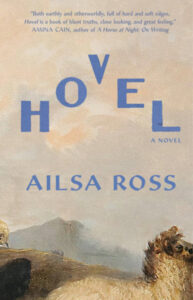
Hovel by Ailsa Ross is available from Strange Light, an imprint of Penguin Random House.

Ailsa Ross
Ailsa Ross is the author of HOVEL, a novel, published by Strange Light. She grew up in the north of Scotland, lives in the Canadian Badlands, and writes about ascetics, artists, and strange places for the Guardian, Outside, ARTnews, and others. Her Substack newsletter is called Holy Fools.