







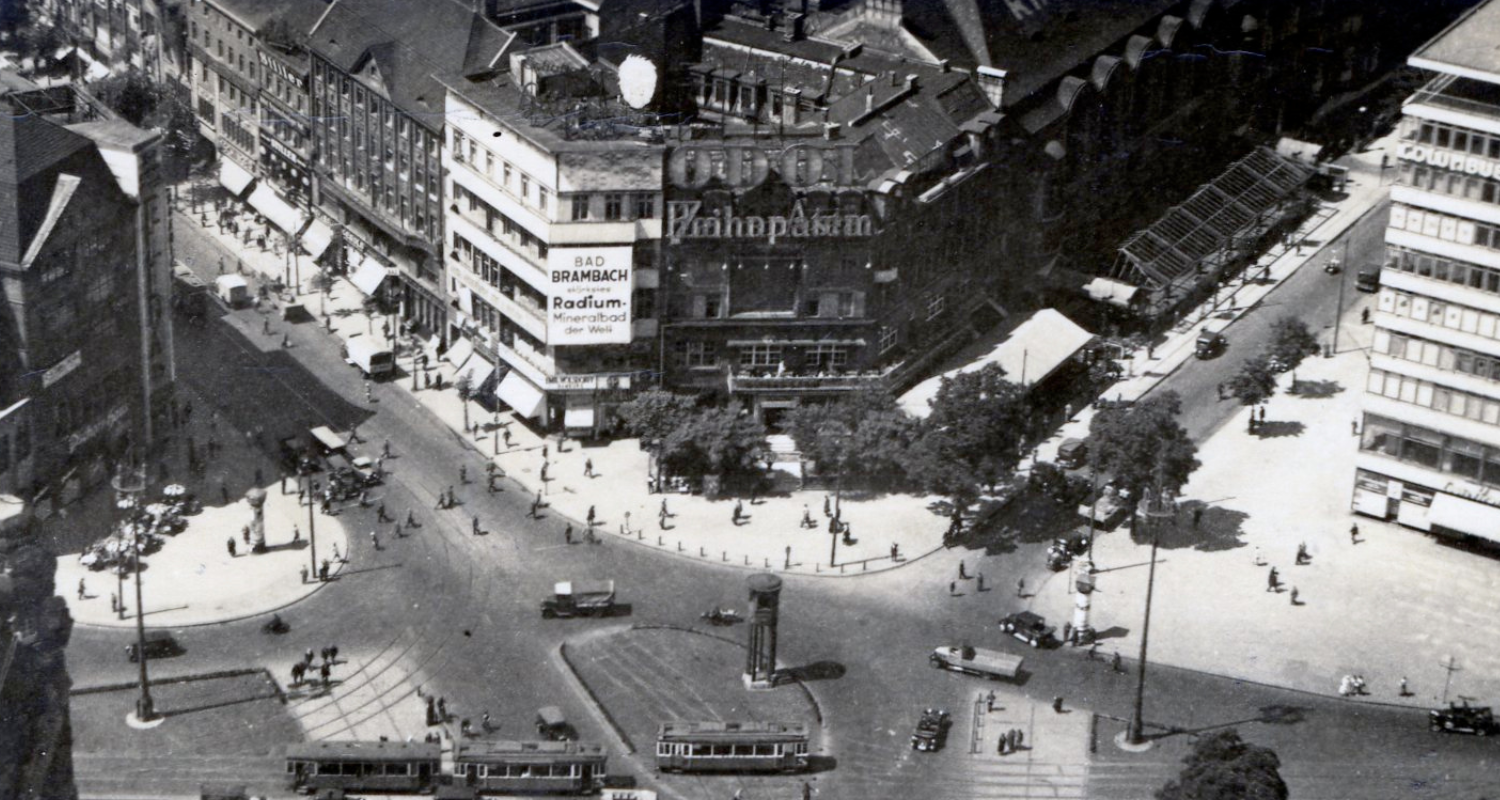
Fake News, Far-Right Propaganda, Exaggerated Crowd Sizes, a Squabbling Left...Welcome to 1930s Berlin!
Victor Sebestyen on the Political Landscape That Preceded the Nazi Takeover of Germany
“Clever and persistent use of propaganda can make a nation believe that heaven is hell and, conversely, that the most miserable life is paradise.”
– Adolf Hitler, Mein Kampf (1925)
“The European mind is capitulating. It is capitulating out of weakness, out of sloth, out of apathy, out of lack of imagination. It will be the task of some future generation to establish the reasons for this disgraceful capitulation.”
– Joseph Roth (1894-1939)
*
In 1930, the Communist stronghold of Friedrichshain in eastern Berlin was a run-down slum district of red-light areas, cheap bars and tenement blocks; casual violence was endemic. On the night of January 14, after some drinking, two young men started brawling and the incident turned bloody—an average Tuesday evening in this part of the city at this time. One of the men was a twenty-one-year-old Nazi stormtrooper called Horst Wessel, the son of a Protestant military chaplain, who had abandoned his home and his law studies at university to live with a young prostitute, Erna Jaenichen. The other was Albrecht Hohler, thirty, a Communist member of the paramilitary group the Red Front Fighters and well known locally as a particularly vicious thug—a petty criminal who had been released from jail only a few months earlier.
Despite their political differences, both earned a meager existence in the same line of trade: they were pimps. But their fight had nothing to do with either politics or business. Wessel owed rent for the room he shared with Jaenichen on Grosse Frankfurter Strasse (in the twenty-first century, a part of Karl Marx Allee in Berlin Mitte). Hohler knew the landlady who had sublet the room, Elizabeth Salm, and he had promised her he would make Wessel pay his arrears in rent. When they met in the room at around 10pm, Wessel refused to hand over the money, according to Hohler’s account to the police later, and they started fighting. Both were armed but Hohler managed to get hold of Wessel’s gun and shot him in the stomach. Wessel was rushed to hospital; Hohler was arrested a couple of days later.
Goebbels knew the value of fake news and was an expert in manufacturing it.
It was hardly, on the surface, an episode from which heroes are made. Yet the moment he heard the story, Goebbels saw the propaganda opportunity it afforded. He understood how important a martyr would be to the Nazis and, since he had taken over as party boss in Berlin, he had been on the lookout for a young man whom he could build up to die a hero’s death for the cause. He alighted on Wesssel, and he invented an entire biography of “the martyr for truth” (minus his profession).*
Wessel was in the hospital for six weeks before he died of sepsis on February 23. In Der Angriff, Goebbels issued condition reports from the bedside every day, alleging the death was “murder” and an act of terrorism committed by a “subhuman Communist,” along with another Leftist accomplice, who was never implicated or charged with any offense. Invented stories were run about Wessel’s charitable work, as well as his loyal and courageous membership of various SA groups. Goebbels interviewed Wessel’s grieving mother and wrote of Jaenichen and Wessel as childhood sweethearts, as though their story was from romance fiction. He knew the real story. One of his diary entries of the time shows his absolute cynicism. “It’s like a Dostoyevsky novel: the idiot, the worker, the tart, the bourgeois family, eternal torment of conscience, eternal agony etc.”
Goebbels mounted a vast funeral of “a new martyr for the Third Reich,” which was filmed in a clever way that appeared to show many more people attending than actually turned up. Goebbels claimed 30,000 people were there, but the true figure was nearer 3,000. There was a full-page obituary in Der Angriff, written by the Gauleiter himself, that was full of Christian as well as Nazi symbolism. It described Wessel as “a man who calls out through his deeds…One man must set an example and offer himself up as a sacrifice…Well he was that man.” On the front page the paper printed the words of “The Horst Wessel Song,” which became the Nazis’ official anthem—or, as one satirist called it, “the battle hymn of the anti-republic:”
Oh, raise the flag and close your ranks up tight!
SA men march with bold, determined tread.
Comrades felled by Reds and Ultras in the fight
March ahead by our side, in spirit never dead.
Goebbels knew the value of fake news and was an expert in manufacturing it. He organized, and filmed, protests by young Nazis pretending to be opponents and planted stories in other papers lambasting Leftists who would not let “peaceful National Socialists” bury their dead without disruption. Other right-wing papers were carrying the stories too, and soon after Wessel’s funeral foreign diplomats were becoming deeply concerned by the dire state of the German economy and the rise of fascism. “No one has any money, the price of bread does not fall, unemployment remains high,” the British Ambassador, Sir Horace Rumbold, reported to the Foreign Office in London. “People do not see how they are going to come through the winter. They seem to themselves to have nothing to hope for…it is the lack of any hope which makes the situation to them so depressing and makes it difficult for Bruning to keep them in hand.”
*
The Communists used spectacle, marched under banners and needed martyrs for the cause in the same way as the Nazis. They, too, had plenty of ruthless cynics in their ranks, but there was nobody in the KPD with the propaganda skills of Goebbels. The KPD had recovered from the fiasco of 1923 when their attempted coup failed and, like the Nazis, the Communists gained strength in the Depression: the workers’ party became the party of the unemployed. They recruited actively among the jobless and, during the worst of the slump, the summer of 1932, in the poorer areas of Hamburg and districts like “Red Wedding” in Berlin, only 10 percent of the known Communists had jobs. Throughout Germany three-quarters of new members of the KPD were unemployed. Communist Party membership nearly trebled between 1929 and 1932, from 115,000 to 360,000—it was not growing as fast as the NSDAP (Nazi Party), but still considerably. In the 1930 election, the KPD vote had also gone up—to more than 4.5 million, just 5 per cent below the Nazis’. The party was the main political force in the two biggest German cities, Berlin and Hamburg, but it never became acceptable in most of the country or to the middle class, or even to the vast majority of the intelligentsia.
During the Depression, the KPD organized almost daily demonstrations and “hunger marches.” Frequently they ended up in violent clashes with the brownshirts, the police—and often both. The split between the KPD and the SPD widened over the years. The “martyrdom” of Luxemburg and Liebknecht was used as a symbol at virtually every KPD rally. Young Communists, often armed, congregated regularly at the Lustgarten, an open grassy area close to the old Royal Palace (known in the twenty-first century as Museum Park). “The Soviet standard is saluted with reverence. Long processions marched here from all corners of the city, led by strange instruments: trumpets with multiple bells, jazz tubas, African drums,” wrote Franz Hessel. “These fighters are uniformed just like those they want to oust and beat up. The grey shirts and brown tunics are belted in military style. And the processions are orchestrated by the red armbands of their leader.” The paramilitary Red Front Fighters’ League and its successor, the Combat League Against Fascism, were as violent as the SA, if less effective—because they had fewer members in total and hardly any had received “combat” training of any kind. At least some stormtroopers had basic experience with Freikorps units.
The most important struggle in German politics was not between the Nazis and the KPD, but between the socialists and the Communists.
But the real failure of the KPD was ideological. It adopted a craven line following whichever tactical turn was taken in the Kremlin, which after around 1929 meant whatever was dictated by Stalin. For the German Communists, the SPD were “social fascists,” and as bad as the Nazis, if not worse, “because if the Nazis by any chance win power they cannot keep it and then our time will come,” as an editorial in Die Rote Fahne argued in December 1932. Every now and then there would be talk of an “anti-fascist front” between the SPD and the Communists, but neither side meant it. Their gang members fought constantly. The most important struggle in German politics was not between the Nazis and the KPD, but between the socialists and the Communists.
To the last, the Communists unceasingly attacked the SPD as “the gravediggers of socialism.” The Soviet Politburo issued a memorandum in February 1928 and reconfirmed the point to its German client party, the KPD, in the summer of 1932, that “the principal enemy of the workers’ movement in Germany remains the Social Democratic Party.” Members of the armed wing of the party were required to make a further, ritual, pledge: “I promise at all times to fight unceasingly for the Soviet Union and the victorious world revolution, and to always be a pioneer of irreconcilable class hatred within all proletarian mass organizations, trade unions and the workplace.” Despite the misery of the poor and the working class in the Depression, the mass unemployment and the fast-growing popularity of the Nazis, the socialists and Communists, for their own party reasons, could never find a way to work together—or even to stop fighting each other on the streets. A suicidal error, as it made life so much easier for the Far Right, which was adept at exploiting the splits on the Left.
In the eyes of most Germans—including most Germans of the moderate Left—the KPD was seen as the agent of a foreign power, the Soviet Union. The party could survive only through Russian help. They received very little in subscriptions, when the vast majority of its members were unemployed from around the start of 1930, and next to nothing from rich supporters—Willi Munzenberg was the only major donor to the party of any note. Yet it employed more than 200 full-time officials and ran twenty-seven party newspapers around the country, all financed by money from Moscow, laundered through various Russian trading companies. The party also possessed a stockpile of weapons, provided by the Soviets. The Comintern’s agitprop department ran several “front” organizations that were supposedly unaligned—Peace Aid, the Anti-Fascist League and so on—as well as the official Far Left groupings, like International Workers’ Aid, Red Aid, the Revolutionary Trade Union Opposition.
To the middle class and moderate liberals, the Communists were terrorists and far more visibly a threat to the state than the Nazis. KPD paramilitaries regularly attacked police officers, killing eleven and wounding 1,153 in Prussia alone in the winter of 1930-1931, mostly by rooftop snipers shooting at specific targets below. One attack, on August 9, 1931, received massive publicity when two senior police detectives were murdered and three other people were injured outside the Babylon Cinema in Bulowplatz, one of the biggest movie theaters in Berlin. The assassination was ordered personally by Walter Ulbricht, head of the Berlin Communist Party, as was widely reported at the time, though it was vehemently denied. KPD support dropped soon afterwards, even in “Red” Berlin.
The Nazis murdered Communists, socialists, liberals and Jews, but they were careful not to mount attacks on the police, state militias or “organs of the state.” They were desperate to appear as though they were on the side of law and order and deliberately not antagonizing the middle classes, where their support would come—the fellow travelers who could safely believe that it was entirely the Communists and the Left who were causing the violence and mayhem on the streets.
The Nazis, in particular, did not want any sort of clash with the army or to appear as though they were preparing a coup or armed uprising, which is why Hitler took what became known as the Ulm case so seriously. In October 1930, a month after the Nazis’ breakthrough election, three junior officers were charged with breaking the rule that soldiers should not be members of parties or visibly seen to be campaigning for political parties. The three young soldiers had been going around the country recruiting others—brother officers and other ranks—to join the NSDAP and passing around party literature. The army made the complaint because they believed it would damage the reputation of the Reichswehr if it was even remotely seen to be too close to the Nazis, but the state prosecutors took over the case. The three men—Richard Scheringer, Friedrich Wendt and Hans Ludin—were eventually charged with the serious offense of “Preparing to Commit High Treason” and the prosecution alleged they were in the early stages of organizing an attempted coup. There was a ten-day trial in Leipzig. All three were found guilty and sentenced to eighteen months in jail, but the big story in the case was the appearance in court, as a witness, of Hitler, who said he did not know the three lieutenants, had no involvement in their actions and denied any intention of mounting an insurrection. The NSDAP had been using entirely legal methods since 1923, he declared. But he issued a warning: “When our Party emerges victorious—by legal means—a new Supreme Court will replace this one…and the criminals of November 1918 will find their reward. Then heads will roll.”
_______________________________
From Weimar Germany: The Death of a Democracy by Victor Sebestyen. Reprinted by permission of Pantheon Books, an imprint of the Knopf Doubleday Publishing Group, a division of Penguin Random House LLC. Copyright © 2026 by Victor Sebestyen.

Victor Sebestyen
Victor Sebestyen was born in Budapest. He has worked as a journalist on many British newspapers including The Times, the Daily Mail, and the London Evening Standard, where he was foreign editor and editorial writer. He has also written for many American publications, including The New York Times, and was an editor at Newsweek. He is author of Twelve Days: The Story of the 1956 Hungarian Revolution, Revolution 1989: The Fall of the Soviet Empire, and 1946: The Making of the Modern World.