Fady Joudah’s Meditation on Language and Time Under Genocide
Bilal Urick on Exhibit G, Joudah's new multimedia poetry collection
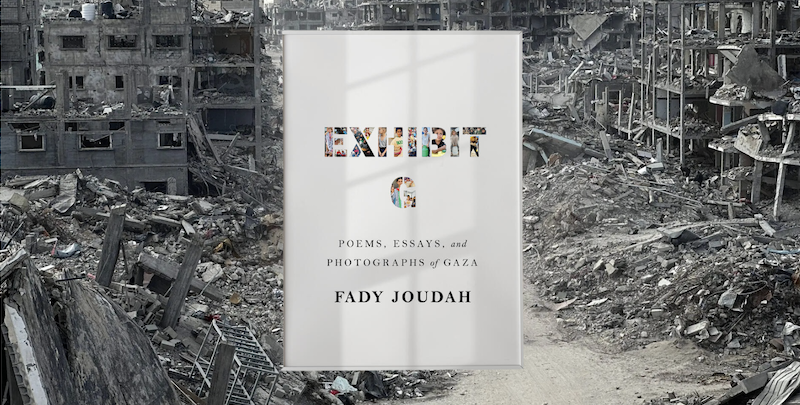
Fady Joudah’s Exhibit G is among the first of its kind. The multimedia poetry collection—assembled in the diaspora, and yet, across form, content, and voice, never anywhere but Gaza—charts Palestinian life under genocide.
Exhibit G continues Joudah’s poetic meditation on language and time, the basic structural forces of life, stripped of stability under genocide. Where Joudah’s […] (2024) dwelt in silence and its residues, Exhibit G constitutes the utterance ultimately yielded by the refusal of certain speech. Confronted with the impossibility of ensuring its people’s survival tomorrow, the “Exhibit” assumes a polyphonic form in the language of Gaza.
A collaboration among Joudah—a Palestinian physician and poet from Gaza, based in Houston, Texas—Palestinian poets writing from and about Gaza, and the Gaza Soup Kitchen alongside the Gazan photographers documenting its work, the collection answers the need for a renewed poetics as Palestine struggles to endure in English and Arabic alike. Moving across poems, essays, photographs, and drawings, Exhibit G gathers the many hands, faces, and odes of a people feeding, burying, and naming itself as the US-Israeli genocide persists, unrelenting, from the 1948 Nakba to its present horrors.
Joudah sits with a single letter—“G”—that lingers on the tongue in the moment before utterance. The “G” of genocide, the “G” of Gaza in English, becomes here a disinterred horizon, a grammar of ghurbah (Arabic for exile or alienation) and ghurūb (Arabic for setting or decline). The sun rises and sets ceaselessly in the West; its light refuses Palestinian shores, the visible landscape and its accompanying clock forced into another reality of perpetual darkness. Neither a museum nor an exhibition nor a criminal case document, Exhibit G highlights Gaza’s unceasing endurance, counter to the fleeting “exhibit” that has been made of Palestinian suffering under the Western sun. The result is a formidable journey through committed verse necessarily without a clear exit for the reader.
In the reality of genocide, Joudah and his interlocutors construct a Palestinian poetry through the ceaseless demands of stable time, lineage, and language, now destroyed. Labīd—at the beginning of our Arabic poetic heritage—reminds us that time, still, is always at hand. For the war of empires, the battle of time between “pre-” and “post-”, has been ours since before we knew it:
دِمَنٌ تَجَرَّمَ بَعدَ عَهدِ أَنيسِها حِجَجٌ خَلَونَ حَلالُها وَحَرامُها
Dark and dirt-trodden now lie their grounds, their people, gone with
years past, months both sacred and profane.
Joudah, indeed, walks along a timeline similarly disfigured by its own passage. Between the Arabic of Palestine and his English in the United States, Fady Joudah tells us that he cannot “turn off time” as it courses through Exhibit G. The dirt of Labīd’s ode, in its years, struggles to speak through the broken West’s enforced silence:
Because no oxygen for the dead.
Then they came for the dirt, and the dirt had no lips, so they tossed our corpses in the street
–“Truth is Never Finished,” (10).
The “never” of Joudah’s title maintains its crevices in this Exhibit, into which the people and months, sacred and together, enter. And still, his opening words speak:
And a world we want to begin begins:
I turned my love for you into art,
that I may triumph over death (1).
Gaza emerges as a language of Palestine unto itself—a new beginning, the final and only utterance of the single “G.” Engaged in a poetic tradition whose words now filter between Israeli bombs and smiles condemned to life under rubble, Joudah and his partners in Gaza “triumph” against the global attempt to confine Palestine to the erasure captured in Labīd’s “their people, gone.” Here, not only those writing in other lands, like Joudah himself, must confront their distance from the accumulating ruins; but those under the bombs must likewise push through the endless checkpoints—material and linguistic—separating them from the Gaza they knew. The “Exhibit” thus speaks in the language of Nakba—of genocide as it ensues, all over, and again.
As the collection meanders between voices and moments in Gaza, Joudah struggles against the finality of genocide through the “What yet?” of his eponymously titled poem, “Exhibit G: Surviving Image”:
Good love will be bread. Water before love.
“Who smiles when marked for extermination?”
Who asks this? The image
of the unforgettable to you. Who wants proof
of what went too far but did not go far enough?
What yet?” (24).
The collection searches for all that is left of Gaza through the tormenting mix of rubble in sound and silence, survival brought forth in the glottal “G” stuck in our throats. Images from Gaza look back at us across the book’s spine, uncertain, not necessarily representations of the poems they meet. On the page across from Joudah’s poem “Salaam, Ya Salaam,” the reader sees a photograph of a woman flashing an incomplete smile. This version of “Salaam” appears on the page with her name written in verse fractured by Israel’s genocide:
Israel killed his younger brother, sister-in-law, and three of their four
children: The daughter who survived: Salaam.
Their corpses could not be retrieved. Rubble and snipers. In lieu of grief,
my friend decided to start a soup kitchen during the annihilation.
Family and friends will run it, he said, my youngest brother and
my sister. Israel would later assassinate his youngest brother. He would be
Buried. Salaam would go on to have a baby girl.
–“Exhibit G: Surviving Image” (14).
What survives for Salaam is not herself, but first, what “Israel killed.” Joudah’s colons still refuse closure and further complicate the form of linear time and space. The in-between grammar of “G” endures in the “decided” of once choosing to “start a soup kitchen” for life. It is also sustained in the faces and smiles in photographs, but they are not the images “you reposted.” “G,” Gaza, where “could not” becomes the devastation of bodies never retrieved. The unmade ruins of the future arrive in “would be / Buried”, once the simplest dignity, now a distant wish itself. “Salaam” still goes on, into the winds, the foregone and the young, and breathes anew against a watchful end, only known in extermination.
“… [D]uring the annihilation years,” Gaza arrives as “A fascicle: in parallel, in sphincters, convergent, or pennate” (19). The fascicle: the locus of structural organization, of poetry, its lines; of hunger, its lines; of tradition, its lines; of bombs, the imperial re-ordering of the world into lineages under murderous imperatives; and medically, of nerves, the interior made exterior, bunched into one, together. In Exhibit G, the physician-poet mobilizes the fascicle to map the temporal and spatial dimensions of Palestinian togetherness—a collectivity constituted under, and repeatedly fractured by, a world predicated on Palestine’s extermination. It is the throbbing meeting-place of a land from which Joudah hails, now only reached through his surname in the lists of martyrs. It is Palestine in “G”, a people forced into the unrelentingly coherent sounds of Gaza as Genocide and Grammar and Ghurūb and Ghurbah:
To stand in line and shout, beg, howl, grin from ear to ear, feel, feel, feel.
The time before and after food is merriment within internment. Kids
dressed up in their best remaining clothes and shoes. Their favorite
pajamas. Or the only one left (19).
“To feel” the “Time before and after food,” another measurement of life, marred. “Before and after food” no longer follows the periods before dawn and after dusk, the horizon line no longer visible under bombs. Language is felt through the fall and rise that lingers as it should not:
What free fall and what ascension.
What accrues in the kids’ memories is stored in their bodies. What’s stored
in their bodies is a beginning of love stored in time.
Too many Palestinians are a beginning of love stored in time (19).
Joudah’s poetics require a constant recourse in return. “Beginnings” are multiple, and as Joudah tells us, they are inevitably Palestinian.
The poem tries desperately to make real what cannot be. Another beginning arrives: a hanging, standalone “the,” rarely separated from its nominal partner in Arabic, finds itself left at the surviving edge of imperial English. This tongue spits noise audible only to those forced into the world’s cruelest habits:
The
drones overhead, the white noise of genocide (19).
Genocide in Gaza becomes the sounds of the unforgiving sky above. Gaza’s people sit at the hanging edge of Joudah’s “The,” as the definite article leans toward a sky made whole not by the commercial planes and idle ceiling fans, but drones of drumming death:
Another marker: to become the emblem of humanity’s call to all peoples (20).
The light of a negated Palestinian horizon here fades, and with it,
The aleph of dimming souls, may the good Lord shield you from it, sees
resistance to injustice as the cause of ruin, and not the injustice (24).
Joudah marks the time of genocide and the genocide of time through language in which ruins arrive first. The invocation of the Hebrew “aleph” marks the displacement of the poet’s Arabic language. The Arabic “alif,” if transliterated into English cannot—will not—engage with the wanton destruction. The rubble is not its own. The Arabic “alif” first recalls and stretches outward: it opens the alphabet and asks questions, tries to meet the letters that can together articulate Joudah’s “I,” rarely welcomed throughout the collection. The Hebrew “aleph” thus commences the poem’s ultimate demise in form and practice, a skeletal language counter to Gaza’s Arabic poetic heritage. The Palestinian “I” may only gain entry into the linear space of poetic life only once already dead, marshaled in by the Hebrew that readied the continual Nakba. “And you reposted it,” says Joudah. The Arabic “alif” cannot be the breath,
The incinerated
air the people breathe (24).
And we hear the cries of Shaban al-Dalou. Israel’s genocide twists Gaza into the incinerators of holocaust, our airways overtaken by language crafted against Palestinian life. Israel’s bombs consume the nineteen-year-old boy, breathing his own skin as it burns with his bed. A social media post distributes Shaban’s gruesome death before he receives his engineering degree.
Exhibit G seeks to recuperate an alternative chronology uninhibited by the West’s dark ghurūb over Gaza, a lexical order that honors Palestine before its unjust abandon. The Exhibit itself opens unto the abrasions of language—of an English whose decided holders refuse to “recognize what they’ve declared in the material truth it has become” (144). Joudah approaches the rubble and the reality it intimates in a poetry unbounded by form; he understands the English in which he writes as the discursive arm of a politics that prohibits Palestine from the “all” and “humanity” it otherwise claims.
Rawan Hussein, a Palestinian poet of Gaza, consolidates the Exhibit in this searingly idiomatic system: her poems, together with those of Nima Hassan, bring forth voices numbered one through five. Rawan’s first name runs directly under the title; Hussein, her surname, follows, held together with Gaza by a taught comma; and then, Rawan Hussein, Gaza—people and place—break in time, secured to another comma that leads to 2021. Joudah reminds us to engage the signs that deliver our consistent destruction. We remember 2021, the year of the “Unity Intifada” met with Israel’s undying attempts to erase Gaza, Palestine. We see page twelve at the end of Poem #1 of 5. We count the years. Stop counting, she tells us and arrive at time. We peer back through twelve more cruel years before our today, 2014. 2014 signifies numbers not on the calendar. We read Israel’s cruel naming of that year in the casually lethal “Battle of Withered Grain,” clear in its pronouncement of forced famine, a gradual genocide begun long before the Gaza Soup Kitchen’s formation. The horizon from which the sun should rise burns up as it reaches Hussein and Joudah from Gaza 2014, Gaza 2021, Gaza 2026.
Hussein’s signature appears in italics before the poem’s first utterance, an inverted and deterritorialized “takhallus” forced out of the Arabic poetic tradition’s signatures delivered at a poem’s end, after which one may leave verse. We do not leave Rawan’s poetry. “Dawn broke on our heads,” writes Rawan Hussein:
Time set itself aside
and places shut their eyes,
like a girl with words
that gray behind her lids.
Ceilings tumbled
waterfalls of stone,
and under the rubble
the last perceived image
hangs: a final painting
sculpted on our faces.
Alone we grow old tonight
weave hours and wear them,
gobble the terror that runs
down our kids’ mouths.
Someone will devour
our rusted lips.
Hussein’s words struggle against the fatalistic consistency that persists in the Exhibit’s disorienting march through Palestine in ruins. They return to the silent “lips” that guide Joudah’s “Truth is Never Finished”, here “rusted” as rubble rather than left in the “dirt.” Hussein’s poem engages the structuring of temporal and material reality against Palestinian life, now with a painfully modern hue. Across the page we find another number, sixty-seven; it carries us to the beat of a broken watch, our entry into Palestinian time. Sixty-seven holds the image of a man in motion: he first walks away and then toward us, again. We remember 1967, the Naksa, the “setback” on liberation already left behind English’s ticking clock.
“The Palestinian body creates the overlap zone between Arabic and English. In that zone, the body renders the alphabet illiterate,” writes Joudah, as we exit Exhibit G (164). Gaza, as language, brings into existence the only path through manufactured borders, built from letters and walls and calendars and clocks and narratives that try to contain it, once and for all. Palestine, still, is the way back: to home, to return, to the Arabic poetic heritage that rises again from Gaza’s ruins.
To read this collection and see, hear, and feel Gaza within it is to speak the language of Palestine’s continual endurance. Joudah’s collection is one uniquely and honestly guided by Gaza and her people, amidst a contemporary scene of diasporic Palestinian and Arab poetry often adherent to the literary industry’s neutralized politics of lettered sanctity, whether in English or Arabic. Exhibit G reminds us that no language—not Arabic, nor Joudah’s English in the diaspora—may utter even a single letter, “G”, otherwise.
Gaza and her language, the only path to “forever.” Gaza, the beginning of always.
Bilal Urick
N. Bilal Urick is a Palestinian writer, editor, and doctoral student in Arabic and Persian Literature at the University of Pennsylvania in Philadelphia. His work takes interest in questions of borders, displacement, and legibility across Arabic and Persian poetic modernities. Bilal’s words have previously appeared in Fikra and Palestine Square, among others.