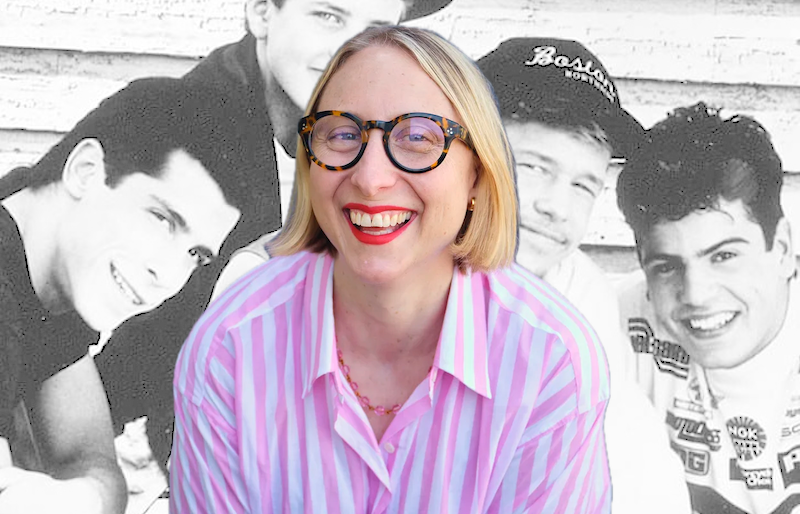
Emma Straub Owns an Original 1990 New Kids on the Block Fanny Pack
Maria Sherman Talks to the Author of American Fantasy
Music writer and author of Larger Than Life: A History of Boy Bands from NKOTB to BTS Maria Sherman spoke with Books Are Magic bookstore owner Emma Straub about her new book, American Fantasy (out now with Riverhead Books), boy band cruises, devotion, aging, and exhilaration of really loving something.
*
Maria Sherman: I absolutely inhaled this delicious, heartfelt, treasure of a novel. I do have questions about the actual writing, of course, and probably too many about the human condition. But I want to kick things off with: Do you self-identify as a boy band fan?
Emma Straub: I just want to pause so I can just grab a prop. It’s nearby.
Here’s something that I found recently. This is an original 1990 New Kids on the Block fanny pack that is full: I have like hundreds, hundreds of New Kids on the Block trading cards that people have given me over the years. Because people see them and they’re like, “Oh my god, I know just the freak to give it to.”
MS: My heart stopped for a moment and I felt as though I could smell the plastic of the fanny pack through the screen, it was visceral. It’s nice to be that friend… You’re part of their memory in your devotion. And not just because you went on the NKOTB cruise.
ES: It’s great. And you know, what’s funny now is that like, you know for a long time, I mean, certainly like in my high school years and in my 20s, the fact that I liked New Kids on the Block was something that people knew about me, but it was like this, I don’t want to say a tawdry secret, but it wasn’t something that I advertised. Because, you know, I listened to Elliot Smith and the Magnetic Fields.
MS: And yet, I think there’s a shared language between any music obsession and boy band fandom. Your book is going to reframe how people think about boy bands, or at least the sort of taboos that live deep within us—not crediting this music as valid, thinking of these groups as unartistic, or uncool. Does it feel sneaky, to you, to get readers on our side?
ES: I think yes, I think it does. And I do see it as part of my larger project as, like, a human, which is to eradicate snobbery. I have no patience for snobs of any kind, really. Like, I’m just not interested. I feel that way about books. I feel about music. Just full stop. It’s one of my core beliefs that snobs suck. And it’s probably not even that sneaky. But I do think that the people who need to know, need to know.
I think that people who do know, will feel validated. And hopefully the people who disagree will have a momentary pause and maybe ask a question, you know? That’s all I’m asking, really.
MS: In reading your book, I was thinking about how it really feels pretty common to ascribe personality and ideals and morals onto these people that we don’t really know anything about, except for maybe their favorite color is blue and they like walks on the beach, whatever you learn from various teen magazines. Which is rich for fan fiction, and fiction! Is there something in that that inspired the idea of a boy band cruise for a novel?
ES: I think my affection for New Kids on the Block alone is definitely not a novel. But a cruise that you’re stuck on with whoever’s on it with you—to me, that’s a perfect novel.
I think my affection for New Kids on the Block alone is definitely not a novel. But a cruise that you’re stuck on with whoever’s on it with you—to me, that’s a perfect novel.
The idea of like a fan cruise, that’s really where I could see it. Not that I had the plot or the characters or anything, but I was like, “Oh, not only is this a novel, but it’s my novel.” Some cynical person could write a version of this book that’s totally different, that makes fun of everyone, you know? But I just knew I could do it and make people feel seen and understood, and have it be funny but not at anyone’s expense. That’s what I saw in the idea.
MS: I had a completely mirror experience with my book, where I was very much like, “It’s not a question of if, but when someone will write this book and I want to be the one to do it.” Because another person will perpetuate the same tropes.
The structure of your book functions so well for boy band fandom because, to quote Backstreet Boys, it’s larger than life. It’s hard to zero in on the whole magic of it, so you keep these people in the container that is a cruise and examine it in four days.
ES: When I was planning it, I was like, “Well, I could have flashbacks,” but I didn’t want it to be everything. I didn’t want it to be like Infinite Jest. I don’t want it to be 700 pages, and back and forth in time. And I wanted it to be contained. And people who are in boy bands—and maybe we can expand it to like people who were famous in their youth—they spend so much time there already. They’re forced to see those images of themselves all the time, the audio of their voices then, the dances they could do then versus now. And I didn’t want that. I wanted these people, both the band and the fans, I just wanted them now. I just really wanted to look at who they are now, their bodies and their emotions and their psychology.
MS: That makes me want to ask about your protagonists: We have Annie, who’s a former fan that has to reactivate that. Somebody in the throes of their enthusiasm, that’d be a very different book. And your boy band member, Keith, isn’t the heartthrob. He’s not the leader. That remove allows for more emotional possibility. How did you find these characters?
ES: I came up with this structure pretty, pretty quickly. I wasn’t sure if I wanted to have a few more points of view. I had some other ideas. But I knew Keith.
In any boy band, if you look at their members, especially if they’ve gone on to get back together, there are the ones who were the lead singers, who have stayed in the public eye more, maybe they’ve done reality shows, whatever it is. And then there are the other ones. They are mysterious to all of us because they don’t share as much. They’re not doing front, forward-facing camera soliloquies or whatever. What’s going on there? What are they thinking about? Do they want to be there? Or do they just have an enormous mortgage payment? Or do they have an expensive divorce? Or do they actually find it really fulfilling? Or is it sort of like a family obligation at this point?
What I discovered with Keith is just that he’s a lovely man. He’s a human.
And the same is true of Annie. I knew that I didn’t want someone who was like fully in it from the beginning. I wanted to have her notice the differences between herself and some of the other fans and to see those differences melt away as time went on.
MS: Like Annie, did you have to grapple with your own judgment? Or some deeply embedded stereotypes?
ES: Yes, yes, I think so, just because it’s part of the human condition to be like, ‘Yes, this still brings me pleasure. And I enjoy this. But also, I’m not like that.’ And then it’s like, ‘Okay, but did any of the other 3,000 women on this boat go home and write a whole novel? No. Who’s the crazy one? I don’t know. I don’t know if it’s them.’ I think we all just do things in our own way. And the deeper that I got into it, actually, the more I understood that I was not different and that felt good.
And I think that is part of me being so happy to be in my 40s now, where I’m like, “Well, I don’t know, do people take me seriously anyway?” That’s a whole other conversation. But, like, do I care? Do I care if there are people who don’t take this seriously because it’s about a boy band? First of all, that seems so stupid and embarrassing for them. But also no. No, I don’t care. Because this book and my last book are like the most authentically me books that I’ve ever written. If boy bands weren’t an enduring, deep, profound interest of mine, and I decided to write this book, maybe I would have fretted more.
Sucks if you can’t see the beauty in this. Like, I’m doing me.
MS: And sucks for you if you haven’t been a super-devoted fan or enthusiast of something! I’d love to hear about research, because your characters feel so lived in. You manage to detail fan-on-fan competitiveness without demeaning the experience. Is that from speaking with fans on the ship? What did you learn from them?
ES: A lot of the dialogue from the tertiary fans on the ship were direct quotes. I wrote down so many amazing things that people said. Like, I got on the elevator one day on the ship and someone literally said, “If I die, you can have Donnie.” I can’t make this up. It’s too perfect.
But yeah, the complicated relationship between the fans was really interesting to me. With any of the groups that have reunited and gone on to tour extensively again, there really are a lot of opportunities for fans to interact with them. There are always meet and greets and special events that you can pay for. And so the super, super devoted fans really do know each other and really are jockeying with each other for position in a way that feels both real and imaginary.
Maybe this is like my number one blind spot, and I just cannot see myself for what I am, but to me, it’s not nostalgia. To me, I did not write a book about nostalgia. I wrote a book about a woman rediscovering herself.
I was really interested in that line: I don’t think it’s really accurate to describe those kinds of relationships as parasocial relationships, because like they kind of aren’t anymore. The women who are able and willing to spend the dollars to do the meet and greet over and over and over and over again, they really are meeting these men, I don’t know, several times a year or every few years depending on their touring schedule and building some kind of relationship with them. I’m not saying they’re all like getting their favorite person’s phone numbers and texting. There definitely are opportunities for relationships to transform into more genuine relationships.
I think I went (on the cruise,) I don’t want to say cynically, because obviously I was there because I loved it and because I thought it was going to be a great idea and because I wanted to be there. But I was amazed by the fans in ways that surprised me. Like their creativity, in terms of costumes. And their friendship. I met so many pockets of people who were either friends because of this, who then started to do this experience together.
MS: Some readers may pick up American Fantasy hoping to scratch some sort of nostalgic itch. Or maybe that’ll be the result of it: They’ll think about these passions they had when they were younger. Has your relationship with nostalgia changed, in writing this book? And what’s your fantasy for it, anyway?
ES: Maybe this is like my number one blind spot, and I just cannot see myself for what I am, but to me, it’s not nostalgia. To me, I did not write a book about nostalgia. I wrote a book about a woman rediscovering herself.
It’s about her feelings now. It’s about Keith’s feelings now and that’s not nostalgia. The book is about how these people feel today, and is sort of working around and through and surrounding something that has been a part of their lives for many decades. But it’s not really about engaging in some soft focus, ‘Let’s look back at the good old days.’
My fantasy for the book is that every person who has ever been a fan of anything reads it and sees themselves in it. And that anyone who has ever looked down upon boy bands reads it and has some more human take.

Maria Sherman
Maria Sherman is a music writer and culture critic currently living in Brooklyn, New York. She has worked as a senior writer at Jezebel, managing editor at Gizmodo Media Group, senior correspondent at Fuse TV, and contributor at BuzzFeed Music. You may have seen her work at NPR and in Billboard, SPIN, Rolling Stone, Entertainment Weekly, and many other quality publications. If she were in a boy band, she’d be the bad boy. Also, Harry Styles ruined her life. Her book Larger Than Life: A History of Boy Bands from NKOTB to BTS is available from Black Dog & Leventhal.