Emily Doyle on the Subtle Tyranny of Realism
“What do we mean when we use the term realism? What counts as real?”
This first appeared in Lit Hub’s Craft of Writing newsletter—sign up here.
My grandmother suffers from dementia. I could say that her sense of reality is unstable, but that would be misleading. It is more that her sense of reality is unbound from time and space. When she looks at me, she sees me, and she sees my mother. She remembers that I am married and then she asks when I am getting married. She reaches for my hand and, when she touches it, recoils with a cry that my skin is “so cold.” A few minutes later, she reaches for my hand again.
From an early age, my life has been defined by people with loose grasps on the world around them. At my other grandmother’s funeral, my uncle spent much of his eulogy recalling his vivid—perhaps too vivid—memories of being born. The principal of my Christian high school regularly attributed world happenings—terrorist attacks, presidents elected or not elected, the price of gas—to unseen spiritual warfare. When I was thirteen, I worried I was being stalked by a demon and, when I shared these suspicions with the woman in charge of my Bible study group, she didn’t say I was imagining things. She just started to pray.
While I can’t say whether my background is typical, I do think it’s common to have a skewed relationship to everything outside of, and sometimes inside, the self. In fact, it’s perhaps inevitable. All sorts of factors—religious fervor, drug trips, the absurdities of aging—can unmoor a person’s mind and spirit. So what do we mean when we, the citizens of the literary world, use the term realism? What counts as real?
In the past, we may have been referring to a specific literary tradition beginning with a movement that emerged from the nineteenth-century literature of French and Russian writers. Now, we seem to think of realism as that elegant, default genre that scholar George Gouldin defines, in part, as a “sympathy with ordinary life.” By this, we suggest that ordinary life excludes my grandmother, my uncle, and even me.
What do we mean when we, the citizens of the literary world, use the term realism? What counts as real?
This problem became especially obvious to me when I wrote my story “New Mercies,” which appears in my debut collection Please Don’t Touch the Body and was first published by the Kenyon Review. Through this piece, I wanted to look at dementia from within and without. With this goal in mind, I wrote a story in a close third-person point of view from three overlapping perspectives, ending with that of the person with dementia.
I based the first perspective on a teenage girl named Kori. In the story, she volunteers at a retirement community in an effort to absolve herself of sin by teaching residents about poetry:
Kori has never seen a penis. Not fully. Not free of clothes and springing away from a dense tangle of hair. She has felt one, though. Once. She felt its coiled energy under tight briefs, straining. She fumbled her fingers over its length until a dark, wet spot bloomed through cotton, and she pulled her hand away, nauseated but looking into a face she considers faithful. Although she struggles with specifics, with tracking rights and wrongs and yeses and please don’ts, conviction pierces her. She stumbled and caused another to stumble, too.
In this passage, Kori is confused. She blames herself for what someone else has done to her, claiming that she has “stumbled and caused another to stumble, too.” Her entire section abides by the general expectations of realism, though her thoughts and feelings are warped by religious guilt.
The second and third perspectives are based on the only two people who show up to Kori’s poetry lesson: Martha and Anne, who are longtime romantic partners. Martha’s section confirms what we might have already suspected based on Kori’s: that Anne has dementia and that her dementia is most apparent when she gives into a fantasy about cloning Martha and Anne as babies in order to extend their lives. We also learn that Martha is obsessed with preventing Anne from showing any signs of her dementia. Martha bargains with the universe, thinking that if she can only get through the poetry lesson without Kori realizing something is wrong with Anne, Anne will be well. When this fails, Martha is distraught:
There is no making sense of Anne’s speech, which reveals, in a few seconds, how Anne’s reality has warped beyond understanding. Yet Martha feels as if she’s somehow the crazy one. She wants to push Anne from the room and shut the door. She wants to hold Anne’s head in her hands and kiss her curls. She wants to twist Anne’s neck and peer into her ears and yank out the roots of her senility. She wants Anne to be Anne.
Although Martha’s thoughts are clouded by her desire to undo Anne’s condition, her section also abides by the terms of realism, never straying too far from what could be considered ordinary life.
But in the third section devoted to Anne’s perspective, genre distinctions become trickier. Anne harbors an inner world that, while upsetting for Martha to witness, is nonetheless rich. Through Anne, we weave in and out of the current moment with Martha and Kori, following the threads of Anne and Martha’s shared past and Anne’s fantasy about cloning. Part of her section reads:
Anne and Martha receive what’s theirs with a knock at their door and swaddled newborns on their doormat, delivered like room service. Although Martha has finally agreed to the babies, Anne watches closely for her reaction. At first Martha only looks down, her hands at her mouth. But then the babies start wailing, and she reaches for them.
What is a hallucination when told from Martha’s perspective becomes a truth in Anne’s. The cloning is real, as are the babies, as is Anne’s hope for her and Martha’s future.
Throughout Anne’s section, the veneer of realism falls away not because of any shift in strategy related to point of view or perspective, but because of a continued commitment to the original approach. And by ending with Anne’s dementia-distorted experiences, I wanted to resist prioritizing any one perspective over the other, instead asking the reader to embrace the conflict between those perspectives, and to embrace the idea that reality is not one consistent thing.
I wonder what we gain by separating works of realism and surrealism, and what we lose.
While I would not label Anne’s section as realism, I wonder what about her perspective is not real. Is realism based only on minds untouched by illness or some other distorting factor, or at least not so touched that that mind becomes, as my grandmother’s is, unbound? It occurs to me that if I were to write a novel based on my own experiences as a child, that novel would take on, with its demons and angels and visions, a surreal quality despite fidelity to the details of my daily experience.
While writing this story, I was thinking especially of Franz Kafka’s The Metamorphosis. At once a fantastical tale about a man turning into a giant insect and a committed depiction of a mentally ill person misunderstood by his family, The Metamorphosis challenges the genre of realism, exposing the ways in which our definition comes apart at the seams. Consider, for instance, this moment late in the novel, when Gregor attempts to reintegrate himself with his family on a night that his sister plays the violin:
No-one noticed him, though. The family was totally preoccupied with the violin playing. . . . Gregor’s sister was playing so beautifully. Her face was leant to one side, following the lines of music with a careful and melancholy expression. Gregor crawled a little further forward, keeping his head close to the ground so that he could meet her eyes if the chance came. Was he an animal if music could captivate him so? It seemed to him that he was being shown the way to the unknown nourishment he had been yearning for. He was determined to make his way forward to his sister and tug at her skirt to show her she might come into his room with her violin, as no-one appreciated her playing here as much as he would. He never wanted to let her out of his room, not while he lived, anyway; his shocking appearance should, for once, be of some use to him; he wanted to be at every door of his room at once to hiss and spit at the attackers.
This passage straddles the boundary between realism and surrealism, beginning with the ambiguity of “no one noticed him,” a statement that could apply equally to a scurrying insect and to a human who thinks he is an insect, lurking uncertainly in the shadows of a room, not knowing how he will be received. This dual possibility is further emphasized by the teasing line: “Was he an animal if music could captivate him so?” When we reach the end of the passage, we might feel even more destabilized as we read, “He wanted to hiss and spit at the attackers.” That is, we might flicker between two images, one of a distressed insect, and another of a man, literally hissing and spitting while crawling across the floor.
We are meant to sit in the discomfort of not knowing, or of knowing two things in opposition to each other. Without this commitment to Gregor’s distorted experience, The Metamorphosis would not be what it is: a story that, to me, is simultaneously about witnessing mental illness from the outside and being trapped within that illness—or put another way, a story about the inevitable difference between one mind and another.
I’m not suggesting that the categories of realism and surrealism are meaningless. They are helpful when we talk about our work, and especially when we sell it. And of course there are works of science fiction and fantasy that are written as purposefully separate from our world—for example, N.K. Jemisin’s Broken Earth trilogy, Susanna Clarke’s Jonathan Strange & Mr. Norrell, and Octavia E. Butler’s Kindred. But the category of realism blurs at its edges. Worryingly, when we label one experience “real” and another “surreal,” we necessarily demote the experience that falls into the realm of the surreal.
I wonder what we gain by separating works of realism and surrealism, and what we lose. Maybe realism offers us more comfort than it does truth, a way for some people to say my mind is stable, we can agree, it is bound.
_______________________________________
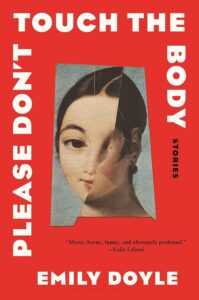
Please Don’t Touch the Body by Emily Doyle is available via Bloomsbury Publishing.

Emily Doyle
Emily Doyle is the author of the debut collection Please Don’t Touch the Body and her forthcoming debut novel, Encounter. Her work has appeared in Ploughshares, the Kenyon Review, the Sun, and elsewhere, and she has received numerous awards, including the Abraham Lincoln Polonsky Endowed Award and the Bread Loaf–Rona Jaffe Foundation Participant Scholarship. She lives in Los Angeles and teaches at UC Riverside.