Emerald Fennell’s Wuthering Heights is a Deranged, Half-Assed Bodice-Ripper That Entirely Misses the Point
“Imagine a wealthy Oxbridge don giving their teenager a blank check for their Brontë Birthday Bash.”
I did not quite finish my umpteenth read of Emily Brontë’s Wuthering Heights prior to seeing Emerald Fennell’s Wuthering Heights. Ever the overeager lit student, I entered the theater positive that some reference would slip by me, ruin my enjoyment of the film, and cause me to fail the assignment (this review).
I needn’t have worried. As soon as the opening titles rolled, we were roaming the moors without a compass. Before the first shot, a man moaned in apparent sexual pleasure in time to the rhythmic squeak of a mattress and (I foolishly thought) we were immersed in the oversexed romp the movie’s teaser had promised. But the moans turned out to be a hanging man’s last gasps, the squeaking, the hangman’s rope.
As he died, we were… treated?… to a close-up of his erect cock straining against his dirty britches. The camera flashed to a very blond child, about 12 years old—Catherine Earnshaw, watching the hanging with glee. I may not have needed to finish rereading Wuthering Heights to grasp Wuthering Heights, but anyone inspired by the movie to pick up the novel for the first time is in for a shock.
Shock is Fennell’s stock-in-trade, and she tries hard to weave it as tightly through Wuthering Heights as the red ribbons in Cathy’s corsets, doing away with major characters and plot points and turning the book’s eponym on its head. Wuthering Heights is named for the 16th-century farmhouse where Catherine Earnshaw is raised alongside her violent, alcoholic brother, Hindley, and their two adopted siblings, Nelly and Heathcliff. Nelly is the child of a beloved servant who becomes a lady’s maid and housekeeper; she’s also the book’s primary narrator. Heathcliff is an orphan of uncertain origins that Mr. Earnshaw, the children’s stern but kindhearted father, brings home from a business trip to Liverpool (to Cathy’s disappointment; she was hoping for a whip). This quartet comes of age in the sturdy house, which contains and outlasts their quixotic miseries by design.
Fennell abandons sturdiness to stage Wuthering Heights as a series of bespoke dungeons for Count Orlok and/or Christian Grey. Nelly becomes the bastard daughter of a lord who is taken on as Cathy’s “companion.” Fennell erases Hindley altogether, endowing Earnshaw with his drunkenness and brutality. He beats the child Heathcliff and vomits quantities of Sunday roast onto the floors. Young Cathy weeps over Heathcliff’s wounds and the two pledge their undying love to one another. We flash forward to find that Earnshaw has gambled away the family’s fortune. Although Heathcliff and Cathy are still in love, Cathy is forced to sell herself in marriage to Edgar Linton, a nouveau-riche neighbor who made his fortune in textiles and lives with Isabella (who in this adaptation has been inexplicably turned from his sister to his ward), but not before she discovers Joseph and Zillah, the house’s servants, having S&M sex in the dungeon barn, complete with iron masks.
In one of the few scenes taken straight from the book, Cathy tells Nelly she plans to marry Edgar Linton because to marry Heathcliff in his current state—a bastard servant—would degrade her, despite her totalizing love for him: “Nelly, I am Heathcliff,” she says, but only after Heathcliff, hearing her initial insults, has fled.
Writers I admire have characterized all of this as nods to the home, in Gothic literature, as a place of women’s entrapment..
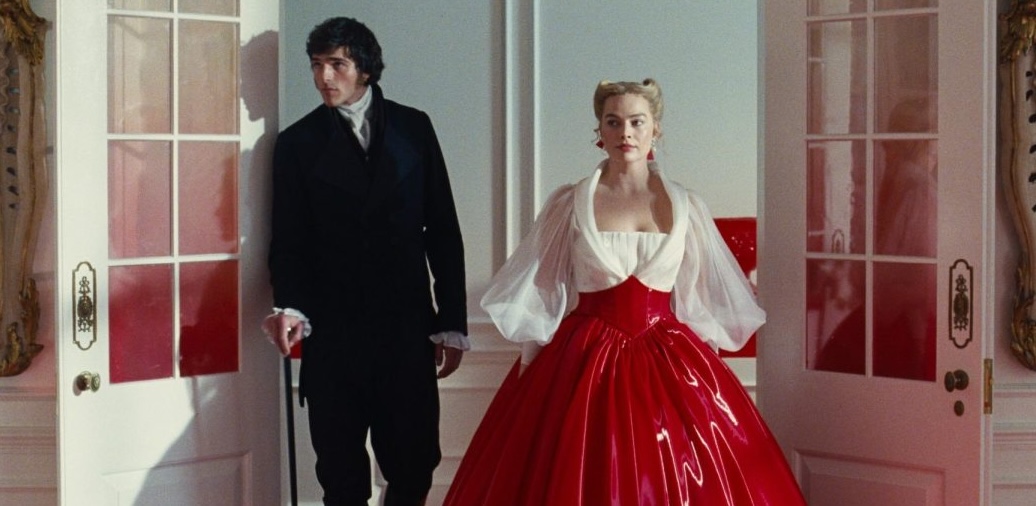
He will return, rich and clean-shaven, with a cunty little gold hoop earring, but he stays away for the series of musical montages that pass for a plot in which Catherine and the Lintons play dress up, toasting one another over a groaning dining table the size of the Seller Glacier. Thrushcross Grange, the Linton estate, is tricked out as the sprawling inverse of the Earnshaw oubliette, twinkling and glittering with chandeliers and shiny blood red floors, and so many dewy body horror allusions, it was like David Cronenberg got an episode of Cribs.
A massive fireplace crawls with hundreds of white plaster human hands and, in the world’s weirdest wedding present, Edgar Linton outfits his new bride’s quarters with floor to ceiling panels meant to replicate her skin, complete with moles and spidery blue veins. Writers I admire have characterized all of this as nods to the home, in Gothic literature, as a place of women’s entrapment. Sure—but when your set becomes your story, you’ve lost the plot. This was also the case in Guillermo del Toro’s Frankenstein, which abandoned the novel’s complex (and, importantly, entertaining) moral quandaries in favor of a clock tower colossus doubling as a steam punk charnel house.
Both of these films are invested in embodying the “unhinged” discourse of the zeitgeist; del Toro and Fennell seem to think this can be accomplished by dispensing with the substance of the source material in favor of style. But no one did unhinged better than Mary Shelley or Emily Brontë, women who spent their lives immersed in tragedies which make their novels look tame by comparison. You can’t contain or embody that in decor and dresses, but damn if Fennell doesn’t try.
Imagine a wealthy Oxbridge don giving their teenager a blank check for their Brontë Birthday Bash and you might begin to grasp the vision. The costumes move without constraint or concern for money or taste, from Princess Di’s wedding gown to Elsa in Frozen 2, to the clerk at your local mall’s prom dress shop really putting that 30 percent discount to work. Catherine’s tits strain against each gown with all the dead pleasure of that anonymous hanged man’s cock against his homespun britches. Even Robbie’s hair is at one point corseted in red leather ribbon.
Fennell loves a framing device, and this corset-hair could have been clever, Robbie’s hair a doll and her body its house: Cathy as her own familiar. If the movie was smarter—if it could be bothered to take its source material, or itself, at all seriously—this could have acted as a nod to Catherine Earnshaw’s famous statement that she is Heathcliff, and Heathcliff is her, a Victorian embodiment of that most famous Platonic ideal. Instead, the hair corsets give way to a dress that looked to be made from Bounce Dryer Sheets, one offset by Cathy’s giant white fur muff which, for my taste, was a bit on the nose.
Imagine a wealthy Oxbridge don giving their teenager a blank check for their Brontë Birthday Bash and you might begin to grasp the vision.
The performances mirror the costuming. Margot Robbie weeps and heaves and bleeds and wallops herself in the face, a Catherine Earnshaw whose primary inspiration seems to be Miss Piggy (no shade to Miss Piggy, I would watch A Muppets Wuthering Heights). Elordi’s Heathcliff is defanged. Hong Chau’s Nelly doesn’t act so much as sneer. Martin Clunes’s aggressively Dickensian Earnshaw, with his leering mouthful of yellow teeth, brought to mind Noel Fielding’s character “The Hitcher” from his British sketch comedy show The Mighty Boosh.
Shazad Latif’s Linton has the sleekly graying temples of Mister Fantastic, but mostly stands around confused until Cathy’s bloody, septic, leech-ridden demise. And Isabella. Oh, Isabella. My truncated reread of the novel affirmed my admiration for Linton’s sheltered younger sister, who makes the fatal romantic error of running off with Heathcliff and immediately finds herself in hell.
In one of Brontë’s most psychologically revealing moments, Isabella lays hands on Hindley Earnshaw’s gun and feels “not horror, [but] covetousness.” Hindley quickly reclaims his weapon, but not before we watch how even brief exposure to domestic violence has turned Isabella from petted ingenue to power-seeker. After Heathcliff throws a carving knife at her head, slicing her skin below the ear, she cleverly escapes, pregnant with his son, and spends the next dozen years as a single mother hundreds of miles away. When Isabella dies and we meet their son, he is astounded to learn he even has a father—Mama never told me I had a father. I don’t know him. My kind of gal.
In most of the film adaptations, Isabella is unfairly cast as a blond Regency bimbo. Alison Oliver plays her as a nerdy simp begging to attend public executions of women and pushing her new toy Cathy on a swing made of purple velveteen scrunchies. Oliver’s performance is, for my money, the best in the film. She’s the only actor who genuinely adapts her character’s material into something fresh and new, nodding to the story’s origins while commenting on the world we currently inhabit. In the film’s most engaging scene, Heathcliff proposes whilst telling Isabella frankly that he is a brute who can never love her and will marry her with the sole purpose of torturing Cathy for revenge. “Do you want me to stop?” he asks her after each escalating threat.
Elordi’s Heathcliff is dripping wet and at least seven feet tall in this scene, so we understand why Isabella says “No,” each time he asks, untying her nightdress question by growling question. But we also understand that a woman of Isabella’s time and station had little access to consent or choice when it came to marriage, and, once married, had signed onto whatever her husband could, or would, desire, including rape and domestic violence.
In our own time, we have tried to remedy these issues legally and socially, most recently with the “affirmative consent” discourse, which holds that a lack of no isn’t enough, that all parties must verbally, actively affirm what’s happening between them for sex to be legal, or simply to succeed as pleasure. This is hardly a fix for the inherently toxic power differential of hetero relationships, in which, too often, women agree to sex or even a life they don’t want because they can’t see a way out, to say nothing of envisioning a different kind of existence.
Elordi and Oliver have the kind of genuine chemistry that he and Robbie lack, which Fennell squanders with a turn toward the ridiculous: returning to the underhalls of Wuthering Heights, we see Isabella chained to the fireplace and snarling like a dog. Heathcliff throws her scraps from a table littered with what appeared to be orange rinds and moss, which she catches in her mouth. It’s absurd; but it made me wonder what might have happened if Fennell had the guts to cast Oliver in the lead and Margot Robbie as Isabella since, in most ways, the two of them embody the physical characteristics of the characters as described in the novel, and might have turned Wuthering Heights into the kind of film many of us hoped for, rather than a half-assed bodice-ripper.
*
The trailers for Wuthering Heights led every straight woman on the internet to believe that Fennell would manage (finally!) to translate all the rangy, ragey tension of Cathy and Heathcliff’s vibe onto the screen. By the time Catherine kicked her father’s corpse and ran out into the rain again (in the movie, you’re either bejeweled, bedrenched, or be-both) with Heathcliff in tow, I thought, If they don’t fuck now, I will demand a refund. I had to wait another beat before their lackluster Gothic coitus montage.
Elordi’s Heathcliff lacks entirely the deranged sexuality of his literary predecessor, who digs up his beloved twenty years after her death and tries to convince the reader she’s still got it. After 34 years of picturing Cathy and Heathcliff fucking, it was a minor payoff. Carriage fucking, table fucking, cunnilingus in the rainy garden. Cathy wept and Heathcliff licked her tears. It didn’t hold a candelabra to Heated Rivalry. It didn’t even live up to the aforementioned S&M scene in the barn.
Of all Fennell’s anticipated changes, turning Joseph, Brontë’s dully blathering fanatically religious manservant, into a dom is really the last one I expected, and here I will just admit that I don’t have a clue what the point is. If we were going to watch two characters have sex in an iron mask, why not have it be Heathcliff and Cathy who, when they do fuck, are wearing all of their considerable clothing? Cathy hints to Heathcliff that her sex with Linton “would make you blush” but all we see of that is him placing a hand gently over her mouth in her Brontë Barbie™ bed.
As Cathy started dying in earnest, the gallon drum of club soda I had consumed over the course of two hours had filled my bladder to the point of agony (“our drinks are one size”). I panicked, not wanting to miss one minute of this spectacle, still clinging to the possibility that there would be some trace semblance of Emily Brontë in this Wuthering Heights, that we might meet the next generation of Earnshaws and Lintons. Once more, I needn’t have worried. Cathy bled out onto her Princess Peach sheets, Heathcliff wept over her corpse, and the credits rolled to another Charli XCX banger.
I left my husband to gather our things for dinner and scooted to the loo, where I was faced with a David Lynch-like scene far stranger than Fennell’s moors. A woman in one stall loudly begged a drunken stranger (who was dressed to the nines for her Valentine’s Day date) for toilet paper, her disembodied hand wiggling beneath the hanging door, as the drunken stranger opened a stall and rolled a giant pile of tee-pee around her diamond-studded hand, screeching “CAN YOU SPARE A SQUARE, REMEMBER, CAN YOU SPARE A SQUARE” to me, the only other person in the room old enough to catch that Seinfeld reference. Two young women in Taylor Swift hoodies who had been in the theater with us were weeping over the ending, saying, Why? Why? What was the point? They weren’t talking to me, and god, I was glad, since I had no answer for them.
I know I will be dragged as a purist for this take, but I am unapologetic. I am known for my work on Sylvia Plath, but I am also a lifelong Brontë fan who has come to love their novels more as I’ve aged and lived and visited their home, the Brontë Parsonage, in West Yorkshire, wandering the moors behind it. I once wrote to a fellow Plath enthusiast, enclosing pictures from a recent trip to England, so that he might see what I had seen, what Plath had seen: the country house where she wrote Ariel, the graveyard in the distance, the wild ponies on the moors. “It’s all just… there??” he replied, astonished. In fact, it is, if you’re willing to go and look. Fennell recently penned a foreword to a new edition of Wuthering Heights which she closed by paraphrasing the novel: “Emily Brontë is our murderer. We love her for it.” This is a clever way to sell books (and movie tickets) but it belies her understanding of a book which is not asking us to love our murderers, but to free ourselves from a world where love kills, rather than liberates.
In 1987, Andrea Dworkin wrote of Wuthering Heights that “we have not yet faced what Emily Brontë knew and said and showed” about the relationship between race, gender, sadism, power, and justice. Fennell’s Wuthering Heights makes it clear that we are still not willing to go and look. Watching it, I was left with the image from Arrested Development when Michael opens the refrigerator and sees a brown paper bag marked “Dead Dove, Do Not Eat” by his brother GOB, an aspiring, terrible magician who keeps accidentally killing his props. Michael takes the bag from the fridge and glances inside, closing his eyes in disgust and recognition. “I dunno what I expected,” he says. Amen, buddy.

Emily Van Duyne
Emily Van Duyne is the author of Loving Sylvia Plath: A Reclamation (W.W. Norton & Co., 2024) and an associate professor of writing at Stockton University in New Jersey. She is represented by Iris Blasi of ARC Literary Management.