Embodied, Unbodied, and the Body Destroyed: Five Books About the Body
Lydia Mathis Recommends Justin Torres, Jesmyn Ward, Sarah Gailey, and More
In undergrad, I took a few creative writing classes, and as I was trying to figure out the stories I wanted to write, the things I wanted to focus on, I kept coming back to the body. As I read and as I wrote, I kept thinking, “where is the body in all of this?” What was the body doing, how was it moving, where and when did it excrete and vomit and laze and bleed, move minutely, stay still impossibly? So, I took up the mantel to tell the body’s story. I placed myself in the bodies that I created. The body became my everything. It became my whole thing. And even after leaving those classes, I couldn’t stop the fascination. There was no turning it off and no going back. And now, when I come upon books that are preoccupied with the body, I am entranced. Tormented bodies, changed bodies, possessed bodies, vacated bodies, manufactured bodies. All bodies in their myriad forms. They’re my quiet obsession. Here are some books that have an entrancing focus on the body.
*
Justin Torres, Blackouts
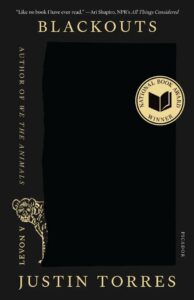
The joy of Blackouts by Justin Torres is that you get actual bodies on the page. Images populate the book, and because Blackouts is a book that features a book inside its pages – those images have layered meanings. The book within Blackouts is called Sex Variants: A Study of Homosexual Patterns, a real book by George W. Henry who, along with other straight scientists, essentially stole the groundbreaking work of queer journalist and researcher Jan Gay. That book is given to our protagonist by his dying mentor of sorts. The book itself has been heavily redacted. So, we have the images of researched queer bodies that have been stolen by straight scientists, and then we have the body of work, changed and manipulated. I am intrigued by the idea of how much reproductions of ourselves are ourselves, and what does it mean for those reproductions to be taken, misrepresented?
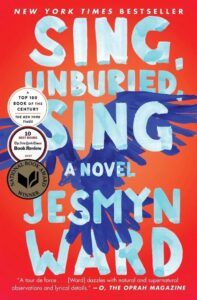
Jesmyn Ward, Sing, Unburied, Sing
Bodies are tormented throughout Sing, Unburied, Sing. Set in Mississippi, Ward chronicles a family dealing with loss, much of it caused by racism and its child: brutal violence. It is the unbodied, the ghosts, in particular that really make the novel sing. They are history that is not to be refused, that lingers because the unjustness done to them demands it. A world that allows – that causes – such atrocities deserves its haunting and the agonized psyche that comes with it: “I washed my hands every day, Jojo. But that damn blood ain’t never come out. Hold my hands up to my face, I can smell it under my skin.”
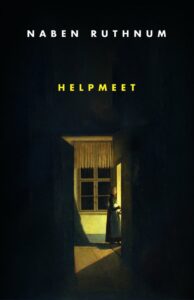
Naben Ruthnum, Helpmeet
I’m not one to typically read horror, as I’m a baby and prone to nightmares, but I read this with a friend and lived for the descriptions of a decaying body. The horror here is understated, observational. Emotions are near entirely removed, and we get to watch as if this is a kind of Cronenberg directed nature documentary. Besides the beauty and preciseness of language describing a deteriorating body, there’s also the quiet contemplation of the characters affected. There’s the crumbling husband, who makes you consider what you’d do if your body so viciously revolted against you. And then there’s the wife, who takes care of her husband. How do you bear watching a live decomposition? What must you do to survive that?
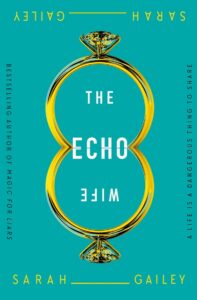
Sarah Gailey, The Echo Wife
What makes a person themselves? Is it their experiences, is it their memories, is it their body, their make up? What if all that is replicated, in as much as it can be replicated? What if the scars on your body were copied along with the memories attached to them? Is that new person, thing, or entity – are they you? The Echo Wife explores what make us us as we follow Evelyn Caldwell whose award-winning research has nefariously resulted in a clone of herself named Martine. Martine was created by Evelyn’s ex-husband in order to get the family that he couldn’t get from Evelyn. When he gets Martine pregnant, which should be impossible and is most definitely illegal, more questions surrounding personhood arise. Books that explore the autonomy of clones and similarly created beings always invite fascinating philosophical questions and debate. Self-determination, bodily autonomy, consent, government control over bodies, misogyny, etc. What grips me with this book is the question it poses about responsibility. Would you feel responsible for something made of yourself, even if it was made without your knowledge or consent. Does that thing created from a part of you belong to you in some way? When does it become not yours? Can it become not yours?
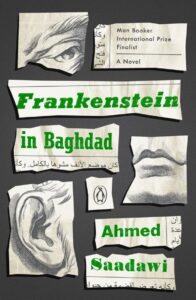
Ahmed Saadawi, Frankenstein in Baghdad
Frankenstein in Baghdad takes the classic, Frankenstein by Mary Shelley, to the U.S. occupied city of Baghdad, and presents us with Hadi, a scavenger, a liar, and the man who creates the Whatitsname, the stitched together body of people who died in bomb attacks. Hadi’s reasoning for his creation of the Whatitsname is for the victims to get a proper burial. By combining the pieces of bodies he finds, and turning them into a complete body, he concludes that the government will have to recognize the parts as people. Maybe even more than Shelley’s Frankenstein, Frankenstein in Baghdad, truly makes one consider what makes a person a person. If my arm is by itself, the rest of my body lost to it, is it still me? Does some essential element of myself reside in it when it’s left alone? Each body part that makes up the Whatitsname seem to have some element of the person it was once apart of still in it. The Whatitsname becomes a sort of vigilante, getting revenge on those that harmed the parts of itself. But the Whatitsname takes on goals of its own, as it needs more flesh in order to survive. And all of this is wrapped in a story that feels like an epic, with epithets for the wide cast of characters, and a fluid and spiraling movement through time and in and out of points of views.
__________________________________
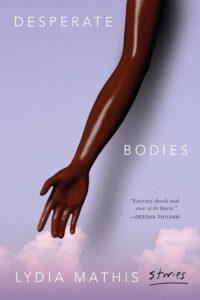
Desperate Bodies by Lydia Mathis is available from Roxane Gay Books.

Lydia Mathis
Lydia Mathis is a black writer, editor, and creator. She has an MFA in fiction from New York University. She earned her BA in English Literature with a minor in Classical Civilizations from Agnes Scott College. She has worked as a teacher for Teach for America in Memphis and as a teaching fellow at Coler-Goldwater Hospital in New York City. She is the recipient of A Public Space’s 2023 Editorial Fellowship and is currently an assistant editor at A Public Space. She has stories published in North American Review, Southeast Review, Torch Magazine, Stanchion, Five on the Fifth, and oranges journal. She is based in Atlanta, GA.