Ellie Roscher on Fair Game and the Future for Trans Athletes
In Conversation with V.V. Ganeshananthan and Jennifer Maritza McCauley on Fiction/Non/Fiction
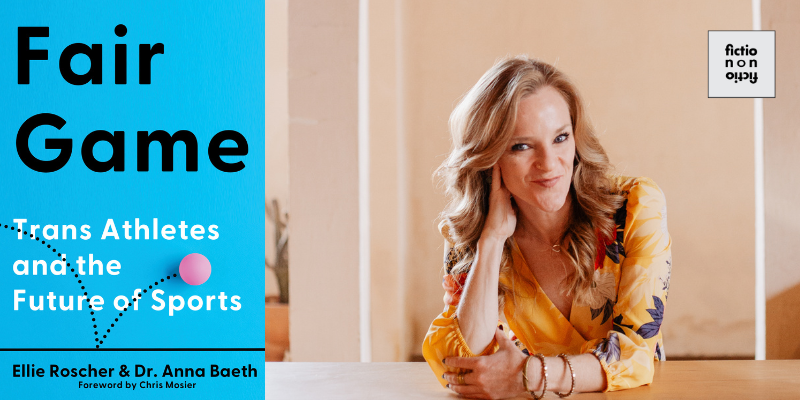
Author Ellie Roscher joins co-hosts V.V. Ganeshananthan and Jennifer Maritza McCauley to talk about her recent book, Fair Game: Trans Athletes and the Future of Sports, which explores the roadblocks transgender athletes face and the triumphs they achieve despite these challenges. Roscher discusses the harmful myths surrounding trans athletes and describes the current bans against their participation as a “solution in search of a problem.” Roscher, who interviewed 20 trans athletes for the book along with her co-author, Dr. Allie Baeth, interrogates the sex-segregation of the sports world and outlines how restrictions put in place to police the participation of trans athletes are rooted in patriarchy and tend to hurt cisgender participants as well. They consider trans athletes competing at the youth level and the negative impacts trans bans have on children who are searching for play and community. She also explains the importance of advocacy and how everyone wins when everyone is allowed to play. Roscher reads from Fair Game.
To hear the full episode, subscribe through iTunes, Google Play, Stitcher, Spotify, or your favorite podcast app (include the forward slashes when searching). You can also listen by streaming from the player below. Check out video versions of our interviews on the Fiction/Non/Fiction Instagram account, the Fiction/Non/Fiction YouTube Channel, and our show website: https://www.fnfpodcast.net/ This podcast is produced by V.V. Ganeshananthan and Whitney Terrell.
Fair Game (with Dr. Allie Baeth) • The Embodied Path • Play Like a Girl
Others
Fiction/Non/Fiction Season 9, Episode 5: Max Delsohn on the Importance of Portraying Trans Men • Fiction/Non/Fiction Season 8, Episode 43: Gary Shteyngart on Vera, or Faith, and American Authoritarians
EXCERPT FROM A CONVERSATION WITH ELLIE ROSCHER
V.V. Ganeshananthan: I really appreciate the way that the book deals with the specificity of sport. For example, there is a trans athlete who takes medication and then finds that they have to widen their stance for basketball because their shoulders have broadened or that Do is crushing the girls’ competition in this very specific sport, powerlifting. I didn’t realize that that was how powerlifting was scored. The precision with which you write about sports is really helpful, and you are yourself an athlete. Can you just tell our listeners what sports you played?
Ellie Roscher: I did everything as a kid. I just loved to play. I loved being in my body. I did tennis, gymnastics, and softball in high school, and then I competed in gymnastics and softball in college. This book was so fascinating because I had a really interesting cultural shift going from a college gymnastics culture to a college softball culture. Those two sports code a little bit different in terms of gender, and they highlight different parts of my physicality. I was a very normal-sized gymnast, and then I was a very small softball player, for example. So, I loved thinking about that and how different parts of my physicality were highlighted in those different sports.
When we’re saying trans athletes can’t compete in any of these, or that men always have an advantage over women, for example, and then we assume that trans women are men, it becomes problematic right away, because it depends on the sport. Gymnastics in particular was interesting because you look at, for example, Simone Biles who’s thriving in women’s gymnastics, and that’s not going to translate exactly the same way into men’s gymnastics, and it’s definitely not going to translate into other sports. That’s what I’m saying about having nuanced, particular conversations that honor how complex our bodies are and how complex our different sports are, and different types of strength and how we judge bodies in competition to say who showed up the best that day.
Jennifer Maritza McCauley: So, in June of last year, Kirsty Coventry, the president of the International Olympic Committee, indicated it’s possible that trans athletes could be banned from competing in the women’s categories in the 2028 Olympics. The committee has also stated that it plans to reintroduce genetic sex testing as a way to verify the sex of all female Olympic athletes before they compete, which is a decision that’s already faced a lot of backlash from sports advocacy and human rights organizations. Could you explain what genetic sex testing is and how it’s harmful to athletes?
ER: As long as we’ve had the female category, we’ve had folks policing the female category, and that has shifted over time. At first, we would see nude parades where your sex was proven by your external sex traits. Folks would be doing genital tests, and that is so invasive and makes the women’s category really feel unsafe. Then we had a season of chromosomal passports where we would equate being female with what your chromosomes were. So you had to get your chromosomes tested ahead of time and then prove on this piece of paper that you were female. But we see so many chromosomal variants, right? Our bodies are so cool, they’re so varied. Scientists will often use a two bucket system for sex to because it’s neater, it’s cleaner, it’s easier, but that doesn’t mean it’s right. Scientists are starting to agree more and more that a bimodal system where there’s two camel humps, instead of two static buckets, is a better reflection of reality, which makes scientific testing extremely complicated.
It’s hard to get good information about what makes someone female. We have chromosomes, we have hormone levels. Anyone going through perimenopause with peers knows how varied our hormones are body to body. We’re now in this period where we’re equating the female category with levels of testosterone. That’s how we’re deciding what is male and female. And testosterone is fascinating and complicated. Our level of testosterone changes during the day. It changes during our life. There’s an overlap between cis men and cis women and their level of testosterone. And really, if we’re going to be talking about competitive physical advantage in sport, where we need to talk about how the body uses testosterone—testosterone receptors—and that’s very hard to track. We’re hearing rumors about things like period tracking or going back to these genital checks, and you have to know that the women who get pulled out to get tested to prove that they’re women are the women who we deem as being disobedient to our feminine ideal.
If you look at me, there’s some ways you could argue I have a fairly obedient-looking body in terms of being feminine, but at the same time, when I was competing, I wasn’t menstruating, so I would not have passed the menstruation check test that would deem me female. And I have coarse hair on my chin, which is a secondary sex trait. So it gets more and more complicated to figure out how we decide who fits in the female category. The more we learn about bodies—about folks that have intersex variations and chromosomal variations and about interesting hormone combinations in our bodies—it’s trickier and trickier. And the people who lose out in this policing, more often than not, are women of color, and women of color that present as being muscular and strong and disobedient to what we think of as feminine instead of being celebrated for being amazing athletes. So we have to ask, who’s going to be paying for this policing? How invasive is it? Why is it only the female category? Can we see that all girls and women are going to lose if this starts being instituted, instead of just letting more bodies play.
VVG: As you write in the book, so much of the public conversation around this really has centered around Caster Semenya. Watching the experience of Castro Semenya being scrutinized, to have your body examined in this way which, of course, also speaks to the histories of the ways that black and brown bodies have been scrutinized by the state or other people positioning themselves as authorities, whether those are institutional or corporate or something else, it was just horrifying. This is affecting not only trans athletes, but also the conversation about gender for all of us. You have, in the book, described really effectively how these policies are made under the guise of protecting cis women like myself, but in reality, end up harming them as well. You have this line that really stuck with me, that describes the fate of cis women and trans women as intertwined. I wonder if you could elaborate a little bit on that.
ER: Absolutely. So, research is showing that in states that are more trans friendly and trans inclusive, not only are more girls and women participating, they’re also reporting having better experiences. There’s something about this idea that cis women need to be protected from trans women that takes away our dignity. I don’t want to divest from that. I don’t need cis men protecting me from trans women. I’m powerful beyond measure. I’m not fragile. I want to compete against trans women, and I can handle that. I can very clearly see in our sex-segregated sports world, there’s so much work to do to bring more equity into the women’s sports system that I don’t want to be distracted thinking that trans women are the problem. They are not. They’re decidedly not the problem. If cis women and trans women can come together, and all women can fight for equity in the sports system, I think everybody wins.
Boys and cis men are losing here too, by saying that the worst thing for you to be is a woman, and that the worst thing to have happen would be for a man to have to compete against a woman. I should take offense at all of these pieces of logic. I definitely want sports to become safer, and I definitely want to think about fairness. The conversation with that is so much more interesting than just saying that trans athletes are the problem. There’s all of these ways that that the system will come in and try to separate people so that we won’t come together to fight like hell, and in this case, I see the system coming in trying to separate cis women from trans women, so we don’t come together and fight like hell for more equity in sports systems. We just got great news about the WNBA that they’re starting to get paid what they deserve. These are the big wins where we’re talking about, feminist coaching and pay, and we’re talking about opportunity, and we’re talking about media time. Any energy I put toward thinking that trans women are the problem is energy I’m not putting toward actually working toward the equity that we deserve.
Transcribed by Otter.ai. Condensed and edited by Rebecca Kilroy. Photograph of Ellie Roscher by Juliet Farmer.

Fiction Non Fiction
Hosted by Whitney Terrell and V.V. Ganeshananthan, Fiction/Non/Fiction interprets current events through the lens of literature, and features conversations with writers of all stripes, from novelists and poets to journalists and essayists.