
Elizabeth Strout on Creating a Quietly Strong Protagonist
Jane Ciabattari Talks to the Author of The Things We Never Say
After creating literary immortals like Lucy Barton, Olive Kitteridge, and Bob Burgess, Pulitzer Prize-winning author Elizabeth Strout is back with her eleventh book, which contains a multitude of new characters, centered around Artie Dam, 57, a self-deprecating high school teacher beloved by his students who seems woven into his small-town community, but who, as the book begins, feels so lonely he is suicidal.
What motivated you to create this new character, Artie Dam? I asked Strout. “Artie arrived to me as many of my characters do,” she explained. “They just ‘show up.’ In this case, a friend, a few years ago, had sent me some obituaries from upstate New York, and I remember looking at a man whose last name was Damm (with two m’s) and he had wire framed glasses and just looked pleasant. That was my first piece of Artie.”
*
Jane Ciabattari: What sort of research was involved in pulling together Artie Dam’s various attributes—teacher of eleventh graders, coach (first soccer, then, as he grew older, baseball), in a long marriage with Evie, a woman raised by a well-to-do family unlike his own (his father was a super for an apartment building in Revere, his mother suffered multiple psychotic episodes), father of one son, 27, who at 17 survived a car crash in which his girlfriend was killed (the family tragedy that leads Evie to become a therapist)?
Elizabeth Strout: How he evolved after that is hard to say; he presented himself. I spoke to a few current high school teachers so that I understood what it was like to be in a classroom these days, and I also called upon my experience of teaching at Manhattan Community College years ago when I was young and enthusiastic. From those memories I understood Artie’s stance in the classroom, and how each class winds up having its own personality.”
When I write I concentrate profoundly on who the character is, and in this way, he was the one who showed me who he is.
JC: After setting so many of your novels, including your first, Amy and Isabelle, the Pulitzer Prize winning Olive Kittredge (2008), Olive, Again (2019) and The Burgess Boys in Maine, why this shift to coastal Massachusetts?
ES: I can’t say exactly why I switched to the coast of Massachusetts, but I wanted to start fresh. And the coast is familiar to me, although culturally there are differences between Maine and Massachusetts. (I lived in Boston many years ago.) My husband and I took a two-day car trip down the coast of Massachusetts, as I always need visuals for my work. We went to different high schools, drove through many towns, found a house that could have been Artie’s. These are the things I need to do.
JC: How did you arrive at the title for this new novel?
ES: My editor, Andy Ward, came up with the title and I thought it was great. The main thing Artie learns in this book is that within each person is a vast unknowable universe. There are so many multi-faceted aspects of every single person walking around and Artie doesn’t have that realization until later in his life. And he learns that because there are so many universes within each person, people often do not say what they hold within themselves.
JC: In your opening scene, Artie is meeting with his recently widowed friend Flossie for farewell drinks. “It was the middle of June and the sun all day had kept right on shining with sweet lightness. ‘Stay jovial, please, Artie! Just promise me that. Please stay your old jovial self!’’ What drew you to start the novel this way?
ES: In my memory this was the first scene I wrote, and it turned out to be the first scene of the book, which seldom happens with me. What I wanted was to establish the word “jovial” to describe Artie. This is how Flossie sees him, how many people have seen him for years. And from there I was able to go deep inside him and show how much we often do not know people the way we think we do.
JC: In your next scene, at home, Artie’s wife Evie makes it clear she isn’t fond of Flossie, or her late husband: “‘Reginald McDonald,’ Artie said, shaking his head slowly. ‘Poor brilliant man.’ He added, ‘He drank too much, though.’ ‘He had to, living with Flossie,’ Evie said, and Artie let it go. ‘She drinks too much herself,’ Evie added, and Artie let that go, as well; it was true.” What did you intend with this snapshot of the marital dynamics?
ES: I was trying in that scene, to let the reader know that Artie, at that point in the book, is oblivious to who Flossie’s husband actually was. And I wanted Evie to put down Flossie, for reasons that we will find out later.
JC: Artie yells at his class after his student Danny Marino ridicules the way a classmate, Rhonda Lazarre, walks—with her arms out and her mouth open. You write, “An unexpected fury rose within Artie, and he stood up from his desk and said, ‘I just now saw that one of you thought you were better than someone else in this class.’” After he yells, Artie observes that Rhonda seems oblivious to the slight, and that Danny is aware he was the student being called out. When he tells Evie about it, she supports him, but he has second thoughts. How did you go about developing the self-consciousness that seems one of Artie’s key traits?
ES: I was only trying to be true to this character who had come to me. When I write I concentrate profoundly on who the character is, and in this way, he was the one who showed me who he is.
JC: I was intrigued to encounter that moment in The Things We Never Say when it comes to Artie with utter clarity: “I am lonely enough to die. He remembered that his wife had loved some book—oh, years ago now—about a crotchety old woman from Maine, and he had read the book reluctantly only because his wife had liked it. He’d forgotten about it until now. In the book the awful old woman’s father had killed himself when the woman was younger, and now that she was older, the woman thought: People die of loneliness. It happens all the time. And he thought: Yes, that was correct. People do die of loneliness and I am—or will be—one of them.” Through what process did you create this Easter egg?
ES: It occurred to me that Olive Kitteridge had thought a similar thing, and so I understood that the chances were that Evie had read that book in a book club at some point and had made Artie read it. It was just a fun thing for me to get a reference to Olive in there if people saw it.
JC: And we do! In the course of this new novel, you create a mosaic of sorts, sometimes interweaving different timelines and referring to a range of viewpoints (like how Artie’s students Rhonda Lazarre and Danny Marino will remember him long after completing his class). Primarily you use an intimate, interior third-person close point of view. What are the advantages to that approach?
ES: This was a different narrative approach for me. And I thought, Well, let’s try it and see. So I did. It was a little freeing to have the narrator invade the story directly at times, and also to be able to fast forward in the story. So I kept it.
I write very much with the character in my head and seeing where he or she will take me.
JC: There are so many subtle plot twists to this novel I hate to get too specific and ruin the reading experience with spoilers. Did you have the range of secrets and various dramatic shifts—shoplifting, affairs, kleptomania, paternity disclosures, childhood trauma—in mind when you began this novel? How did they evolve?
ES: Most of these things were not pre-planned, which is how I write, I seldom know what will happen until I get there. For example, with the young woman who turns out to be a kleptomaniac, I had her fingering the tiny boxes on the table, and I had a thought—let’s spice this up. And then I realized it had reverberations with the shoplifting scenes, so I kept that.
JC: You include sections connected to contemporary American life—Artie’s reactions to various political news, and his “quiet dread” at the actions of the new president, for instance. Did you find it challenging to make reference to “real” events?
ES: When I wrote Amy and Isabelle, it came to me very strongly (once I was done with it) that literature is about place. And also time in history. I have always thought if you have a time in history and a place and you throw in a character you will have a story. This story of Artie’s took place in the contemporary political scene of our country, and because he was a history teacher and had studied history—had thrilled to it—I knew I had to write this story as his.
JC: The Things We Never Say brings to mind Our Town (in particular a staging of the play I saw long ago at Lincoln Center featuring Spalding Gray as the stage manager—Spalding, whose mother died by suicide in 1967 and who committed suicide himself in 2004 by jumping off the Staten Island Ferry on a bitterly cold January day). Was Our Town an inspiration? Or other literary works?
ES: I would like to say that the production you saw of Our Town was an inspiration, but it was not, alas. I honestly do not know where the ideas came from. I write very much with the character in my head and seeing where he or she will take me. An author who inspires me broadly as a writer is William Trevor. I’ve often talked about how much I learned from his work—about class, voice, and pace. And especially that the writer can and should be compassionate to all their characters.
JC: What are you working on now/next?
ES: I would love to tell you what I’m working on, but it is not good for the work for me to ever mention it—so I am sorry.
_________________________________
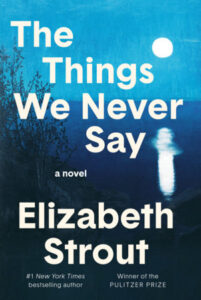
The Things We Never Say by Elizabeth Strout is available from Random House, a division of Penguin Random House, LLC.

Jane Ciabattari
Jane Ciabattari, author of the short story collection Stealing the Fire, is a former National Book Critics Circle president (currently on the Advisory Board ) and a member of the Writers Grotto and Page Street. Her reviews, interviews and cultural criticism have appeared in NPR, BBC Culture, the New York Times Book Review, the Guardian, Bookforum, Paris Review, the Washington Post, Boston Globe, and the Los Angeles Times, among other publications.