Elizabeth McCracken on Writing About Writing, At Last
In Conversation with Whitney Terrell and V.V. Ganeshananthan on Fiction/Non/Fiction
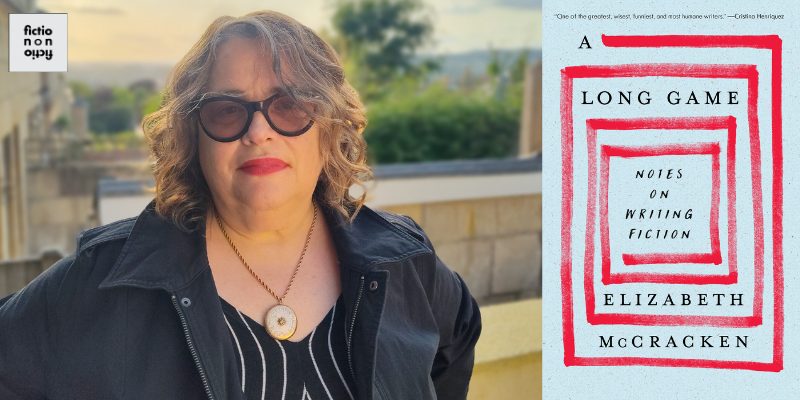
Acclaimed fiction writer and long-time creative writing professor Elizabeth McCracken joins co-hosts Whitney Terrell and V. V. Ganeshananthan to discuss her ninth book and first volume about craft, A Long Game: Notes on Writing Fiction. McCracken reflects on her long-held reluctance to attempt such a project and the impossibility of creating absolute rules for writing. She explains why she doesn’t believe in “show don’t tell,” “write what you know,” “write every day,” and other classic canards of craft. McCracken talks about the importance of imagining characters’ physicality; well-executed present tense; how time can shape narrative; justifying flashbacks; and writing outside one’s own identity. She reads fromA Long Game.
To hear the full episode, subscribe through iTunes, Google Play, Stitcher, Spotify, or your favorite podcast app (include the forward slashes when searching). You can also listen by streaming from the player below. Check out video versions of our interviews on the Fiction/Non/Fiction Instagram account, the Fiction/Non/Fiction YouTube Channel, and our show website: https://www.fnfpodcast.net/ This podcast is produced by V.V. Ganeshananthan and Whitney Terrell.
A Long Game: Notes on Writing Fiction • The Hero of This Book • The Souvenir Museum • Bowlaway • Thunderstruck & Other Stories • An Exact Replica of a Figment of My Imagination • Niagara Falls All Over Again • The Giant’s House • Here’s Your Hat What’s Your Hurry?
Others:
Tinkers by Paul Harding • The Gates of the Alamo by Stephen Harrigan • Affliction by Russell Banks • Gilligan’s Island • Allan Gurganus
EXCERPT FROM A CONVERSATION WITH ELIZABETH McCRACKEN
Whitney Terrell: Early in the book, you wrote some sentences that I enjoyed—they weren’t the only ones, but these ones I flagged: “I don’t like craft books. It’s possible I’ve never read one through. I distrust both rules and optimism and the combination gives me the heebie-jeebies.” I sometimes feel that way about craft books myself. And oh, then you add “Craft feels like regarding a vast tapestry and saying, This is how I wove the blue part.” So given all of that, what made you decide to ignore this feeling and write one of your own?
Elizabeth McCracken: That’s a good question. I’ve had, over the years, a couple of students say “you should write a craft book,” which I think students say to any professor of Creative Writing. And I would say, “I don’t really believe in craft,” and they would give me an odd look and say, “but every single class, you end up talking about craft.” And I probably said “Nonsense! I talk about art.” But I was talking about very practical aspects of creative writing and how to think about them.
I had written a novel. My last novel was highly autobiographical and to trick myself into writing that, I decided that I was going to be enormously clever and have a bunch of end notes or footnotes—I hadn’t quite decided—in the form of craft book attached to this book, dissecting it, so that I could be sincere in the novel and then clever in the notes. It did not work, the notes didn’t. I published the book, but I took the notes off so I had some stuff to work with. The more I thought about it, the more I thought, “Oh, maybe I would enjoy trying this, trying to actually put down what I think I know about writing in published sentences, as opposed to sort of coming up with them on the fly, which is how I generally work when I teach, responding specifically to students work.” I also feel like I’m literally getting to the end of my teaching life. I’m gonna retire from academia at the end of this academic year. So it felt like a good time in that way, too.
V.V. Ganeshananthan: So I also share this distrust of craft books. Maybe even just the word “craft” makes me a little itchy, the idea that you can follow writing advice “like a recipe,” as you say. You have a very good souffle analogy. So I read this book as a response to normie craft books, one that is sarcastic and iconoclastic and bent on blowing up the truisms of writing advice that we always hear: show, don’t tell, write every day. Can you talk to us about some of the “conventional wisdom” that you question here?
EM: For me, writing every day is the first one, and I talk about it a lot in the book. I don’t know if you guys had teachers who said that. I had teachers who I loved, who said “real writers write every day, you have to write every day to be a writer.” And I just write terribly if I write every day. I think writing every day is one of those pieces of advice that is great if it works for you. It’s good advice for those for whom it’s great advice. But for a lot of us, it makes us feel like we’re failing at the first practical step that anybody is supposed to be able to do, which is to write every day. I felt a lot of shame over my inability to write well every day, and shame is a really bad thing to take into a writing practice. It’s really good to write about shame, all for that, but if you feel like you failed before you even get to the big stuff in writing, it’s bad for your work. It’s certainly bad for my work. I should say, anytime you hear any writer talking about their rules for writing all they mean is “this is it’s bad for me,” or “this is what works for me. I would like to be validated, so I’m gonna say it in a voice of authority.” That’s true for me as well. I think it’s terrible to start off with shame. There might be people for whom it is great that you sit down every day just feeling so ashamed and it’s a kick in the pants.
VVG: It’s funny because you were the first person to make me feel like it was okay to not write every day, I remember so appreciating that, because I was experiencing a lot of shame. I think we may have had the same teacher who said “Write every day.” It was Frank Conroy, for those of our listeners who might wish to look up, look him up. He said real writers write four hours a day.
WT: He was at three when I was there.
EM: Maybe he was ramping down.
VVG: And he would do this intense hand gesture where he would put his hand against the table and shove it across, and be like “You have to face the resistance.” I was wracked with shame. So it was great to have you puncture that for me and be like, “I don’t.” There are some other truisms that you question in here as well: “show, don’t tell,” which is a common one. And then also there’s “write what you know.”
EM: Show don’t tell is one of those things that people say because it has the ring of truth, but nobody actually knows what it means. I will also say that when I was in graduate school, which was late ’80s, ’88 to ’90, everything was supposed to be written in scene, and you were supposed to have no exposition whatsoever. I took that on, and it took me a long time to understand that there aren’t two gears in fiction, exposition and scene, that you can be fluid about the way you give information and also the way that you dramatize things. I was so convinced that everything had to be shown in real time had to be dramatized in the form of a scene.
Specificity is great, but I think people say “Show, don’t tell” when, for first person narrators who are literally telling their own stories, you can’t get away from telling, I think, in fiction. “Write what you know” that, again, is one of those pieces of advice that for some people is absolutely essential. Some people have to write from their own experience, they’re compelled by it. I think any writer should write what they can’t get to the bottom of, and if you’re compelled by your life story and the experiences you’ve had and you return to fiction to understand it, that’s great. I have very little autobiographical information or things that I know, that I feel that way about, and I’ve always really loved doing research and figuring out how I can know things that did not happen to me.
WT: There are some writers who can’t do anything other than write with a character that is some version of their own persona—Hemingway would be an obvious example of that—and then other writers who hate doing that. I don’t like having myself in my own work at all, but it’s helpful to learn that early on and see how other writers work. John McPhee, a creative nonfiction writer, was my teacher, but he hated writing about himself and he invented a kind of nonfiction that was basically the opposite of New Journalism. His position was very deeply recessed, and the other characters were forwarded. So, when I read craft books, I read them as if I was one of my own students and saying, “Oh, Terrell was wrong about that thing. See what McCracken is saying, something different.” So I find that interesting. I don’t know if you guys do that, but I’m thrilled when something reinforces an idea that I’ve talked about, and then mortified when you say something that contradicts something I’ve endorsed, for instance I do tell students to write every day. But that latter category is more interesting because in the end, it tends to make me think more critically about what I’m doing and maybe change things that I do. Sugi and I are going to both give examples of how this happened in your book to us. But has it ever happened to you? Have you ever reconsidered some teaching practice based on something that you read or heard from another creative writing professor?
EM: Anything that I have believed in, I have encountered some brilliant writer who is describing their own process and says the opposite thing has worked for them. Fifteen years ago, Paul Harding came to the University of Texas, and he had just won the Pulitzer Prize. He was a student of mine at Iowa, and I had known this thing about his process. I was always telling students that they should try to write a first draft of their novel from the beginning to the end, then they could figure out other things later on, but that if they skipped around in the manuscript, they might lose some tension, they might be using it as a form of procrastination. Somebody asked Paul about how he wrote Tinkers, and he said, “Well, I would write a little over here, and I would write a little over here.” And then he made these circles with his hands and said “Each piece would acquire mass until they joined up.” And I was like, that is so amazing to me. Also, the hand gestures were key. All of a sudden I understood how that could work.
And I was working with another teacher at UT, and I had said, “I think it’s a pretty good idea to try to write a first draft in a relatively short period of time.” And he said, “Oh yeah,” this is a writer named Steve Harrigan, “Oh yeah, that’s interesting. It took me eight years to write the first draft of The Gates of the Alamo, and it was pretty much the last draft.” That sort of thing happens to me all the time where I think, “Okay, I’m clinging to this one piece of advice, and then somebody talks about how the exact opposite has worked for them.”
Transcribed by Otter.ai. Condensed and edited by Rebecca Kilroy. Photograph of Elizabeth McCracken by Edward Carey.

Fiction Non Fiction
Hosted by Whitney Terrell and V.V. Ganeshananthan, Fiction/Non/Fiction interprets current events through the lens of literature, and features conversations with writers of all stripes, from novelists and poets to journalists and essayists.