Education as a Lifeline:
Hope and Hardship in Gaza
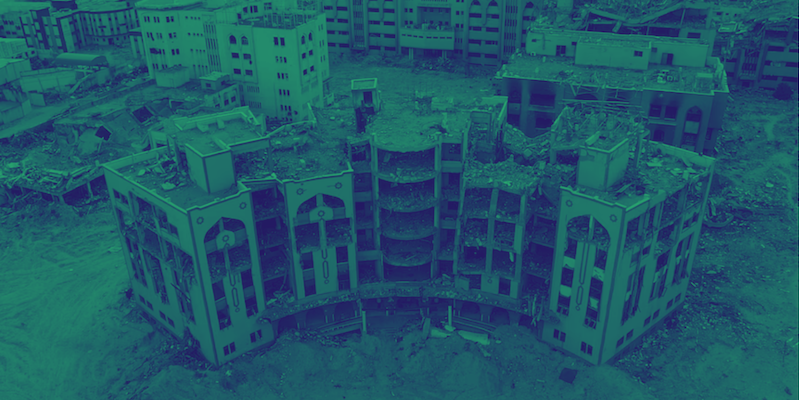
Hassan Herzallah visits his destroyed university
It was seven in the morning, and I was on my way to buy chicken—both hands buried in my pockets, trying to keep warm as the cold bit sharply. All I could see along the way were tents in quiet fields. Ahead of me, a small child was walking, carrying a tiny plastic bag. Inside it I could make out a pen and a notebook.
He looked about seven or eight. I approached him and asked, “Where are you going so early?” “To school,” he replied simply.
I walked with him for a short while until we reached a tent that was being used as a makeshift school for children. In that moment, one question sprang to mind: Is this tent his very first classroom?
After more than two years of war, life in Gaza is still shaped by loss and displacement. In some ways, the fragile “ceasefire” only exists on paper. Despite this, people try their best to reclaim the lives and the rights that were taken from them—including the right to education—while also searching for small moments of joy.
*
It was the last week of November 2025. The sky was overcast and I was in a hurry, hoping to find a place to charge my phone before the sun disappeared completely. On the way, I received a call from my friend Mahmoud, who lives in northern Gaza. He wanted me to spend the night at his place and then go with him to visit the Islamic University, where we once studied together. We had heard rumors that classes were resuming there.
As he spoke, my mind drifted and for a few seconds played back a reel of memories. I remembered the day the war began, when all classes were suspended. I remembered taking exams online while bombs dropped nearby. I remembered the previous winter, living in the same tents we still live in now, preparing for a final exam. I had ventured out into the pouring rain to find a café where I could charge my phone a little, all the while knowing our tent would soon flood. I remembered walking for more than two hours just to download some lectures.
When Mahmoud told me he was waiting for me so that we could check out our old university together, a series of questions ran through my mind:
Would I be able to attend my final classes in person?
Would I ever pass through the university gate again?
Would I see my old professors teaching in front of me?
Would I give the presentation I was supposed to deliver on October 7, 2023?
Would I find my friends—and were they still alive?
“Hassan, are you with me?” Mahmoud asked.
I awaited the next day with a mix of eagerness and fear. In my country, education was always a core part of our identity. It was our great hope for the future. Before the war, schools and universities were places of dreams. After the war, many of those same schools and universities became shelters, where books were precious items we carried from one tent to another. Teachers in Gaza never stopped doing their duty. They set up temporary learning centers in the tents. Many of these tents were flooded during storms, yet educators adapted, cleared the rubble, shared the scarce resources under solar lights, and transformed any available space into a classroom.
It took two and a half hours to reach Mahmoud’s place, even though the same route used to take no more than an hour before the war. Today, due to the difficulty finding a car, the almost completely destroyed streets, and the shrinking of Gaza’s territory under occupation control, any trip within Gaza has become long and exhausting.
As soon as I arrived at Mahmoud’s, I realized that I was extremely hungry. We went straight to a Tailandi restaurant, one of Gaza’s most popular, which had just reopened and which I had always wanted to try. As Mahmoud and I ate our shawarma, after going more than a year without, we weren’t just eating food; we were tasting the memories we had lost. It was a simple moment, yet it made me feel that some semblance of our old life could perhaps return to what it once was.
The following morning, Mahmoud and I headed to the university. A strange feeling of unfamiliarity washed over me, even though I was now in my final year and should have known the place well.
Entering the ruined campus, I scanned for familiar faces and corners that held memories. The first thing that caught my eye was the university library, the place I had longed to visit. It was completely destroyed, and what remained was now sheltering displaced families who had nowhere else to go. The books were gone, and the studious quiet that once filled the space had turned into a heavy silence.
I felt like a part of my life had been stolen. Not just a building or a classroom, but entire years that were meant to be lived here, years that I and many others would never get back.
We continued walking through campus until we reached the cafeteria. It used to be where students from all faculties gathered to eat, laugh, and review their lectures before exams. At that moment, I wished I could order my usual cup of mint tea with a za’atar, just like I did in my first year—the only year I had attended classes in person. But the reality was different: half of the cafeteria was empty, the other half was rubble. Still, I imagined students sitting there, laughing and debating over exams, as if the scene were still alive in my memory.
Mahmoud and I continued walking until we reached Building K, the Faculty of Arts building. My building. I knew its classrooms and hallways by heart. But when we arrived, everything was gone. All that remained was debris.
I felt like a part of my life had been stolen. Not just a building or a classroom, but entire years that were meant to be lived here, years that I and many others would never get back.
As we walked among the devastation, we noticed a student carrying his university backpack. We were surprised by his presence, so Mahmoud called out to him to stop. His name was Saeed. Just a regular young man in his early twenties, his bag slung over his shoulder as if it were just another normal day at university. He told us he had recently completed high school with high marks, which allowed him to enroll in the engineering program here.
Saeed explained that the university had partially reopened, but only two days a week, and only for programs like engineering and medicine. He clarified that attending classes wasn’t easy, but it was his attempt to hold on to whatever remained of normal life.
Then Saeed shared something that amazed us: he was living in a tent on campus. After his family’s home in central Gaza was destroyed, they had no other place to go, so a university classroom became their shelter. He smiled faintly, as if trying to soften the harshness of reality.
“The best thing about it is that I live in the same place where I study,” he said, “so I never miss a single lecture.”
It was a bleak statement, but there was no note of complaint in Saeed’s voice. Amidst the destruction, he seemed strangely optimistic. I saw in him a model of a student who refuses to surrender to circumstances, who refuses to give up on his dream.
Through Saeed, I saw how education in Gaza has become about more than just studying—it is now a daily effort to assert existence.
My friend Mahmoud asked him, “Why do you study at a university that’s half-destroyed?”
For him, education was no longer a deferable prospect; it was an immediate necessity. It was a quiet act of resistance against the occupation and everything it had tried to do to erase the educational firmament of Gaza.
Saeed paused for a moment before answering. He explained that the war had disrupted the studies of thousands of students who were in their final year of high school, the “Tawjihi,” for two full years. During that period, they couldn’t complete their exams or enroll in universities, leaving their futures in limbo.
He told us that in September 2025, after all the delays and the waiting, he and thousands of other students were finally able to take the Tawjihi exams online. Saeed achieved a score above 90 percent, a grade that could have opened many doors for him, had life been normal.
Yet Saeed didn’t want to wait for the crossings to open so he could continue his studies abroad. Like us, he heard daily promises about the possibility of opening the borders, but reality offered only repeated false assurances from the occupation. Waiting meant risking further delays and having his dream suspended again, something he could no longer bear.
So, despite the harsh conditions and the fact that the Islamic University was half destroyed, he decided to register and study there. For him, education was no longer a deferable prospect; it was an immediate necessity. It was a quiet act of resistance against the occupation and everything it had tried to do to erase the educational firmament of Gaza.
Saeed’s story is not unique. More than seventy thousand high school students have gone through similar experiences: interrupted studies, postponed exams, and uncertain futures. Yet, they all cling to education as the only path to survival. In classrooms stitched together from rubble and memories, learning carries a different weight. We aren’t studying just for grades or jobs, but to remind ourselves that we still exist as thinking, dreaming people. Every lecture in a damaged building, every notebook filled despite the noise of drones overhead, is a quiet refusal to let war define the limits of our lives.
*
I returned to my tent before another storm hit. While the world celebrates its 2025 achievements and looks forward to 2026, we in Gaza are still trying to reclaim our basic rights: to eat, to find moments of joy, to feel safe, and to continue our education. Winter in Gaza today shows no mercy. The cold aches through your bones, and the streets become small rivers, slowing every step. Winds tear through the tents, and the rain blends with the roar of planes, making daily life even harder. Yet, we continue, even when charging our phones or accessing the internet is almost impossible. We hold on to the belief that the coming year may bring some stability, and that hope will always remain our companion.
Hassan Herzallah
Hassan Herzallah is a Palestinian storyteller, writer, and translator based in Gaza, currently in his fourth year studying English translation. He writes about Middle East affairs and life under siege, displacement, and daily struggles in Gaza. His work has been published by international media and translated into more than eight languages.