Dylan Landis on How Writing Her Rainey Royal Series Saved Her Life
“The devotional act of writing Rainey became the lifeboat I stepped into every day.”
Rainey Royal saved my life.
It was 2011, the year I cried every day.
My husband and I had just moved to New York City from Washington, DC, and for a long time we lived out of wardrobe boxes in a dark, furnished midtown flat so tiny it had no table or chairs. My aging parents, whom I adored, were always sick, or falling, and my phone rang with crises through the nights. Cancer had taken a big bite from my right breast, and every morning I stared at the bathroom mirror, willing it back.
My marriage was hurting, but I couldn’t let go.
And, after four years of work, I’d just abandoned a novel.
But this girl, Rainey! I’d finally written two new stories about her—this feral teenager who, at age thirteen, had opened my first book of fiction, Normal People Don’t Live Like This. In that collection, she lay pinned beneath her father’s best friend as he groped her and her fantastic mind wandered free of him, a form of resistance. Now, in this new work, she was reinventing herself as a young artist, and also, much to my joy, as a criminal.
An invisible Post-it above my laptop challenges me to always create conflict. It reads: How can I fuck this up? So nothing was easy in Rainey’s life. Her mother had abandoned the family, and her father, a jazz pianist, was narcissistic to the point of cruelty. That best friend of his couldn’t stay out of her bedroom, “tucking her in,” as he called it.
I loved her and feared her, and wanted to be her—it’s possible I still do.
In those New York days I woke daily at seven when my husband did, made the coffee, wended my way around boxes jammed with clothes and books, and climbed back into bed with my laptop. In the tenuous gray courtyard light, I dialed into Rainey’s channel and fell into the fictional dream.
And in that dream, to write her, I conjured the essence of actual girls and women I had once not only known, but loved—or at least revered—and followed off a series of cliffs, real or imagined. Or, at least, had wanted to. These were girls I came to think of, unfairly to them, as the car-crash friends.
In sixth grade, Katie dreamed up threats that made my eyes well up right there in the crowded hall. This was 1967, back when teachers said teasing should be ignored. In dodgeball, she kicked the ball into my face. At lunch, she dropped her olive pits onto my lap. When I finally slapped her, on my mother’s advice, she laughed and slugged me back. Katie was a goddess. She was fully developed and, to me, fearsome, her eyes glittering with excitement, her hair thick where mine was stringy, her teeth perfect where mine needed braces. She was gifted at smoking and boys and dancing where I shrank back. I loved her and feared her, and wanted to be her—it’s possible I still do.
In my twenties I met Sandrine, she of the hoarse laugh and the near-whisper. I had to lean in close to hear her improbable, almost mythic stories about casinos, exotic travel and family fortunes; entranced, I believed it all. I was working in a rat lab, and Sandrine finally confided that she was not a waitress but an exotic dancer. “Can I come watch you dance?” I asked. That night, with the manager’s permission, she coaxed me onstage with her; she’d even brought what I needed to wear.
It was exhilarating to hold men spellbound under those lights, at least to think I could—to pretend I could fashion a life as she did hers, on her wits and under the radar. For a few months I lived with her, injecting the poor rats by day and addicted to the secrecy and sorcery of dancing on Thursday nights. Or, rather, I relished the thrill of doing it for a thrill, which had exactly nothing in common with doing it out of necessity, like Sandrine.
But I began to feel like two people, both of them trapped in the gray light of her basement apartment, which she so graciously shared. One of me fought back anxiety in the Pussycat Lounge, where I knew I was a fraud. The other hid her nighttime persona as she excelled in the lab. One night, overwhelmed and driven by a panic attack, I packed up and fled.
Yet they also revealed something fantastic that I drew from in my fiction: a spirit on fire, and a capacity for grace.
In my thirties, still in New York, I met Renee. She had a knowing glamour, like Katie all grown up. Like Sandrine, she told stories that were larger than life, or at least, larger than my life: a heartbreaking childhood, harrowing romances, finances that periodically plunged. The details kept me mesmerized. I saw people bask in her attention, so her friendship even felt like a prize I’d won. Her personality was so strong, her beauty so arresting, that I almost missed the vulnerability.
Almost. She snapped once at a homeless woman and once at a man with crutches, and I thought: She’s afraid of being them. A few years later, after a disagreement to which each of us brought baggage, we both backed away.
The way I believed my car-crash friends drove through life made me feel reckless, and I loved it: my hair flying, my breath held, waiting to see what lay around the bend. Sometimes they moved on, like Lily, who for a year confided her affair with a world-known celebrity, all their backstage and hotel meetings, till she left town. Other times, when things felt overwhelming, frightening, or unhealthy, I simply went dark.
What had I sought from them? Therapy took me back to the emotional disappearances of my mother. She loved me with deep affection, yet could sink into immobilizing spells of depression that made her robotic. This terrified me as a child. I’m a psychoanalyst’s daughter, so it’s hard not to see how the car-crash friendships repeated something of that early life: excitement and fierce attachment, followed by unpredictability and, sometimes, a glissade of fear.
Yet they also revealed something fantastic that I drew from in my fiction: a spirit on fire, and a capacity for grace.
And each woman tilted toward me an unforgettable sense of Story—which my mother, too, shared—wafting mystery and suspense like a trail of perfume.
Material.
In 2011, after a few hours of writing in bed each morning, I would shower, pack up my laptop and walk to the Center for Fiction, then also in midtown. There, I worked on Rainey at a rented writing space the rest of the day. Whenever a close friend called, I rushed into the stairwell and wept into the phone. There seemed like so much to cry about—a parent in the hospital, the other parent in the hospital, both parents in the hospital, my marriage in disrepair.
Then I got back to work, because to ignore Rainey was to drown.
I remember how beyond the windows at the Center for Fiction, the city felt gray, and mirrored my mood. But inside, up on the eighth floor where the writers worked in silence, Rainey’s world unfolded for me in Technicolor, lit by her fiery aura.
All I can say is that the devotional act of writing Rainey became the lifeboat I stepped into every day.
That rebel child I’d created was so much tougher than me. She never cried. Angry, in one story, she carved up a cello. Vengeful, in another, she conned a female teacher into kissing her on the mouth. For a lark, in a third, she stole her father’s gun. Her moral code had only one rule: loyalty. She was fiercely loyal to her flawed family, to her deceptive best friend, most of all to art.
Girls like Rainey Royal aren’t supposed to be capable of genuine love: They’re too busy self destructing. But car-crash girls are, in fact, fierce in their attachments, devoted to the few people who can penetrate their hard shells. They can be generous with what they have. Their eyes glitter with excitement because the world genuinely thrills them, and that deep-seated need to hold people in thrall also makes them fantastic storytellers. Writing Rainey in the weepy darkness of 2011, I channeled the spirits of those supposedly fast friends who’d offered safe harbor and encouragement to the bad girl deep inside me.
In return, Rainey Royal offered me that same shelter.
Maybe there are times that a writer must create the people she needs in her life, characters who behave fearlessly, even shamelessly, when she cannot. All I can say is that the devotional act of writing Rainey became the lifeboat I stepped into every day.
Now, three books in, Rainey remains my alter ego, a riveting car-crash girl who keeps me up thinking at night. She’s forever young, insouciant, full of grace and criminality, her survival instincts honed.
She’s vulnerable at the core. She’s an artist who will never stop making beauty out of scraps. She will always be the girl who saved my life. And she’s a girl I’ll never run from.
Maybe three Rainey books will be the charm for me.
Or maybe she will never set me free.
__________________________________
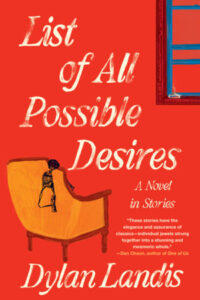
List of All Possible Desires by Dylan Landis is available from SoHo Press, an imprint of Penguin Random House.

Dylan Landis
Dylan Landis is the author of the novel Rainey Royal, a New York Times Editors’ Choice, and the novel in stories Normal People Don’t Live Like This, both in the Rainey Royal Cycle. Her work has appeared in the O. Henry Prize Stories, Best American Nonrequired Reading, and other anthologies. She has received a National Endowment for the Arts fellowship in fiction and lives in Los Angeles.