DIY Creativity: What Conserving Art and Writing Fiction Have in Common
Karma Brown In Praise of Hands-On Experience When Drafting and Researching a Novel
I’m at the Art Gallery of Ontario (AGO), standing beside the workstation of the art conservator who answered my research inquiry a couple months earlier. We’re chatting through the steps involved in restoring a painting, and she shows me the oversized cotton swabs used for testing the many solvents a conservator works with daily.
We’ve just returned from a guided tour of the museum, where she gave me an up-close-and-personal view of paintings she’s helped to restore. Her work is mostly invisible, except to the trained eye, which is precisely the aim of a skilled conservator. As we walk the exhibits she tells me she has three goals when doing conservations: keep the art “stable”; make sure the artist’s materials are preserved; and ensure everything she does to the painting is reversible.
One of the greatest creative opportunities, and responsibilities, a novelist has is to build the book’s world and bring its characters to life.
“There’s a lot of DIY involved,” she says now, explaining that conservators need to be creative and resourceful about tools. Proving the point, she moistens a pull of cotton batting in her mouth, then wraps it around one end of a bamboo skewer. Voilà—a homemade Q-tip.
With visible HVAC, wooden packing crates on dollies, art in various stages of restoration, and an impressive array of microscopes, the work space feels like a mash-up of artist’s studio, science lab, and warehouse. It’s quiet, minus the air filtration system, as conservators hunch, laser-focused, over their projects. It reminds me of being at a writers’ retreat, when a roomful of authors start a sprint and the room goes silent, except for the sound of tapping laptop keys. Much of a conservator’s work, like a writer’s, is isolated, but it’s never in a vacuum. The space buzzes with the energy of collective creativity and collaboration.
As for how I ended up behind the “Staff Only” door at the AGO discussing art conservation, it all started with the great novelist Rebecca Makkai. In a 2023 interview in the New York Times Makkai said she wished she, “…could hear more about the details and peculiarities of characters’ jobs. Not a generically boring office job, but something terribly specific that we don’t normally get to hear about. I want to enjoy a novel and at the same time learn everything about eel fishing or asbestos removal or typewriter repair.” Makkai’s comments stopped me in my tracks.
I had only just begun to scaffold what would become Mother Is Watching—I was at the DIY the Q-tips stage of novel writing. At that point my protagonist, Mathilde (Tilly), was a journalist, which is a job I’ve held. But my enthusiasm for the original premise about a mysterious, haunted painting had stalled, likely because I was about to spend months writing Tilly from a place I knew all too well.
One of the greatest creative opportunities, and responsibilities, a novelist has is to build the book’s world and bring its characters to life. Writers should be inherently curious, and when I read that interview I realized the issue: Tilly, and her job, didn’t pique my curiosity. Worse, that meant I was at risk for not piquing the reader’s curiosity, either. So, I considered other ways into the story and Tilly’s character. I swapped her role as observer (journalist) to active participant, as the art conservator restoring a mysterious painting. That simple decision transformed the book, along with my experience writing it.
I’ve come to see the many similarities between crafting a novel and conserving a great work of art. Both first require observation, as you search for the right way into the story. You must also resist the urge to rush, because that’s when plot holes or the wrong solvent choice can mean a big mess to fix later. There’s detailed research, and specific “tools of the trade.” Typical choices for novelists are notebooks, pens, and laptops, while conservators use brushes, scalpels, and fine sandpaper. There are more eclectic preferences, too. Rumor has it that Danielle Steel uses a vintage typewriter, and James Joyce preferred writing in crayon. For conservators, you might find corks, feathers, and much-coveted porcupine quills at a work bench. Later, I bring the conservator a jar of quills my mom removed from our family dog’s snout, after a run-in with a porcupine 40 years earlier.
I began to view my first draft like a piece of art arriving to the AGO in a wooden packing crate. It already exists, so you’re not creating something from scratch. But it has layers of grime, or holes, that need to be removed or repaired before you can see it clearly. During our many visits, the conservator showed me examples (both her own, and others she didn’t work on) of how it isn’t always possible to restore something to its precise, original state. The goal isn’t perfection, she explained, which is also true for a completed novel on the shelf.
Maybe the ghostly energy of the artist does lives on in the art, the way an author’s imagination remains in the ink on the page.
Over my many meetings with the conservator, we discussed art, the role of women in both our industries, as well as what it’s like to be storytellers and stewards of history. She shared personal experiences, too, like how during the pandemic—when the museum was shuttered for months—she and her colleagues worked in shifts. At times, she was the only conservator on the floor, walking through darkened exhibits at night, like a mother quietly peering in on a sleeping child. It was eerie, she said, being alone with the art like that. That story led me to a central question of my novel, which is, “What if some part of the artist lives forever in her painting?”
In my research into haunted art I came across the Woman in the Rain, painted in 1996 by Ukrainian artist Svetlana Telets. Telets claims the piece took her only about five hours, and that she felt as though someone else was controlling her hand. That painting has been sold, and returned, a few times. Its owners have noted chilling ill effects after the art’s arrival, like insomnia, nightmares, and a sense of being constantly watched. There have also been reports of hearing someone walking through rooms when no one else is home. It’s considered to be one of the most haunted paintings in existence, if you choose to believe in that sort of thing.
Writing Mother Is Watching felt similar to how Telets described her painting. I wrote it quickly and in many ways it felt effortless—a sort of creative fever-dream. Perhaps my research efforts to make Tilly as authentic on the page as the conservator was to me in real life opened some sort of portal. Maybe the ghostly energy of the artist does lives on in the art, the way an author’s imagination remains in the ink on the page. Either way, I don’t expect I’ll ever approach another novel without thinking of Makkai, or of my friend, the art conservator. With a homemade cotton swab or porcupine quill in steadied hand, meticulously searching for the painting’s story so she can bring it—and its artist—back to life.
__________________________________
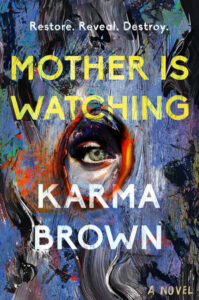
Mother Is Watching by Karma Brown is available from Dutton, an imprint of Penguin Publishing Group, a division of Penguin Random House, LLC.

Karma Brown
Karma Brown is the author of five novels: the #1 international bestseller Recipe for a Perfect Wife, Come Away with Me (a Globe and Mail Best Book of 2015),