Did Jane Austen Invent the Wellness Guy?
Chris Cohen on the Self-Optimization Obsessions of Austen’s Male Characters
Jane Austen was a perceptive observer of male vanity. Oblivious social climbers and heartless rakes got the worst of it, but she was an all-purpose anthropologist of masculine pomposity and self-delusion, up to and including her romantic heroes.
One tool in Austen’s chest was portraying men as excessively fastidious: over-concerned with propriety, moral rectitude, social rank—or sometimes furniture. And even though two centuries have softened many of these Regency considerations, aspects of these types are instructive in our own time. In Pride and Prejudice, the tiresome Mr. Collins and his fussy attention to domestic arrangements ought to send a chill down the spine of every guy with an online shopping habit. He gets all the best gear at the advice of his patroness Lady Catherine de Bourgh then brags about it to Mr. Darcy and everyone else he encounters—substitute “Reddit” or “The Strategist” or “GearLab” for “Lady Catherine” and we’re suddenly up to date.
One figure from these novels that is particularly recognizable in our own time is a middle-aged man who is worried about his health and longevity. He frets over physical activity, he knows the best skincare products, he bores his dinner companions with the details of his diet and doctor visits. Jane Austen anticipated the Wellness Guy, in other words—the podcasters and influencers and authors and doctors who create media, marketed to and largely consumed by men, with advice and inspiration for improving every aspect of daily living for longer, healthier lives.
More precisely, she anticipated their followers: the kind of fellow to structure his daily routines around “protocols” from Andrew Huberman or seek to extend his “healthspan” after reading books by Peter Attia. There’s a growing constellation of media catering to these fixations: the tough-love motivations of former Navy Seal David Goggins, the self-expermentation of Bryan Johnson and his nighttime erection statistics, the bizarre morning bath of chilled Saratoga water from the influencer Ashton Hall. Even a meaningful portion of The Joe Rogan Experience, long the number-one podcast in America, is dedicated to this sort of self-optimization.
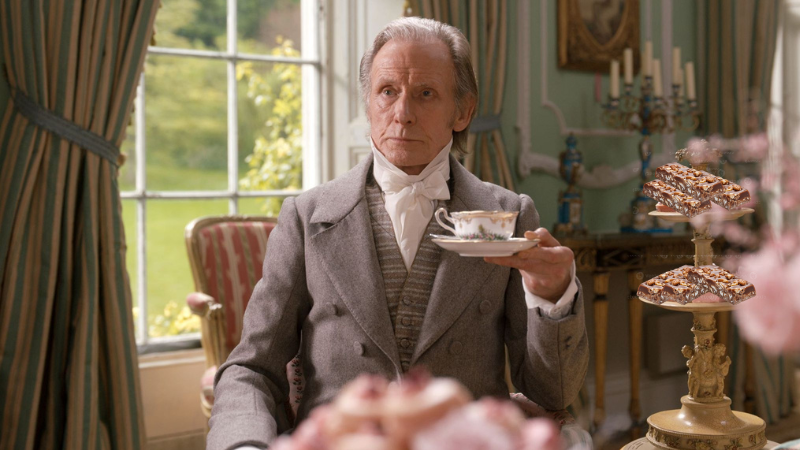
Given the recent primacy in our culture it could be easy to mistake wellness guys for a contemporary phenomenon, but Austen’s characters demonstrate masculine anxieties around health and aging are not a novelty. Consider Mr. Woodhouse, the father of the title character of Emma, whose “own stomach could bear nothing rich” and so bores his dinner guests with advice about diet and the danger of unhealthy activity, like traveling or going too near to the insalubrious seaside. He frets over drafty rooms and the fat in the pan of roast pork. Above all, he eats gruel, and wants everyone else to eat it too: a nice basin of gruel, always thin but not too thin, which is harder for a kitchen staff to prepare than it should be. Imagine if someone told him about intermittent fasting.
It’s a little touching: he’s not just worried about himself, and his concern for his friends and relations seems genuine. But, at least when it comes to Emma, he’s worried about the wrong things: while his daughter needs to grow up and to stop meddling in other people’s lives, she’s a healthy 21-year-old and can probably take a walk on a chilly day without contracting a deadly illness.
A less sympathetic picture comes in Persuasion, in the form of Sir Walter Elliot, a conceited baronet and the indifferent father of the protagonist, Anne. Extravagance and the consequent money troubles force him to rent his estate to an admiral, which brings his family into the society of naval men—including Captain Wentworth, a suitor who Anne was persuaded by her relations to reject eight years ago.
During that time Wentworth has distinguished himself at sea, and become a man of means, but all Sir Walter can talk about is the UV exposure sailors rack up: “It cuts up a man’s youth and vigour most horribly,” he says to Anne—“a sailor grows old sooner than any other man.” He recounts meeting a naval officer, “A certain Admiral Baldwin, the most deplorable-looking personage you can imagine; his face the colour of mahogany, rough and rugged to the last degree; all lines and wrinkles, nine grey hairs of a side, and nothing but a dab of powder at top.” Asked by a friend to guess Baldwin’s age, Sir Walter figures 60 or 62. Turns out he’s 40. Navy life is a hit to a sailor’s biological age.
Sir Walter’s preferred anti-aging protocol is a lotion. “I should recommend Gowland, the constant use of Gowland, during the spring months,” he says to Anne, noting that his young friend Mrs. Clay has used it to erase her freckles. This was a gag: Gowland was notorious at the time of the novel’s writing for its destructive properties—it contained mercury. If this seems like a relic of the patent medicine era of pharmacology, consider that a recent report found alarming amounts of lead in several influencer-favorite plant-based protein powders.
He frets over drafty rooms and the fat in the pan of roast pork. Above all, he eats gruel, and wants everyone else to eat it too: a nice basin of gruel, always thin but not too thin, which is harder for a kitchen staff to prepare than it should be. Imagine if someone told him about intermittent fasting.
But while Gowland’s lotion may have been a net-negative on a gentleman’s healthspan, modern science tells us Sir Walter was certainly correct that excessive UV exposure ages your complexion prematurely, and could shorten your life. The essential flaw of wellness optimizations isn’t always that they’re incorrect—it’s the self-absorption they reveal.
A similar logic holds in our own time, when it’s the affluent that tend to obsess over marginal gains—the “worried well”—even as our systems for nutrition and healthcare fail countless people at a basic level. It’s not that creatine and Ironman triathlons and concierge doctors don’t work to promote longer, healthier lives. It’s that these things tend to be pursued by people who are already pretty healthy, and who have money and time on their hands—a bit like Mr. Woodhouse and Sir Walter. As with much of Austen’s comedy, the description of the health preoccupations of these two fathers is inseparable from her moral vision. Focusing on your health and clinging to your youth doesn’t make you a better person, she seems to say, and it’s certainly not enlightening for your companions.
This allows Austen to weave Sir Walter’s absurd thoughts on aging with other foolish views. The baronet offered his objections to the sailor’s life alongside his objection to naval service “as being the means of bringing persons of obscure birth into undue distinction, and raising men to honours which their fathers and grandfathers never dreamt of.” This opinion is put in its correct place—the kind of thing you’d hear from a guy who would also recommend you rub mercury cream on your face.
The characterization of Mr. Woodhouse is kinder, but the flaw underpinning his health anxieties is still a kind of narcissism: “He could never believe that other people could feel different from himself,” we’re told. “What was unwholesome to him, he regarded as unfit for anybody.” Much of Woodhouse’s disquisitions on health are pitched at the younger generation. It’s clear that Woodhouse has forgotten what it’s like to be young—and thus won’t be much help for the difficulties of Emma’s coming of age.
In Austen’s novels, the young people always have to figure out the big problems of love and life for themselves. The older generations always have advice, but it’s never the solution to the emotional and moral agonies of youth. And at a time when people in their 20s increasingly structure their days around anti-aging and wellness but lag behind in romantic coupling and other measures of vitality, it’s a good reminder: You don’t have to eat the gruel yet.

Chris Cohen
Chris Cohen is a writer based in New York. He was the Wellness Editor at GQ, and has also edited for Saveur, Lucky Peach, and Outside.