Diagnosing Murder: How Addiction Became a Central Motif in Crime Fiction
Theodore Martin Explores the Impact of the War on Drugs on American Literature
The War on Drugs was clearly on the minds of crime novelists in the early 1990s. Patricia Cornwell’s All That Remains (1992) finds medical examiner Kay Scarpetta working for the national drug policy director, “one of the most powerful and admired women in America,” who got her start prosecuting “high-profile drug cases in the federal system.”
Walter Mosley’s White Butterfly (1992) sees detective Easy Rawlins traveling to Oakland, where he observes that there is a “war going on.” James Ellroy’s L.A. Confidential (1990) revolves around a plan by the diabolical police captain Dudley Smith to flood Black neighborhoods with heroin. Lawrence Block’s A Walk Among the Tombstones (1992) tells the story of a private detective hired to investigate the murder of the wife of a drug trafficker. Barbara Neely’s Blanche on the Lam (1992) describes a world in which people “automatically” assume that a Black woman living in New York City must be “a junkie.” Joyce Carol Oates’s Because It Is Bitter, Because It Is My Heart (1990)—a finalist for the National Book Award—finds it necessary to comment on the tragedy of “black men killing one another” in the context of “the drug trade.”
Are they evil or are they sick? While novelists writing in the years of the War on Drugs were asking this question about serial killers, the general public was asking the same question about drug addicts.
These six novels, running the gamut from pulp fiction to literary fiction, have something else in common. All of them are about serial killers. L.A. Confidential includes an extended B-plot (cut completely from the more familiar film adaptation) about a serial killer responsible for a string of unsolved child murders. White Butterfly is about a serial killer targeting Black sex workers in Watts and Oakland. The villain in Blanche on the Lam is a rich white woman who turns out to have been a murderous psychopath since she was a child. Because It Is Bitter features a twelve-year-old sociopath with “heavy-lidded eyes like killers in the movies” who serially accosts “every girl he sights between the approximate ages of twelve and twenty.”
All That Remains revolves around an unidentified serial killer murdering couples in Virginia. A Walk Among the Tombstones centers on a team of serial killers who are butchering the wives and daughters of suspected drug dealers—and who are themselves former DEA agents. This array of Janus-faced novels raises a fascinating question: What did it mean to think of the drug war and the serial killer as two sides of the same story?
It has long been conventional for crime novelists to describe killers using the language of insanity, madness, and mental illness. But in the crime novels of the 1990s, another term keeps cropping up: sick. The murderer in Blanche on the Lam is “sick….Very sick.” In A Walk among the Tombstones, Block’s detective Matt Scudder decides that the serial killers are either “sick…or evil…take your pick.” In L.A. Confidential, the serial killer Douglas Dieterling isn’t mad, he’s “quite physiologically ill. He gets brain inflammations periodically.” The physiological effects of brain inflammation are also mentioned in White Butterfly, where the big reveal about serial killer J.T. Saunders is that he suffers from syphilis, which has affected his brain. As one of Mosley’s characters explains, “VD can make you insane.” Cornwell makes the sickness more literal still. The killer in All That Remains is identified only after it is discovered that he suffers from “aplastic anemia.”
Cornwell had used this device before. In her debut novel Postmortem (1990), Kay Scarpetta finds herself debating the health status of the serial killer she’s pursuing. “He isn’t sick, okay?” Scarpetta insists. “He’s antisocial, he’s evil.” Her colleague disagrees: “Has to be some kind of sickness. He knows he’s sick.” Although Scarpetta wants to cling to a more old-fashioned conception of “evil,” she eventually discovers that her colleague is right. As in All That Remains, the key break in Postmortem comes when Scarpetta discovers that the killer has a rare “metabolic disorder” whose symptoms help identify him. The killer is sick after all, and the medical work of diagnosing that sickness turns out to be inseparable from the process of catching him.
Are they evil or are they sick? While novelists writing in the years of the War on Drugs were asking this question about serial killers, the general public was asking the same question about drug addicts. By the mid 1980s, crime was effectively synonymous with drugs. Yet the conception of drug addiction as a crime was a relatively recent development. Between 1945 and 1978, the dominant tendency in the U.S. was to understand addiction as a public health concern and to give doctors the primary responsibility for managing it. Broadly speaking, the policy response to drug use in the midcentury decades was one of tolerance. A 1971 poll in New York City found that nine out of ten respondents believed that “drug addicts should be treated as sick people, not criminals.” That was about to change.
Over a very brief period of time, treatment-based attitudes toward addiction were replaced by harshly punitive laws criminalizing drug dealers as well as users. In 1986, Time magazine named crack cocaine its “issue of the year.” The same year, policymakers introduced the infamous 100:1 sentencing disparity for crack versus powder cocaine possession. From 1984 to 1990, a full 90 percent of people who received federal mandatory minimum sentences did so for drug offenses. The War on Drugs was now officially under way. One of the enabling forces of that war was the transformation of a health problem—addiction—into a crime problem. Starting in the 1980s, the drug epidemic that decimated so many American cities was treated as an issue of law enforcement rather than an issue of public health. Addiction itself was not officially classified as a disease until 1987. By then it was too late. The doctors had all been swapped out for cops, the treatment centers replaced with prisons.
As the War on Drugs brought the illness of addiction under the oversight of the criminal legal system, crime novelists found themselves compelled to navigate this rapidly shifting terrain of crime and illness. As they did so, they began to notice an unexpected link between the era’s two dominant criminal types, the drug user and the serial killer—literary characters who sometimes seemed to look like mirror images. Cornwell’s All That Remains concludes with the drug policy director shooting the serial killer herself, as if to signal the novelist’s sense that serial killing was now a problem that fell directly under the purview of U.S. drug policy.
In Blanche on the Lam, one of the serial killer’s murder weapons is an empty syringe. As a figure of fear whose criminality was rooted in overlooked forms of sickness, the serial killer became an unexpected double of the addict—and an important limit case in the showdown between crime politics and medical ethics. In A Walk Among the Tombstones, Block makes this doubling crystal clear. Serial killing, the detective surmises, “seems to be addictive, like any strong drug.” In Postmortem, one of Cornwell’s characters describes the serial killer in exactly the same way: “He’s a friggin addict, Doc.”
Yet if the figures of the addict and the serial killer were frequently linked in the era’s crime novels along medical lines, they were as often distinguished along racial ones. Consider the fate of Douglas Dieterling, the serial killer in L.A. Confidential. At the end of Ellroy’s novel, Dieterling is tracked down by LAPD lieutenant Ed Exley—the same cop who, earlier in the book, murdered three innocent Black suspects during a raid. When Exley confronts Dieterling, one surmises that he will murder this suspect, too. But Exley doesn’t kill Dieterling. Instead, he gives the killer his medicine: “Ed threw the pills at him…[Douglas] grabbed them, gagged them down. Ed aimed at his mouth, couldn’t pull the trigger….[Douglas] fell asleep, his lips curled over his gums. Ed looked at his face, tried for some outrage. He still couldn’t kill him.” A page later, Exley drives Dieterling to the Pacific Sanitarium in Malibu Canyon. He has one request for the sanitarium’s director: “That man taken care of on a locked ward for the rest of his life.” In this way, Dieterling becomes a staging-ground for the pivotal (and fateful) choice of the drug war era. Incarceration or hospitalization? Punishment or pills? In the end, Ellroy decides that what Dieterling needs isn’t capital punishment or even prison, just medical care. The “remedy” for Dieterling’s serial murdering is “the proper drugs applied for life.”
L.A. Confidential indicates how the literary character of the psychopath was, in the early 1990s, entangled in a web of crime, race, and illness that had been woven by the drug war. It so happens that the drugs Dieterling is supposed to be taking are manufactured by one Pierce Patchett—a man who turns out to be the city’s main supplier of heroin as well as the mastermind behind the novel’s central mystery, the Nite Owl killings: killings that are not only pinned on innocent Black men but part of a larger conspiracy (it’s a complicated novel) to push Patchett’s “special blend” of heroin into Black neighborhoods in order to “contain” and “sedate” residents. Patchett is the medical establishment and the illicit drug trade all at once; it just depends on where in the city he happens to be standing. Meanwhile, the final secret revealed by the conclusion to L.A. Confidential is that medical treatment is available for some sick people but not for others. Douglas Dieterling, wealthy and white and suffering from periodic “brain inflammation,” gets “the proper drugs” he needs. The three falsely accused Nite Owl suspects—young Black men assumed without evidence to be responsible for drug-related violence, and killed before they can say otherwise—are not so lucky.
The serial killer J.T. Saunders in Mosley’s White Butterfly bears a surprising resemblance to Douglas Dieterling. Both suffer from cerebral swelling (an oddly specific detail). Both require medication to manage their conditions. And both become unexpected objects of sympathy for the detectives pursuing them. The difference in White Butterfly is that Saunders is Black, and in the end he is murdered, not given his medication, by the police. His very different fate significantly reframes how we are prompted to read Mosley’s intervention in the era’s debates about crime and illness. It is no accident that Mosley chose to have Saunders diagnosed with syphilis—a clear reference to the infamous Tuskegee Experiment, the forty-year study run by the United States Public Health Service in which Black men with syphilis were left untreated so that doctors could observe the progression of the disease.
In short, Saunders suffers from precisely the illness that happens to be the single most famous example of the long, shameful history of African Americans’ neglect by the healthcare system. It is not much of a leap to suggest that Mosley wanted his readers to think of the War on Drugs in similar terms: as a cruel experiment in withholding medical treatment from Black communities being ravaged by an illness (addiction) that was being treated as if it were something else—in this case, a crime. Saunders, a Black man suffering from a treatable illness who is instead killed by the cops, sounds a lot like an addict suffering in America’s under-resourced, over-policed urban core.
Published at the height of the drug war—in 1992 alone more than one million people were arrested on drug charges—White Butterfly sought to contextualize the U.S. government’s recent decision to treat addicts as criminals as part of the longer history of the country’s disinclination to offer adequate medical care to Black Americans. The key to this contextualization was, surprisingly, the character type of the serial killer. For Mosley, as for many other crime writers in the early 1990s, the serial killer was a way of parsing both the criminal justice policies and the racial politics involved in determining what it meant to be considered sick, and which groups of people got access to treatment.
As the War on Drugs brought the illness of addiction under the oversight of the criminal legal system, crime novelists found themselves compelled to navigate this rapidly shifting terrain of crime and illness.
Nor was the literary confrontation around this time between addicts and killers, illness and crime, limited to conventional crime novels. It appeared across the spectrum of late-twentieth-century fiction, including in some unlikely places. A good example is Don DeLillo’s famous satire of postmodern life, White Noise (1985). Early in the novel, the book’s narrator and protagonist Jack Gladney learns that his son Heinrich is playing correspondence chess with a “fellow in prison” who killed six people. Jack and Heinrich’s conversation about the killings quickly turns to the topic of “brain chemistry.” As Heinrich explains, “It’s all this activity in the brain and you don’t know what’s you as a person and what’s some neuron that just happens to fire or just happens to misfire. Isn’t that why Tommy Roy killed those people?”
Echoing Ellroy’s reference to “chemical brain imbalance,” DeLillo’s description of a mass murderer’s misfiring neurons and dysregulated brain chemistry similarly indexes how medical and neurological frameworks had begun to remake the popular understanding of criminality. But White Noise isn’t just about the brains of serial killers. It’s also about what happens to brains that are on drugs. The climax of White Noise revolves around the brain chemistry of Jack’s wife Babette, who is secretly taking an unregulated psychopharmaceutical called Dylar. This discovery causes Babette’s daughter Denise to worry, “Is my mother a drug addict?” Jack reassures her: “Your mother is not a drug addict. Dylar is not that kind of medication.” When Jack says that Dylar is “not that kind of medication,” he does not mean that Dylar doesn’t produce addiction. He simply means that it doesn’t produce the particular kind of people—poor, nonwhite—whom Denise associates with the phrase “drug addict.”
Who exactly is “that kind of” person in White Noise? The answer is Willie Mink, the man who illegally sold Babette the Dylar, who is a dealer, an addict, and one of the novel’s only nonwhite characters. A racially coded figure (“his skin was the color of a Planter’s peanut”) who is at once addicted and responsible for the scourge of addiction, Mink is the emblematic villain of the drug war. Jack responds to him accordingly, confronting and shooting Mink in a cheap motel room. Eventually Jack feels some remorse and decides to drive him to a hospital. While driving around looking for an emergency room, Jack says, “I would take whatever they had, even an emergency ward in the worst part of town. This is where we belonged, after all, with the multiple slash wounds, the entry and exit wounds, the blunt instrument wounds, the traumas, the overdoses.”
Having become the kind of person who goes to a motel to murder a drug dealer, Jack now imagines that he “belonged” in the “worst part of town,” by which he clearly means the inner city: a place, he presumes, where emergency clinics treat the steady stream of drug “overdoses” and knife and gunshot “wounds” that characterized the general public’s image of racially segregated urban areas affected by out-of-control drug use. While Heinrich ponders the misfiring neurons in the brain of a mass shooter, Jack’s pursuit of Mink—a character whose skin color and ambiguous ethnicity Jack remarks on repeatedly—leads him directly into the urban teeth of the War on Drugs.
Judging by bestseller lists as well as bookstore shelves, it would be fair to say that, by the start of the 1990s, serial killers had a stranglehold on popular crime fiction. What was the shocking ubiquity of serial killer fiction all about? It has become more or less a commonplace to say that the popularity of serial killer fiction at the end of the twentieth century was the result of something like a cultural “addiction” to “addictive violence.” Yet this overlooks how the politics of addiction actually functioned in the formative decades of the drug war.
In the 1980s and 1990s, the figure of the addict abruptly shifted from being considered deserving of medical treatment to being seen as an emblem of incurable criminality. As this shift took place, the literary figure of the serial killer gave authors as well as readers an opportunity to sift through the public health issues that were deeply entangled with the racial stereotypes of the War on Drugs. With those issues now more vividly in view, we can say that the defining problem of the late-twentieth-century serial killer novel was less that readers were addicted to reading about violent crime, and more that they were swept up in a cultural moment when the very difference between crime and addiction was in the process of being swept away.
__________________________________
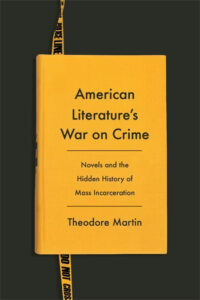
Excerpted from American Literature’s War on Crime: Novels and the Hidden History of Mass Incarceration by Theodore Martin. Copyright © 2026. Available from Columbia University Press. Used by arrangement with the Publisher. All rights reserved.

Theodore Martin
Theodore Martin is associate professor of English at the University of California, Irvine. He is the author of Contemporary Drift: Genre, Historicism, and the Problem of the Present (Columbia University Press, 2017).