Deafness Should Be Allowed to Be Unremarkable
Sara Novic on Hiding Her Deafness in Plain Sight
Accent is dependent upon a variety of factors influencing the speaker’s will and ability to modulate it, including whether the speaker is trying to hear themself against background noise, if they are tired, nervous, angry, or ill. The context and content of the dialogue and its audience, or whether one’s conversational partner has an accent, too, can also play a role. But those who pride themselves on monolingualism tend not to be interested in this nuance, and there’s an even narrower scope of acceptability when disability is at play. In a society that conflates speech with intelligence, the ability to talk can confer privilege, but it also doesn’t change what I can hear now.
I’ve been deaf for more than half my life. I’ve graduated high school, college, graduate school, fallen ill, fallen in love, traveled the world, written books, buried loved ones, given birth, and built my life as a deaf person. Every morning, I wake up deaf. More than that, it’s difficult for me to imagine doing any of these things as a hearing person, much less that being the “preferable” way of having experienced them. It’s hard to convince a hearing person of this, though. To be fair, it was hard to convince me, too, at first.
Fear of deafness (and subsequent bigotries toward deaf people) is often blamed on a lack of “exposure,” meaning hearing people’s limited exposure to us. No doubt this is part of the equation, fear of the unknown being something of a human trademark. In the United States and United Kingdom today, around 1 in 1,000 people are born deaf, meaning a hearing person could go quite a long time, maybe their whole life, without having a meaningful relationship with a deaf person, especially one who speaks a signed language.
Martha’s Vineyard is often upheld in deaf lore as a kind of utopia in a bygone era.
For the same reason, deaf people are also often deprived of exposure to others like them. But what if the ratio were different? How far does the needle have to move to change things? A study of Martha’s Vineyard from the seventeenth to nineteenth centuries suggests the difference is smaller than we might think, and that allowing for deaf people to be in community with one another changes everything.
Popular mythology around Martha’s Vineyard and deafness derives mainly from a set of hypotheses by hearing anthropologist Nora Groce, laid out in her 1985 book, Everyone Here Spoke Sign Language. Groce posits that deaf ancestry on the island can be traced back to a man named Jonathan Lambert, a deaf carpenter who migrated with his family in 1684 as part of a breakoff group of Massachusetts Bay Colonists. Her theory was that Lambert and some of the others could trace their ancestry back to an area of England called the Weald, which itself had a high incidence of deafness and its own signed language—Old Kentish Sign Language.
Perhaps Lambert’s ancestors and others had carried knowledge of the language, as well as the genetic material for hereditary deafness, across the ocean and to the outskirts of the American colonies. Difficulty of travel between the Vineyard and mainland colonies might then establish a relatively static genetic makeup among the island population for nearly a century, resulting in a strain of deafness proliferating with a high rate of expression among the people on-island.
This last notion is at least partially true: While about 1 in 5,700 settlers in the colonies were deaf, on the Vineyard that number was 1 in 155. In the town of Chilmark, at the apex of the island’s deaf population, the numbers were as high as 1 in 25. The result was the development and use of a language known as Chilmark Sign, later coined Martha’s Vineyard Sign Language (MVSL) by Groce, which bloomed on the island and was used by deaf and hearing islanders alike.
This was Groce’s narrative, more or less. The real story is more complicated. As of today, deaf scholars studying the Weald have been unable to verify the existence of Old Kentish Sign Language, or a significant deaf population in the area. And while Groce’s work was groundbreaking, she was also a hearing, non-signing outsider who arrived on the scene to speak to other hearing people, decades after all the fluent signers of the local language had passed. Her notes made no distinction between congenital and acquired deafness, and this, combined with the anonymization of interview subjects and their stories, has made genealogical tracing and interpretation difficult. Groce believed the Vineyard’s deaf population peaked earlier, but recent research into genealogy and migratory patterns suggests the population started and peaked later in the 1850s, further distancing the island deaf from Weald-invoked theories, and underscoring the MVSL as a unique, island-borne creation.
While there is evidence that MVSL was used by both deaf and hearing islanders, allowing for integrated work, worship, and social relationships, the latter group’s degree of fluency is also under scrutiny. It does seem certain that rather than hearing residents interfacing with sign language and deaf people in a patronizing way, deafness and MVSL were unstigmatized facts of island living, especially in Chilmark.
In fairness, given the ratio of population to family size at the time, most folks in Chilmark would have also been related, meaning the fluent hearing signers of the village were likely children, siblings, and parents of deaf people. (Still, this is a marked contrast to the way hearing people behave toward deaf family members today.)
The perception of deafness as neutral rather than a deficit was integral to the success of the community, not only breeding “tolerance” or a feeling among the hearing of being “used to” sharing spaces with us, but overhauling those spaces entirely. Theoretically, mixed-company conversations could be conducted in sign language, but (at least in Groce’s interviews) hearing people reported sometimes also signing without deaf people around. Signed language might also have proven useful for people who made their livelihood out on the water, making communication between land and sea or between fishing boats much easier than the alternative of shouting into the wind.
It’s unlikely that everyone on Martha’s Vineyard signed fluently, and the phenomenon of village-wide sign vocabulary in places with multiple large deaf families has been observed elsewhere, including in Lantz Mills, Virginia; Hillsboro County, Ohio; Lancaster County, Pennsylvania; and Elkhart, Indiana, at around the same time. However, it’s probably also true that on the Vineyard the watery bounds of the community might have left even less room for ableism, especially since MVSL allowed for the inclusion of the deaf in society, creating a cycle in which deaf people could prosper alongside their hearing neighbors. By all accounts deafness was considered a secondary characteristic to someone’s personality or job. Deaf people were respected, integrated members of the community and held positions of leadership—notably a deaf man, Jared Mayhew, founded the island’s first bank.
Martha’s Vineyard is often upheld in deaf lore as a kind of utopia in a bygone era. In the field of disability theory, it is proof that disability is often a social construction, or a clear exemplar of the difference between making accommodations (generally retrofitted) versus building a truly accessible society from the ground up. For others it is a show of human adaptability, or even just a happy and well-timed evolutionary detour. Maybe it’s a little of all these things, with the truth of the island lost to time.
My journaling became actuarial, almost compulsive.
But personally, I like to think of Martha’s Vineyard as a place where deaf people got to be unremarkable, and I find it heartening that this happened even though deaf people were not the majority, not even close. Today, the 1 in 1,000 children born deaf are 0.1 percent of the population, but the Vineyard’s deaf population of 1 in 155 was only 0.6 percent. If half a percent was all it took to transform everything, maybe we are closer than we think. Maybe change like that could happen again.
Back in middle school, though, I was still striving the best I could for unremarkability. My own lack of exposure to other deaf people meant, among other things, an inability to self-advocate, not only from a lack of confidence, but because I didn’t yet know what I needed. I knew my own speech was an important part of the cover story, but voices were increasingly slipping from my grasp. My solution was to assert my intellectual capacity through an aggressive presentation of nerdiness. Even before hearing loss, reading had been my emotional refuge, but now books’ shielding power had also become physical. In classes, I could read a book at my desk right through the lecture and no teacher would bother to stop me.
Writing, too, took on new weight. My mom had long encouraged me to express myself in the form of journaling, and I’d kept some half-finished diaries throughout elementary school. Now, for better or worse, I finally had something to say, so what I felt I could not adequately explain to another person I explained to myself. Over the span of this first real notebook—blue with ballerinas on the cover, the gaucheness of which helped me overcome the literary stage fright I felt when I tried to write upon more appealing stationery—something changed. My journaling became actuarial, almost compulsive. And elsewhere, in a composition book I’d pilfered from a teacher’s stash, I began writing something else completely, stories about people and places I’d invented.
I had a few talented English teachers in a row whose approval I sought eagerly, as can happen when you meet someone older in whom you see a sliver of yourself. English class was also the easiest to prepare for—I could read the stories or novels, and then write down and memorize the comments I wanted to add to the class discussion ahead of time. I threw my weight into these courses, writing and revising my papers, garnering the envy of my peers when a notoriously intimidating teacher drew a star at the top of one of my essays. If voices were untrustworthy, the page was steadfast. A book never covered its mouth or turned its face away, and I could rewrite my lines until the pressure of presenting them to others dissipated, and I’d said exactly what I meant.
But I was still too stubborn and too ashamed to out myself through something as vulnerable as a request for help.
For a while, I found a certain power in the way I’d taught myself to hide in plain sight, took a teenaged pleasure in the way I felt I was pulling one over on others. I’d even devised ways to stay hidden among extracurriculars in the after-school hours, chiefly in the crowd of our large school choir. Music may seem a strange place for me to have run for cover, but I found musicianship mercifully visual; the sheet music and the director feed you the harmonies, the rhythm, the tempo, the volume, and the mood.
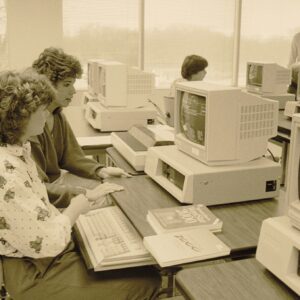
On other afternoons, my hiding was more literal—hours spent in the English department’s utility closet, which served as the “office” for our school newspaper. A boy and I served as co-editors of the paper, titles bestowed upon us because we could write the fastest and reliably remembered to show up to meetings. In the closet, we sat before a behemoth gray IBM, probably old even for the time, and had shouting matches about politics and the Foo Fighters as we populated the fields of our Microsoft Publisher template. Our arguments would flow and ebb as we were drawn back into our editorial duties, which was its own kind of relief.
Keeping my personality buried and my schedule regimented offered me the illusion of control for several years. At home it all might have come to a head sooner, but by the time I’d reached my sophomore year of high school, no one in my family had much time unaccounted for. My sister was a dancer, a serious one, and my mom worked at the studio, holding down the books, teaching acting workshops, and fielding parental angst at the front desk. The two spent all afternoon and into the evening there, while my dad had a long commute and kept increasingly late hours. Though I was bereft of motor skills, I didn’t want to be home alone (or more accurately, I wanted to be more like my mom and sister), so I went to the studio, too.
At the studio, I’d oscillate between the back office, where I’d hole up doing homework, and the classroom, where I’d join in my sister’s classes, despite my being the oldest and worst one there. From time to time, I’d profess that this was my dream, too; occasionally, I’d even convince myself. Seeing how important music and dancing were to my family likely made denying my hearing loss more significant to me than it might have had we been a family of, say, sculptors. I wanted to fit in, and that possibility, if it had ever been there, was slipping away.
Then again—and this cannot be overstated—having always been a terrible dancer, there was really no way hearing loss could have made me any worse. That was its own kind of respite. In a world becoming increasingly difficult to recognize, even being spectacularly bad was an anchor to the way things had always been. In any case, by the time we all got home each night it was late, and there was homework to wrap up and lunches to be made and dinner to be cobbled together (or skipped under cover of fatigue) and we’d circuit through the showers and into bed without much time for a debrief.
As high school progressed, so did my hearing loss, and drifting along with the tide of my coursework turned into treading water. Autodidactism worked well enough for the humanities, but math had grown harder. There were no more microphones or teachers with silly mnemonic devices; the textbooks were all problem sets devoid of explanation. I don’t remember much of those courses, and as it turned out, I never needed to know how to take the derivative of anything once I left school.
But I can visualize one specific afternoon when our calculus teacher invented a set of cheerleading-like gestures to be used synchronously with the order of operations in taking the derivative of long functions, and I felt my eyes well with tears and pulled up the hood of my sweatshirt tight to cover my reddening cheeks. The simple act of making information visual and accessible was enough to send me into a spiral of gratitude and shame.
It should have been a signal flare of how frayed my grip on things had become. But I was still too stubborn and too ashamed to out myself through something as vulnerable as a request for help. And though I know my educational experience is different from that of deaf people who are born deaf or lose their hearing before acquiring language, when I look back on that time, all I see is the amount of energy wasted in trying to keep up with work and appearances, and how little I benefited from the “exposure” to my typical peers that is so touted by those who carry the torch for oralism and mainstreaming, as if their hearing was going to rub off on me.
__________________________________
From Mother Tongue. Used with the permission of the publisher, Random House. Copyright © 2026 by Sara Novic

Sara Nović
Sara Nović is the author of the New York Times bestseller True Biz and Girl at War, which won the American Library Association’s Alex Award and was a finalist for the Los Angeles Times Book Prize. She holds an MFA from Columbia University, where she studied fiction and literary translation, and is an instructor of Deaf studies and creative writing. She lives in Philadelphia with her family.