Dead Matter: On Writing From and Beyond the Archives
chaun webster: “I cannot make the record whole. It was not whole to begin with.”
I’ve read that the American crow will gather around their dead, seemingly performing a kind of funeral rites, looking at the fallen crow and calling out to it in improvised sequence as though enacting a ceremony where they are mourning their loss. Scientists believe this is more likely connected to a kind of record keeping the crows are doing, where they examine the crow that has died, slowly collecting the details of and around its body and urging other crows to do the same, gathering any evidence of the cause to avoid the same end. They make a sonic archive.
This year a text I’ve been working on for ten years is making its way into the world. I was attempting to write about a loss that predated me, whose echo I could still feel. It emerged from an interview with my mother in 2015 where she told me about her father’s twenty-five years of work as a Pullman porter for the Great Northern Railroad and her claim that he retired without pension, dying seven months later. I would spend years just slowly peeling back her words, gathering a birds-eye view as though perched on a branch of a tall tree, trying to make sense of what happened. In time I would interview porters who worked with my grandfather, chasing the archival remains of my dead in employment records, census data, and newspaper clippings.
These absences in what I am able to know from the written record are fissures I try to step into.
Something that never fails to surprise me is the mourning I feel after all the revisions, when the last of the copyedits are finalized and we suddenly have a book. I think it’s a mourning that emerges from the singleness of the book object, the definitiveness of its arrival eclipsing any notion of it being iterative. Recently my editor was talking with a class I teach on publishing and mentioned what some in the industry refer to as a book’s dead matter. As I understand it dead matter is simply the material that has been cut from a text over time, they are its iterations. This designation is hard for me though, to understand a version history as not living, and I’d rather consider the dead matter as what is moaning beneath the text.
I have been looking for several years at a World War I draft registration card for Jerry Lee Clark, my great grandfather. More accurately, I have been looking at a photocopy of it, circling it as though it were outlining a body. The details of the card are written in a cursive that flows against the less elastic serifs of the demographic data questions. I do not know whether he fought in this war or not, I do not know what considerations he may or may not have had about fighting for a country that enslaved his mother and father, only that he complied with the federal law to register for a potential draft.
The archive has dead matter also. These absences in what I am able to know from the written record are fissures I try to step into. He is 28 at the time with his wife Alice and two children the eldest of which is my grandfather Reginald. On the registration card his birthdate is identified as May 4th, 1889. Such a short intervening space after emancipation. On census data this date will stutter between the years 1890, and 1891. The imprecision in his birthdate, which differs from the singularness in the date of his death, feels like an open wound where the dying is more certain than the living. Emancipation was uncertain also.
I seem to be writing more absence than presence, a kind of reverse disappearance with elisions of my own.
He is employed as a porter, the same occupation of his son Reginald years later, the same occupation that I will argue in a book contributes to both of their premature dying. When we get to race in this card’s dry but not objective collection of data, race, where he is urged to specify which and later affirm that his answers are true, he writes africa. This is so deviant from the answers I have looked at over and over on records from this period where it was more common to write negro or colored when identifying race. Race, a biological fiction. Race, a fiction underwritten by material violence. This response would have been noticeably incongruous with the time, and it would certainly be read as the intentions with which it was likely written, as naming a kind of politics. It echoes Marcus Mosiah Garvey’s slogan from the Universal Negro Improvement Association that was gaining momentum while this card was filled out, that “Africa” was “for Africans” and Jerry Lee Clark was not a negro, or a boy, he was an African. Diaspora. To know more than demographic data on Jerry I have had to speculate, reading what is not there as much as what is, I have had to listen for what moans beneath and alongside the text, its grating coos or quiet rambling a sort of dead matter.
I have been wondering, having worked with archives that often only half-tell or miss-tell the lives of my kin if I’m always already writing the dead matter while writing what has been removed from the historical record? I seem to be writing more absence than presence, a kind of reverse disappearance with elisions of my own.
Sometimes I think archival material is treated too preciously. If perseveration of that archival material requires that it be distant from the communities with which its meaning emerges and vibrates, its preservation also signals a type of removal. There is a check I write about in Without Terminus, made out to my grandfather by the Railroad Retirement Board. It is the last check he would receive, and he does not receive it because it is dated for a month after he died. It is the only documentation I have of my grandfather receiving pension, a pension that arrives postmortem. I have requested from the National Archives in Atlanta that the actual check be sent to me and been denied because they only steward the ownership of that document for the Railroad Retirement Board. I own nothing. In this instance the archiving is what enacts the dispossession, it makes the dead matter.
I don’t know how many times I have circled the photocopy of that check, another faint outline of a body, but the details I gather about the conditions that produced my grandfather’s death are not preventative. It still infuriates me, however I have been reconsidering any attachment to that material, and wonder if subconsciously I had been invested in a recovery I don’t actually believe in. I cannot make the record whole. It was not whole to begin with. What I might be able to do is flock with those for whom the material vibrates, examine it and urge others to do the same our heads thrusting up and down with repetitive caws emerging from our throats. And yes, that sound will dissipate and soon will be too faint for my human ears as it is absorbed into space, but Renee Gladman writes that spaces moan. So I will gather the evidence, against the belief that it will put a stop to the premature dying, but a rattle and caw might reverberate and moan as a more proper burial and witness because mourning can be, and must be more than melancholy when dead matter surrounds us.
____________________________
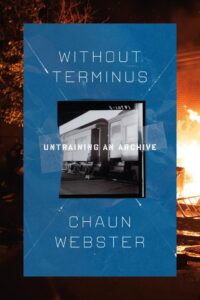
Without Terminus: untraining an archive by chaun webster is available from Graywolf Press.

chaun webster
Work by chaun webster has appeared in the Academy of American Poets’ Poem-a-Day, Angel City Review, Obsidian, The Rumpus, Social Text, and Tilted House. His books Gentry!fication and Wail Song each won a Minnesota Book Award for poetry.