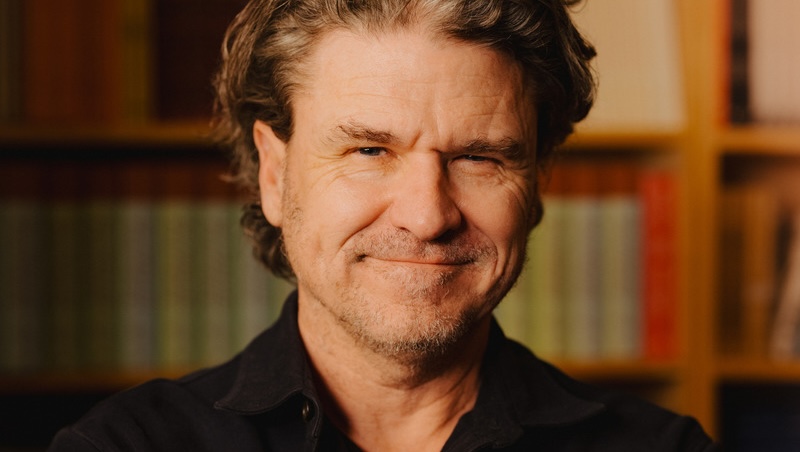
Dave Eggers on Writing a Sprawling Novel of Art and Artists
Jane Ciabattari Talks to the Author of Contrapposto
Dave Eggers’s new novel, Contrapposto, transmits a deep understanding of the impulse to make art—to study, practice, commit to making art on a regular basis, to exhibit and sell your work (or your skills), collaborate with others in the art world, to make its mysteries and practicalities your life. Cricket and Olympia first meet in grade school in a northwest Indiana prairie town. Cricket is drawing two-headed dragons and spaceships, discovering Manet; Olympia is luring him into using his calligraphic skills to deface a playground with vulgar language. So the story begins.
These entwined friends navigate the world for some sixty-five years, reconnecting at the Indiana public university where they study art (and Cricket rebels against the faculty trends); Chicago, where Olympia rescues Cricket from an internship at an art gallery she calls “a hermetically sealed inversion of all that makes life and art worthwhile,” Aliya, the coastal Turkish town where Cricket is scavenging old cruise ships for several years before Olympia tracks him down and lures him into joining her into working for their university art school classmate Kyle Heaney, whose art employs dozens of workers (“…everyone involved….they were all engaged in a kind of factory that made beautiful. unnecessary things that meant very little to anyone who made them”); Phuket, where Cricket makes copies of iconic paintings like Guernica for a shop that includes Kahlo T-shirts and Haring towels…
(Wait! Wait! “You’re giving away all the surprise locations!” Eggers objects: “Now people will know about the Phuket chapter, which is the big reveal for people who love tacky islands full of sunburned Scandinavian men.” Sorry! No more spoilers!)
Olympia disappears, sometimes for years at a time. Cricket drifts far from the contemporary arts scene. Their friendship, with its gossip, theoretical arguments, laughter, and ever reigniting erotic flame, endures: “…he loved her, and would never not love her, she was the only one, she was his greatest friend and also a sorceress and all the world’s storms combined and contained.”
Eggers’s own side gig as a visual artist is evident, from details of artistic training and sophisticated riffs on the art world, to his own drawings, which appear throughout the book. (He prefers to credit Cricket.)
I have no idea why this took so long, but I want to believe that all that time was necessary.
What sort of training did you have in fine art? I asked Eggers. “I started with pretty serious classical training when I was about fourteen, so I know how to approach figure drawing with a kind of academic rigor,” he explained. “For a stretch there all I wanted to be was a painter, and like learning piano or violin as a kid, you never forget how to do it properly. I can still look at most things and get something like a likeness. Especially mammals. Mammals are weirdly easy to get right. And they’ve never complained about my depictions of them, so I assume I was spot-on.”
His return to drawing after a fifteen-year hiatus led to a 2010 show at San Francisco’s Electric Works, “It Is Right to Draw Their Fur” with Talking Heads lead/artist David Byrne, his fellow polymath. Eggers’ book Ungrateful Mammals, was published in 2017. “I’ve sold my own drawings and paintings for about fifteen years now. Not on Kyle’s scale, of course, but to actual humans who buy them from actual galleries (all of this is shocking to me).” A recent set of silkscreen prints supports the International Library of Young Writers, across the street from 826 Valencia in San Francisco.
Contrapposto is intriguing in the ways it consolidates a lifetime of artistic passion. Cricket and Olympia, the characters Eggers has crafted so masterfully, make it irresistible.
*
Jane Ciabattari: When did you first have the idea that evolved into this seven-part novel?
Dave Eggers: I usually take notes for a novel for many, many years before I feel like I know it well enough to begin. In this case, the many years were many, many, many years. Maybe twenty? I have no idea why this took so long, but I want to believe that all that time was necessary.
JC: What inspired this narrative of a long-term relationship that encompasses learning about art, being lovers and friends, working together, exploring the art world in a wide range of historic moments? Is collaborative work in your DNA? (I’m thinking of the magazines and collaborative spaces you’ve founded over the years, for instance, the supportive attention your wife Vendela Vida says you give her work.)
DE: Olympia is much more given to the social and collaborative areas of the art world, while Cricket really struggles with it. For him and for a lot of artists and writers, seeing people experience your work in person—like being at a gallery opening with your own work on the walls and people spilling wine on it—is a kind of hell on earth. So he’s always at a disadvantage, at least in terms of making a living as a painter. For me, I really like the social part; after a book is out in the world, my favorite thing is just to sit and talk to people at the signing table. That part I love. The key for anyone is to be able to figure out that balance between the work you do in your studio and the way that work (and you) interact with the public. You gotta find the balance that keeps you sane.
JC: When did you settle on the title? (Why choose an ancient Greek term that describes a sculptural pose, with the weight on one leg, creating a relaxed realistic balance?)
DE: For a long time, people kept saying to me, “How come you never have titles from the ancient Greek?” So finally I gave in and gave people what they wanted. Happily, the word, a loose translation of which is “counterpositioned,” pretty much describes the two of them, Cricket and Olympia, and how they are both connected but in a tilted, unsteady sort of way.
If you get to make a living by creating pictures, and have found the balance that keeps it fun and human and at the right scale, that’s a very lucky life to lead.
JC: What is the magical element that connects Cricket and Olympia, through all their emotional lows and highs, from out of touch to annoying to sublime?
DE: Devotion.
JC: How do you connect your own evolution as a writer with Cricket’s journey as a visual artist?
DE: I don’t really see any big connection between us. More and more as I wrote, Cricket became very much his own person, and now he feels like an actual person I actually know. His path is very different than my own, but I respect the way he’s gone through the world. He has a certain obstinance that he likes to think is integrity. Maybe it is.
JC: How have you learned so much about the business side of the art world? First-hand experience? Have you ever thought of yourself as having a parallel life as a visual artist?
DE: In general, as an art student and then as a sometime-art writer in the 90s, you pick up some things. And I have many friends who are visual artists, so you get even more information through osmosis. I’ve always been fascinated by the Kyles of the world, who have 100 assistants and operate massive workshops churning out various iterations of their work, often without the artists themselves touching the actual objects. At that point you have to be just as good a manager of people as you are a creator of art—a very rare combination, and one I’m in awe of, actually.
JC: How would you advise a young art student today about making art (and making a living)?
DE: The balance between art and commerce is always the trick, right? How do you make a living, keep the making-of-art pleasurable, without the balance tipping either toward the lonely misery of a Van Gogh, or, on the other hand, the factory-like churn of an industrial-sized studio. I do have plenty of friends who have managed the balance, though. And if you get to make a living by creating pictures, and have found the balance that keeps it fun and human and at the right scale, that’s a very lucky life to lead.
JC: What are you working on now/next?
DE: I’m working on what I think is my first attempt at historical fiction. It’s a short story about the Pan-Pacific International Exhibition here in San Francisco in 1915. They created what I think is the most beautiful mini-city in North America or the entire world, and then tore it down. It was utterly tragic. So the story imagines the Director of Color and Light—based on a real person!—who desperately tries to get the powers that be to let it stand, in the name of beauty and harmony and the rare luck in something coming together perfectly. (Spoiler alert: they tore it down.)
__________________________________
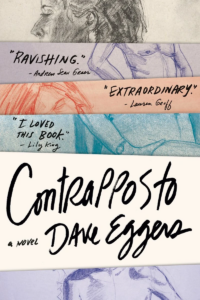
Contrapposto by Dave Eggers is available from Alfred A. Knopf, an imprint of Knopf Doubleday Publishing Group, a division of Penguin Random House, LLC.

Jane Ciabattari
Jane Ciabattari, author of the short story collection Stealing the Fire, is a former National Book Critics Circle president (currently on the Advisory Board ) and a member of the Writers Grotto and Page Street. Her reviews, interviews and cultural criticism have appeared in NPR, BBC Culture, the New York Times Book Review, the Guardian, Bookforum, Paris Review, the Washington Post, Boston Globe, and the Los Angeles Times, among other publications.