Darcey Steinke on the History (and Mystery) of Migraines
Exploring the Many Sides of an Ancient Yet Modern Illness
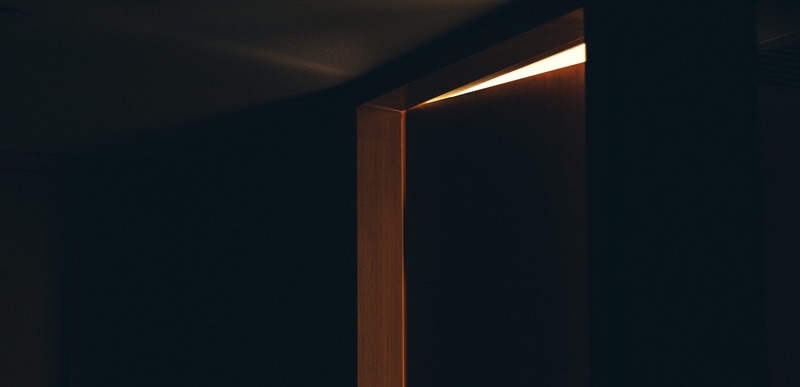
When I was a child and visited my mother’s parents with my family, my grandmother often got a migraine and retreated to her bedroom and shut the door. That door still hovers in my mind, the dark wood; dark, too, around the edges where light usually shone. I understood that on the other side my grandmother was in pain. I knew she was sad, but I could not have told you what I know now, that she had worries that were long-standing and implacable: her and my grandfather’s financial limitations, his drinking, my own family’s instabilities.
Doorways are usually symbols of passage, movement, growth. But the door my grandmother lay behind was like a gravestone, a demarcation between the living and the dead; unable to handle reality, she went over to the other side.
Darwin noted that one of the fight-or-flight responses was sham death, writing that a “passive reaction” to some situations contributed to survival and that “inhibitory states” were “clearly apparent in the animal world.” By inhibitory states, Darwin meant a way of being that slows a creature down and prevents action. The migraine, neurologist Oliver Sacks tells us in his book of the same name, arose over the course of evolution as “a protective measure to those overwhelmed.” A little death to save one from the ultimate one.
Migraines may be more common now because of the pressures of modern life, but they are in no way a new ailment.
More than forty million Americans—nearly 12 percent of the population—suffer migraines. Most migraine episodes start with a visual disturbance, a bright empty spot or a geometrical pattern. Next come sharp head pain, dizziness, and sometimes vomiting. Some sufferers experience only the ocular symptoms without the pain, and others experience only the pain. Migraines may be more common now because of the pressures of modern life, but they are in no way a new ailment.
In an Egyptian medical papyrus called the Ebers papyrus from 1550 BCE, migraines are called “half headaches,” and one remedy includes anointing the head with the skull of a catfish cooked in cumin and juniper berries. In the second century BCE, Galen, the most famous doctor in the Roman empire, called migraines “hemicrania” and suggested they came from an abundance of black bile. The first details of physical symptoms come from Hippocrates in 350 BCE. A man named Phoenix suffered from “flashes in his eyes, usually the right, a terrible pain toward his right temple.”
A few decades after Christ, the celebrated physician Aretaeus of Cappadocia wrote an empathetic case study of his migraine patients, noting that “they flee the light, the darkness soothes their disease…they are, moreover weary of life and wish to die.” The thirteenth-century monk Bartholomaeus Anglicus in his book On the Properties of Things recognized “beating hammers in the head” as a common ailment. His cure: a slew of shallow cuts in the shins to draw off the dark humors and evil spirits. After the cutting, he suggested anointing the head with a mixture of rosewater and the milk from a woman nursing a male child.
Mrs. Corlyon’s “Booke” a 1606 collection of remedies from Great Britain, explained that migraines came from “the opening of the head.” To check whether your head was open, you had to bend over and try to fit your thumb and first two knuckles into the space between your upper and lower teeth. If you couldn’t fit your fingers into your mouth, then your head was open. Luckily there was a home remedy: “Gather your face in your hands—squeeze the face and temple together, so that the fingers meet at the top of the head. Do this as often as is necessary for half an hour at a time.” Just after the American Civil War, people in Pennsylvania were still following the ancient Roman polymath Pliny’s advice to wrap their aching heads with a piece of a hangman’s noose.
By 1873, the English physician Edward Liveing was considering migraines from a more sophisticated perspective. He listed olfactory triggers: turpentine, lilies, roses, and musk. He found dressmakers who stayed up all night finishing party gowns to be particularly susceptible to migraines. One young man was triggered by unique changes in postures: “Stooping, rising too quickly, lifting heavy weights.” Other common triggers were ice-skating and riding in a closed carriage. Liveing believed sleepwalking was also a trigger: “A young lady, who is sometimes in my care, was formerly very subject to walking during sleep. The following day she always suffered terrible headaches.” Weather, particularly strong wind, Liveing reported, might also bring on the inner storm.
Of the dozen migraines I’ve had over my lifetime, stress, not weather, was always the trigger. Unlike the road to other types of pain, which come from damage to flesh and bone, the road to a migraine is mysterious. Migraine triggers fascinate me as they show how fragile the body’s systems are, how easily they can be upended, even by something as everyday and ordinary as weather. For most of the migraineurs I interviewed, not wind but humidity was the culprit. “If the air is heavy,” one woman told me, “I know I will get a migraine.” Another meteorological clairvoyant can predict that it will rain during the night by the growing tightness behind his left eye. The movements of the sun, moon, and planets have historically been linked to migraines. One of Sack’s patients insisted his attacks always came with the full moon, though Sacks wondered whether it was his “stressful fixation” on the full moon itself that brought on an attack.
Besides movements in the planets and fluctuations in weather, less lofty triggers include hormones, strained back muscles, wine, chocolate, fermented foods, dehydration, and lack of sleep. Sleepiness has a sinister aspect for one woman I spoke to. Just before her migraines, she feels something creepy, an “unnatural, irresistible, ominous” drowsiness. For others, the trigger is a good feeling, being hyped-up or excited. “I feel like I have taken amphetamines,” says Carol, another sufferer. If she is too happy or “euphoric” one day, she knows she will have a migraine the next.
Many sufferers have visual triggers. A young therapist I interviewed told me that if she sees any pattern—such as nested V’s or stripes—that she saw the day before, this doubling brings on an eerie feeling that is a prelude to an attack. An unexpected disturbance in the visual field can be a trigger. One man I read about is set off whenever he sees a button fixed to the wrong buttonhole. “This skew in the coat twists in my vision…sets off a distortion which may then spread until it engulfs the greater part of my visual field.”
Poppy, a nursing student, resents that her family feels her migraines are triggered by her going to bed with wet hair. “My mother insists that if I blew-dry my hair, my headaches would vanish.” Poppy is a chronic sufferer who has more than a dozen attacks each month. Darkness is a trigger, but her most common one, she tells me, is “just spacing out.” Whenever she goes into autopilot, she begins to feel a sort of depersonalization that reminds me of my mother’s mysterious journey to her doctor. “Just last week I was walking at night from a friend’s place,” she says. “Though I’d made the journey hundreds of times, suddenly I could not remember the way. Eventually I did find my way to my apartment building; I looked at the number and I knew rationally that it was my building, but it did not feel like my apartment.”
The majority of the sufferers I interviewed listed bright light as a trigger for their migraines. “I have to blow out the votive candle on the restaurant table; otherwise, the light will get inside my head,” says a writer friend. One woman tells me how she had her car windshield tinted because of the glare off of snow, and another says that when she sits outside to eat, she has to have her back to the street because the reflection off car chrome will trigger a migraine. “It’s like I’m suddenly porous,” she tells me, “and the glare outside gets into my head and obliterates my vision.”
Unlike the road to other types of pain, which come from damage to flesh and bone, the road to a migraine is mysterious.
Light was a trigger for Friedrich Nietzsche’s migraines. The philosopher’s epic struggles with headaches led in part to his belief that God was dead, and also to a belief that pain, both physical and emotional, was more generative than health. On bright days, Nietzsche was known to carry a parasol and wear a green-tinted visor and smoked-glass spectacles. On cloudy days, he’d sometimes sit by the sea, as motionless as a lizard. One friend ascribed to Nietzsche “an indescribable strangeness”; in part because of these episodes, he could seem uncanny, “as if he came from a country where no one else lived.”
A doctor prescribed Nietzsche eye drops of atropine, which occurs in deadly Atropa belladonna and other plants of the nightshade family, to calm his eye muscles. Friends reported that his pupils, which doubled in size during an attack, were frightening. But Nietzsche was genial in temperament, and his continuous suffering gave him what another friend called “an almost feminine mildness.” Besides light, the philosopher speculated that electricity was responsible for his attacks: “The electrical pattern in the cloud cover and the effect of the wind: I am convinced that 80 percent of my suffering results from these influences.” When he lived in Italy, he blamed Mount Etna and its volcanic rumblings for his worst symptoms.
“Whoever is the wisest among you,” wrote Nietzsche in his 1883 book Thus Spoke Zarathustra, “is also a mere conflict and cross between plant and ghost.” Human nature is a paradox, with its mixture of vegetative, natural elements and its spiritual or ghostly components. This awkward amalgamation can lead to anxiety. Nietzsche, while working on Zarathustra, suffered from insomnia, indigestion, and migraines. “What is a man?…He is the meaning of the earth, who remains faithful to the earth.” We are not outside of the natural order, but inside it, affected in our very bodies by its extremities.
It was not unusual for Nietzsche to spend nearly forty hours of every two weeks in a dark room. Along with suffering head and eye pain, he also sometimes vomited blood. In letters, he described his pain to friends and said, “My specialty was to endure the extremity of pain with complete lucidity for two to three days in succession.” And while his writing is rife with gratitude to pain—“What makes one heroic is going out to meet at one and the same time one’s highest suffering and one’s highest hope”—he also signed his letters “the one eternally lost.” He submitted himself to treatments that included enemas, meat diets, cupping, salt baths, electrotherapy, massive doses of quinine, and leeches attached to his earlobes, neck, and face.
Nietzsche’s writing is short on somatic details of what his headaches actually felt like. Other sufferers, however, who submitted entries to the 1983 Migraine Art Competition, depicted their pain in drawings and paintings of nails, needles, axes, ice picks, arrows, bolts, jaws, chisels, shivs, guns, red-hot spears, sledgehammers, devils, and long pins. In one drawing, a cap fitted with interior spikes is clamped onto the artist’s skull. A sufferer explains his drawing: “The reason why I show the heart holding a mallet is because when I suffer from a migraine…every heart beat is like a mallet smashing into the inside of my head.” Nietzsche believed that in facing pain directly we find meaning, even transformation. “I love those who do not know how to live except by going under,” Nietzsche wrote, “for they are those who cross over.”
__________________________________
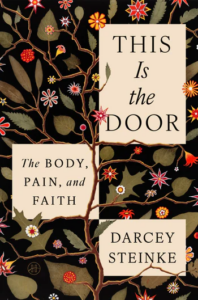
Excerpted from This Is the Door: The Body, Pain, and Faith by Darcey Steinke. Reprinted with permission from HarperOne, an imprint of HarperCollins Publishers. Copyright © 2026.

Darcey Steinke
Darcey Steinke is the author of multiple nonfiction and novels, including her most recent memoir, Flash Count Diary. Her work has been translated into ten languages, and her nonfiction has appeared in the New York Times, The Paris Review, Granta, among many others. She has taught at Columbia University School of the Arts, New York University, Princeton University, and the American University of Paris. She lives with her husband in Brooklyn, New York.