Daisy Hernández on the Myth of Citizenship
In Conversation with Whitney Terrell and V.V. Ganeshananthan on Fiction/Non/Fiction
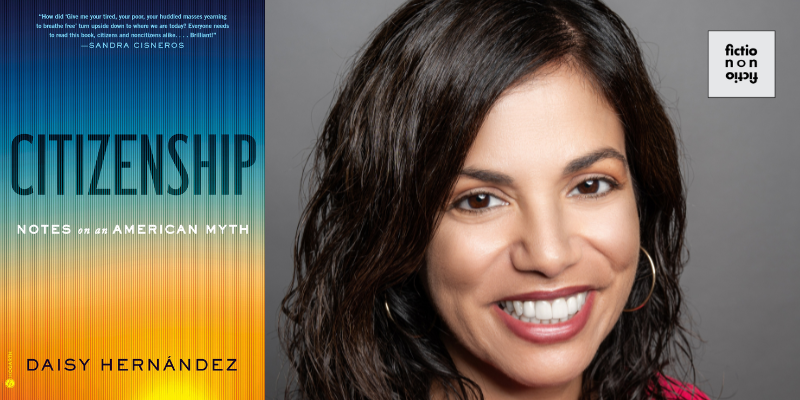
Award-winning author Daisy Hernández joins co-hosts Jennifer Maritza McCauley and Whitney Terrell to talk about her new book, Citizenship: Notes on an American Myth. Hernández explains the history of the term “citizenship” and the damaging power it holds over a wide range of marginalized identities. She reflects on how educators can galvanize change around these issues in the classroom, as well as her own family’s relationship with immigration. Hernández reads from Citizenship.
To hear the full episode, subscribe through iTunes, Google Play, Stitcher, Spotify, or your favorite podcast app (include the forward slashes when searching). You can also listen by streaming from the player below. Check out video versions of our interviews on the Fiction/Non/Fiction Instagram account, the Fiction/Non/Fiction YouTube Channel, and our show website: https://www.fnfpodcast.net/ This podcast is produced by Jennifer Maritza McCauley and Whitney Terrell.
Daisy Hernandez
Citizenship: Notes on an American Myth • The Kissing Bug • A Cup of Water Under My Bed • Colonize This! (2002) • Colonize This! (2019) • Tricycle: The Buddhist Review
Others
Borderlands/La Frontera by Gloria Anzaldúa • Sister Outsider by Audre Lorde • James Baldwin Essays • The Walls Have Eyes: Surviving Migration in the Age of AI by Petra Molnar, foreword by E. Tendayi Achiume • Americans in Waiting by Hiroshi Motomura • Between the World and Me by Ta-Nehisi Coates
EXCERPT FROM A CONVERSATION WITH DAISY HERNANDE
Jennifer Maritza McCauley: Ta-Nehisi Coates talks about the American Dream being a myth and potentially dangerous, and I think that you address many of these ideas in your books. I was wondering how you feel about the American Dream as a concept.
Daisy Hernandez: I also think the American Dream is a myth and a dangerous one.
As you alluded, it’s always being held out as something for you to reach for that’s actually not viable. It also creates divisions among people, this scarcity of “I have to get mine.” There’s actually nothing, at the end of the day, to get because we know that generational wealth makes a huge difference in terms of what your life outcomes will be like, but also the community that you live in. There’s so much that goes into whether you are going to have an opportunity to simply have a college education. Obviously, that’s a huge deal for young people right now who are undocumented and don’t necessarily have access to college or are in college—this has happened here where I teach—and then they’re very anxious about graduating because they’re not going to be able to qualify for jobs. They are qualified, but they won’t qualify simply because of their citizenship status. So what does the American dream mean to an 18-year-old who has a degree from a private, elite university, and yet can’t actually do the work that they were trained to do?
JMM: That’s a great answer. All of these are great answers. So, the chapter on your father, who is from Cuba, is titled “The White Man Who Loved Me.” Could you talk about his attitude toward race and citizenship and how that affects yours?
DH: This was probably the hardest chapter to write in a personal way, because I write very openly about my father being a racist, being anti-Black, and the confusion that I experienced growing up because I saw anyone who was Latino or Latina or Latine as being part of our community. In my mind, you were Latine first, and then everything else came after. But for my father, it was the opposite. So I write about a really heartbreaking moment where I had a love interest in high school. I saw him, this young boy, as being Dominican. I’m Cuban/Colombian, he’s Dominican, that’s how it went in my mind. I was very concerned, because we didn’t go to the same high school, so I didn’t know how much we would have in common after a certain point.
My father saw him as being a young Black teenager, and was verbally violent with him, and kicked him out of our home and this young person, when he called me later, what he was really so upset with was almost not the verbal abuse, but that my father had identified him as being Black. The level of internalized racism was so intense for all of us. That has always really stayed with me.
That particular essay was sorting through what racial categories mean for Latinx folks in the United States and it comes up every 10 years, very forcefully, in terms of the census. I also write about the first Trump administration’s efforts to include the citizenship question on the census as a way to basically diminish the number of Latinx that would be included in the census count altogether. And hopefully the idea was that it would lead to more electoral power for them, but it’s a huge question, the racism that we haven’t acknowledged within our own diaspora. I was sorting through that on my own as well as racial ambiguity; people think I’m all sorts of different ethnicities and even races.
Whitney Terrell: I wanted to talk, also, about the craft of how this book was put together, and the writing of it. Jennifer is at AWP, doing the hard work for all of us, of representing K.C. and talking to writers while I’m here, napping in my bed. But, this book is very interesting. Structurally, you have this mixture of very personal anecdotes, then you shift and suddenly you’re talking about someone from the 1700s or the 1800s and or you’re talking about federal law. So, you’re moving in between this narrow focused way of talking about your specific life, and then a much, much broader lens. I wondered if the book was always structured that way, and how you decided you were going to do it that way. What was, what was your original conception of how this book came together? Sometimes I don’t start doing what I think I’ll end up doing. I don’t know if you started with that idea or it matured during the time of your writing.
DH: I definitely began with that idea. I’ve always been deeply inspired by the works of James Baldwin and Audre Lorde—Sister Outsider, in particular, Audre Lorde’s essays, and all of James Baldwin’s essays, I often teach his work—I feel like they are both such master/mistresses of moving from the very personal, the very intimate, to that larger political and historical context that they were living through and reflecting on. So, it feels pretty intuitive. Sometimes, the big question for me is, “Will readers follow me when I’m making these associative leaps?” I did want this book to reach a very broad audience, so I’m not very experimental. I make it really clear we are now shifting, as you said, “We are now shifting to the 1700s, here’s how we’re doing it.” I provided a lot more connective tissue than I would have if I wanted a more experimental work. This is something that I talk about a lot with my students—I teach in both an MFA program and an undergrad creative writing program—that a decision you’re going to have to make is how much work you want your readers to do with your book or with your standalone essay.
Then, of course, Gloria Anzaldúa, whose quote I use as an epigraph. I was so deeply influenced by her books, especially Borderlands, where she moves, between languages, and even between nonfiction practices, where she moves from writing something that is a political critique to then writing something that’s about the soul and about spiritual life. She’s a huge influence as well.
Transcribed by Otter.ai. Condensed and edited by Rebecca Kilroy. Photograph of Daisy Hernández by Diana Solis.

Fiction Non Fiction
Hosted by Whitney Terrell and V.V. Ganeshananthan, Fiction/Non/Fiction interprets current events through the lens of literature, and features conversations with writers of all stripes, from novelists and poets to journalists and essayists.