Crying in the Multiverse: On the Potential of Possibility as a Literary Device
Genevieve DeGuzman Channels Grief and Loss Into Imagining Other Worlds
When my mother died of cancer in 2023, the grief turned my mind into a speculative machine. For some time, I kept wondering about what choices we could have made differently for her care. I felt haunted by what was left unsaid and unfinished.
Artists have always lamented this. Faced with mortality and in the search for meaning beyond our inevitable death, we wonder about the lives we didn’t choose, paths not taken, promises fumbled and left unfulfilled. The problem is we don’t get do-overs; life isn’t an orderly experiment we can run, comparing life A with life B. In his novel Light Years, James Salter understands this: “For whatever we do, even whatever we do not do prevents us from doing its opposite. Acts demolish their alternatives, that is the paradox.” What greater despair is there than to believe we are living our one life—and it might be the wrong one? The novelist Branch Cabell warned “the optimist proclaims that we live in the best of all possible worlds; and the pessimist fears this is true.”
While we might not be able to live out those other lives, they actually might exist after all. Philosophers first considered the idea of alternate worlds. Gottfired Leibniz, a contemporary of Isaac Newton, coined that phrase “the best of all possible worlds” in attempting to understand good versus evil and free will. He argued that in any world a person’s actions had fixed consequences, but in another world, a person might act differently because their lives would be different.
In the hands of writers, the chaos of the multiverse becomes a source of solace.
By the early twentieth century, the notion of the multiverse was emerging, moving away from theology and tangling with quantum physics and cats. In the famous thought-experiment, Erwin Schrödinger asked us to imagine a cat placed inside a box with a radioactive atom that might or might not kill it. Before we check the box to find out its fate, the cat theoretically exists in a state of “superposition”—it is both dead and alive. In the 1950s, Hugh Everett theorized that all objects in the universe could exist in continuous superposition. The multiverse theory picked up steam when Bryce DeWitt started writing the “many worlds interpretation” (MWI) of physics. From MWI, the multiverse solidified into the concept that all possible worlds that could exist actually do exist—and the one we know and live out is just one of many.
Channeling the multiverse in art is about finding access points to what would otherwise be lost forever. Vanessa Angélica Villarreal’s in Magical/Realism: Essays on Music, Memory, Fantasy, and Borders calls this speculative approach a way to be in conversation with silences and familial memory that we might otherwise have little access to. Consider the Back to the Future films, which delve into salvaging a reality by entering a new one, or the Oscar-winning film Everything Everywhere All at Once, where characters hopscotch through the multiverse, tapping into the knowledge and experiences other versions of themselves have.
In the hands of writers, the chaos of the multiverse becomes a source of solace. In the novel The Midnight Library, Matt Haig tells the story of Nora, a depressed woman beset by her life and its disappointments. One night, contemplating suicide, she finds herself inside a strange library. Instead of checking out books, she checks out different life scenarios where she made other choices.
The multiverse in poetry in no less imaginative about dealing with grief and loss. In the poem titled “in another string of the multiverse, perhaps,” Michaella Batten grapples with faith and sexuality, presenting us different realities where she challenges her upbringing of religious devotion. In Aster of Ceremonies, JJJJJerome Ellis, a Black and disabled poet, imagines alternative histories where oppressed groups find freedom and take back a “stolen will.” Going beyond linear time, writers can collapse memory, historical facts, folklore, and even imagined narratives into a new kind of revelation.
In my collection, Karaoke at the End of the World, I used the multiverse as a way to understand my grief around my mother’s death. Here were poems that pinwheeled through galaxies with an array of strange speakers who were similarly devastated. The voices were disembodied, extinct, ancient, alien, animal, or robot because it took a polyphonic cast of characters to help me circle and confront the experience of my mother’s death.
Gretchen Walkwell does something similar in Lexicon of Future Selves, a collection that channels characters from films like The Matrix, Avatar, and Blade Runner to reflect on the volatility of identity in the face of an uncertain world.
While facts only recount death and grief at face value, the multiverse offers more imaginative runway.
Brenda Shaughnessy is a poet who delves deeply into the imaginative wellspring of the multiverse for comfort and reckoning too. In The Octopus Museum, she takes us to a future reality where earth is now run by Cephalopod Octopoid Overlords, and where humans are relegated to historical curiosities, tragic specimens living in exhibits. In Our Andromeda, Shaughnessy goes into full multiverse mode, trying out new life paths. She writes a series of poems titled “To My Younger Self,” where she addresses herself at various ages, including future selves.
Italo Calvino once bemoaned the weight of the biographical self, the reductiveness of facts. While facts only recount death and grief at face value, the multiverse offers more imaginative runway. Invention might seem strange; reimagining my mother and myself across the multiverse meant I took liberties with setting and place. In my collection, I created a fragmented narrative of a post-human robot, who nevertheless pines for “Mother” and human connection. The thinking goes: my mother and I no longer exist as we did, but here are these alternative daughters and mothers in the multiverse that still do. Those repurposed memories and alternative personas frees us to express those griefs, regrets, and longings in novel ways.
Grief isn’t a linear, single track, but rather a metamorphic, living spiral. It snarls and wiggles; it backtracks and transforms. If the elegy is the traditional literary form for grief that’s supposed to “return the grieving, living speaker to life at the end,” as the poet Elisa Gonzalez has said, it needs more than one, direct route. Our universe began with the Big Bang. And so it is in grief. If it gives birth to the multiverse, it can be one answer to the rupture of death, letting us reach all our selves, not unlike the Evelyn character in Everything Everywhere All at Once. In that story, the discovery of her other lives is the way she battles both the villains and her inner demons. She makes peace with her daughter—and most importantly finds comfort in the here and now.
__________________________________
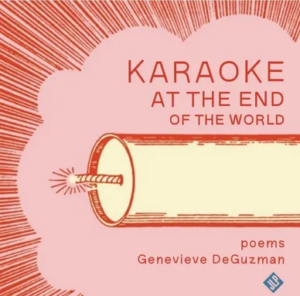
Karaoke at the End of the World by Genevieve DeGuzman is available from JackLeg Press.
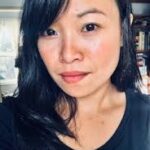
Genevieve DeGuzman
Genevieve DeGuzman is a poet and writer based in Portland, OR. She is the author of Karaoke at the End of the World (JackLeg Press).