Crony Henry, Daddy Henry, Lady Henry, Henry Incinerator: Seven Poetry Books to Read This December
Christopher Spaide Recommends New Collections From D.M. Aderibigbe, Nadia Alexis, John Berryman and More
I’m well aware that, culturally speaking, I’m supposed to care about December: month of countdowns and gift guides, of year-end lists and the sorts of last-minute, life-changing releases than instantly render year-end lists obsolete. But the end of a calendar year has always struck me as a subject too blandly average for the extreme immensities and brevities of poetry, an art that, in William Blake’s immortal boast, can claim “To see a World in a Grain of Sand / And a Heaven in a Wild Flower.” Take my favorite end-of-the-year poem, Thomas Hardy’s “The Darkling Thrush.” It’s really an end-of-the-century poem; dated “31 December 1900,” it imagines the nineteenth century as dead but far from buried: “The land’s sharp features seemed to be / The Century’s corpse outleant”—leaning out of its coffin, that is. The same poem pivots on the song of a nothing-special bird, not a legendary albatross nor a mythic nightingale but “An aged thrush, frail, gaunt, and small, / In blast-beruffled plume,” choosing “to fling his soul / Upon the growing gloom.” You can keep your lists of the year’s best albums and movies, its fiction and nonfiction: I’ll stick with poems, which can bound from zombified centuries to scrappy birds in a few lilting lines.
In this scale-defying, chronology-contorting spirit, my last list of poetry for 2025 gathers books published at the year’s end alongside books released earlier this year—some I found belatedly after attending readings and leafing through journals, others that proved inexhaustible after months of rereading. It doesn’t include the year’s most recently lauded books, such as Patricia Smith’s National Book Award-winning The Intentions of Thunder: New and Selected Poems (written up by my collaborator Rebecca Morgan Frank in her September column), or one of the joint winners of the 2025 Forward Prize for Best Collection, Karen Solie’s Wellwater (which features in my April column).
And it doesn’t include the other joint winner of the year’s Forward Prize for Best Collection: Avidyā (Bloodaxe), the third collection by my friend and former colleague Vidyan Ravinthiran. I’ve been itching to see it in print since first reading the dramatic monologue “Lasantha Wickrematunge,” the book’s unclassifiable centerpiece, which interleaves quotations from the assassinated Sri Lankan journalist of its title with Ravinthiran’s frame-breaking inventions: “Those are my words: / this / is something else—.” I first read the poem in Poetry London, back in 2021. Sometimes, it turns out, the best poetry of the year is four years old.
*
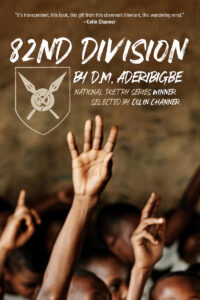
D.M. Aderibigbe, 82nd Division (Akashic Press)
Born in Nigeria, now based in the United States, D.M. Aderibigbe names his second collection after a World War II-era division of the British Army, consisting entirely of forcibly conscripted West Africans. To give voice to those soldiers, Aderbigbige’s title sequence “82nd Division” adopts his own regimented, globe-spanning form: a sonnet crown, something like a paper chain of sonnets, with each sonnet’s last line recycled as the first line of the next (and the last sonnet’s last line wrapping back around to match the first sonnet’s first line). Aderibigbe’s rendition declares its literary debts—from the English soldier-poet Wilfred Owen to the contemporary Black American poet Natasha Trethewey—but its plainspoken musicality and time-traveling correspondences belong to no one but Aderibigbe: “At every turn of thought, I hear / his words: He’ll be useful. He knows English.” (Is that Aderibigbe’s historical speaker, in September 1943, or is it Aderibigbe himself? Who knows English and its obscurest uses better than a poet as accomplished as he?)
Chosen by Colin Channer for the National Poetry Series, Aderibigbe’s second collection plays countless variations on the theme of how to make received forms and imposed divisions your own. Half of the collection’s poems measure themselves up against traditional genres, named in their titles (“Autobiography,” “Failed Elegy,” “Postcolonial Prayer”), or transplant forms from the world over to Nigeria: the Arabic ghazal, the Japanese haibun, the American blues, even twenty-first-century contraptions like Jericho Brown’s duplex. Overhanging the book’s personal and historical losses—the deaths of a mother and a grandmother, colonial violence freshly reenacted on the page—are the paradoxical losses brought about by Aderibigbe’s prodigious poetic gifts. As he explains in the ghazal “English,” the very culture-crossing art that carries Aderibigbe to his grateful readers leads him away from the past: “On mother’s proud days, I was the dictionary on which she relied— / D.M., a name I found, shortly after her death, through English.”

Nadia Alexis, Beyond the Watershed (CavanKerry Press)
I first encountered the poetry and photography of Nadia Alexis when she gave a mesmerizing reading for my university’s students and faculty, which means that I also saw firsthand a central subject of her debut Beyond the Watershed: the self seen not in isolation but interfused with its surroundings, material and spiritual, human and otherwise. In “Self-Portrait as a Father’s Daughter,” a young girl and her grocery-bagging Daddy mutually “avoid meeting eyes”; only the more mature, distanced Alexis can keep the full, abashed family in view. “Self-Portrait at the Dominican Hair Salon” opens on a “selfie,” the self-portrait at its most admiring extreme. But as the poet’s eye takes in the pigeons outside, the salon’s benevolent air conditioner, and the heaven-sent hairstylists around her (“I think I hear / someone say you deserve comfort”), Alexis’s lines relax and spread across the page.
Alexis’s most intricate experiments in self-plus-others-portraiture combine her two chosen media, which she arranges on facing pages. On the left: a photograph of a blurred womanly figure, her white dress smeared into an avian or angelic wingspan, her head eerily effaced, allowing the forest behind her to show sharply through. On the right: one of Alexis’s six interlinked prayers to the Haitian Vodou lwa (or spirit) Èzili Dantò, a protective maternal force. Between these two poles—grounded and transcendent, transient and eternal—Alexis finds a space for herself, for fellow survivors of domestic violence, and for Black women gathering together under a plural pronoun, “we.” As Alexis puts it in a line that recalls, and newly sanctifies, Audre Lorde’s refrain “we were never meant to survive” (“A Litany for Survival”): “we are given powers we never asked for.”
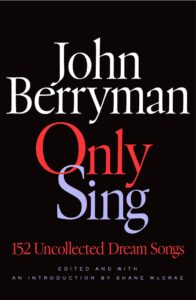
John Berryman, Only Sing: 152 Uncollected Dream Songs, edited and with an introduction by Shane McCrae (Farrar, Straus and Giroux)
Every element of John Berryman’s magnum opus The Dream Songs (1969) is odd, right down to the odd exactitude of how he packaged and published them. The first batch arrived in the Pulitzer-winning collection 77 Dream Songs (1964), the specific number of poems recalling a slot-machine jackpot, 7-7-7, just fallen short of: what a fitting result for Henry, the sequence’s chronically luckless protagonist. Four years later, Berryman published a book exactly four times as long, His Toy, His Dream, His Rest (1968), bringing the grand total of collected Dream Songs up to 385—a number so odd, it doesn’t have a Wikipedia page.
At least since John Haffenden edited the posthumous collection Henry’s Fate & Other Poems, 1967–1972 (1977), readers have known that, in Haffenden’s words, “There are several hundred unpublished Dream Songs, and as many more miscellaneous poems.” With Only Sing, transcribed and edited by the poet Shane McCrae, a book’s worth of uncollected Dream Songs is finally seeing publication. Over half a century on, the Dream Songs appear only more elusive, their laughable blackface personae and malfunctioning dream logic even harder to explain. At the same time it’s oddly comforting to reacquaint oneself with the much-traveled Henry—or, to quote a few of the dozen-odd mock-epic epithets strewn about Only Sing, “Crony Henry,” “Daddy Henry,” “Lady Henry,” and “Henry Incinerator.” And there are few craftsmen in modern American poetry who could match Berryman tinkering with his drafts, who could write a pentameter line as concise and capacious as an epitaph: “Abrupt & brainy, Henry did his best.”
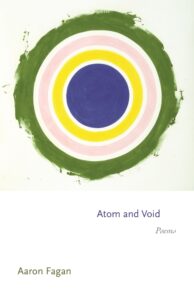
Aaron Fagan, Atom and Void (Princeton University Press)
“A friend shares the same story differently every time we meet. / All of them are my favorite version.” These lines, from the first poem in Aaron Fagan’s Atom and Void, sound an auspicious note for a book centered on that centuries-old, ever-ubiquitous, recession-proof story: the sonnet. Fagan’s fifty-five sonnets share a length (fourteen lines, standard-issue), a commitment to rectangularity (equal-length lines, no white space), and a stance on rhyme schemes (thanks but no thanks). But that’s all: even width-wise, Fagan’s sonnets balloon and scrunch up, ranging from page-spanning lines to the single swan-diving sentence of “Deepfake,” which ought to be quoted entire:
Once you
Realize you
Cannot be
Anything
More than
Who you
Already are,
Why would
You ever
Want to
Let anyone
Know who
You have
Always been?
Page by page, Fagan manipulates the sonnet with a close-up magician’s sleight of hand. Before your eyes, he’ll transform a sonnet into a coked-up shaggy-dog story, a meditation on a drive-in viewing of a Netflix exclusive movie, or even a macabre recipe for invisibility (step one: “Acquire the severed head of a man who has committed suicide”). Not every sonnet can break ground, but why should it: in life as in sonnets, there’s “Still nothing new under / The old chaos of the sun” (that last line, borrowed from old Wallace Stevens, is itself nothing new). In that sense, the sonnet suits the middle-aged recurrences and degradations Fagan describes in “Signs of Things to Come” as “Echoes of echoes,” “Video copy of a copy until / Only white noise remains.” For Dante Gabriel Rossetti, the sonnet was “a moment’s monument”; for Fagan, the sonnet instead monumentalizes a moment’s accumulating redundancy, its breathtaking obsolescence: “I no longer get the book / That changed my life.”
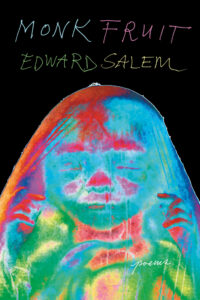
Edward Salem, Monk Fruit (Nightboat Books)
There’s still a month to go in 2025, but there’s no question: the most memorable poem I read in a journal all year was “My Aerodynamics,” from the spring 2025 issue of the Paris Review. The poet, Edward Salem, was new to me; the poem, impossible to place for long. “As I fell from the sky, I smelled fish,” it began, at the crossroads of two traditions of the absurd, part Samuel Beckett monologue, part Wile E. Coyote mid-fall. As the poem and its fall continued, the poem’s bumbling, tumbling “I” plummeted from one genre to the next, from tired schtick—“I actually / fell, harhar, asleep”—to the unembellished testimony at its close: “I missed our home. / I missed smoking. I accepted // I’d never leave this blue prison.”
When I tracked down Salem’s 2025 debut Monk Fruit, I learned that “My Aerodynamics” was a faultless introduction to several of Salem’s distinctive techniques: the deadpan, end-stopped lines; the tonal modulations tucked inside equal-sized stanzas; the commitment to the bit (see how, in “My Aerodynamics,” that opening word “fell” gives Salem a plot, punning possibilities, and a fleet of alliterating f-words). But it was also an outlier in a book more often grounded on our brazen, bloodstained planet, a book whose chief subjects include Salem’s disregarded hometown of Detroit, the genocide of Palestinians and rhyming horrors across history, all the language that offends upstanding audiences and all the violence that apparently doesn’t. For that last subject, see “Curb Your Enthusiasm,” a poem lifting its title and conceit from Larry David’s HBO show of the same name. It needs only three stanzas to slip from physical comedy to collective tragedy to individual trauma:
I find myself hovering my phone
before my torso while peeing
looking at
(insert genocidal image here).
I’ve saved the ones I haven’t
memorized yet to my phone.
But I’ve memorized a lot of them.
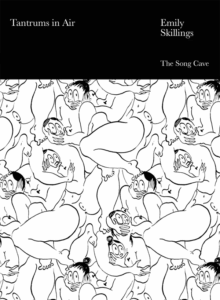
Emily Skillings, Tantrums in Air (The Song Cave)
It’s 2025: what does the self have to say for itself anymore? This year, no poetry renewed my faith in that well-worn mode, autobiography, more than Emily Skillings’s second collection Tantrums in Air. Many Skillings poems start with familiar gambits of cracking the self open: childhood memories, blurted admissions, dreams retold. But midsentence, Skillings will veer from confessionalism to campy and cartoonish performances of feminine subjectivity, less Anne Sexton than Amy Sedaris: “Ever since I was a little girl / I’ve always wanted to yell, ‘My leg! / My leg!’ after a great accident.” Other Skillings poems, scrutinizing the self from the outside in, adopt twenty-first-century forms, like the rubegoldbergian skincare routine or the one-star review, taken directly from an Amazon review of her first book Fort Not (“A Potentially Good Book Soaked in Offensive Perfume”).
Tantrums in Air exhibits the convolutions of translating life into art for a generation of poets who teach art to pay rent, who write poems about dreaming about writing poems, and who express themselves by giving James Schuyler’s poetry to guys who up and write Schuyleresque poems for other women. (What would Schuyler say? How about this, from “This Dark Apartment”: “Goodbye. It’s / mysterious and frustrating.”) It’s a book by an Emily who might title a poem “Emily”—only for the first poet to show up to be that other poetic Emily, Emily Dickinson. The more you read, the harder it is to tell the two apart, and the less it seems to matter.
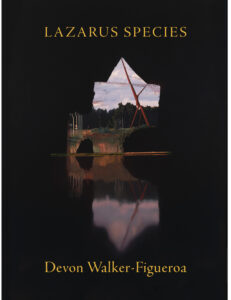
Devon Walker-Figueroa, Lazarus Species (Milkweed Editions)
I know few compliments in contemporary poetry criticism quite as ubiquitous as breathlessly telling a poet no one else could write what you write. Ultimately, there’s no compliment quite as hollow: just because no one else could write what you write doesn’t mean that you should write that way either. So it’s a rare surprise when the compliment carries real weight, when a poem appears that’s at once the inimitable product of an idiosyncratic mind and a public good for poetry generally. Reading Devon Walker-Figueroa’s second collection Lazarus Species, I felt that surprise in poem after poem; you might feel it simply from hearing about it.
No one but Walker-Figueroa would explore the long history of stargazing by rewriting Sir Philip Sidney’s sonnet sequence Astrophil and Stella as “Australopitheca & Starman,” in which the Australopithecus afarensis fossil commonly nicknamed “Lucy” addresses the mannequin known as Starman, who’s currently orbiting the sun in Elon Musk’s Tesla Roadster. No one but Walker-Figueroa would take the recent vogue for the sestina, a form that obsessively repeats the same six end-words, to its mind-numbing conclusion by writing a super-sized, seven-end-word variation called “The Euthanasia Coaster,” inspired by a hypothetical roller coaster that loop-de-loops its passengers into “euthanasia- / induced euphoria.” Walker-Figueroa’s excesses at every scale—her phoneme-braiding lines, her conceits stacked on conceits, this extravagantly long collection—mirror the intricacies she finds abundantly in natural biodiversity and human ingenuity. They’re also defense mechanisms in an inhospitable world, as in Walker-Figueroa’s title poem, named after species that return to life after apparent extinction: “You don’t even need to be born / again in order to be born against / this riddled wall, each bayonet in love / with your bare, stigmatic neck.”

Christopher Spaide
Christopher Spaide is an Assistant Professor of English at the University of Southern Mississippi. His academic writing on modern and contemporary poetry (as well as music and comics) appears in American Literary History, The Cambridge Quarterly, College Literature, Contemporary Literature, ELH, The Wallace Stevens Journal, and several edited collections. His essays and reviews and his poems appear in The Boston Globe, Boston Review, Lana Turner, The Nation, The New Yorker, Ploughshares, Poetry, Slate, and The Yale Review, and he has been a poetry columnist for the Poetry Foundation and LitHub. He has received fellowships from the Fox Center for Humanistic Inquiry at Emory University, the Harvard Society of Fellows, the James Merrill House, and the Keasbey Foundation; for his academic writing and criticism, he has received prizes from Post45 and The Sewanee Review. Currently, he serves as the Secretary for The Wallace Stevens Society. He is the literary executor for Helen Vendler.