Correspondence Versus Connection: Raymond de Borja Reflects on Language, Poetry, and Friendship
“I may not be a better poet when I am in love, but I am a far less frustrated one.”
“Things do not connect; they correspond,” writes Jack Spicer in his letter to the dead Federico Garcia Lorca.
Things do not connect; they correspond—two independent clauses that echo recurring aspects in my work: 1.) A preference for correspondences of things over connections of things, which I practice in collage work, and 2.) Correspondence, as in the correspondence between or among people engaged in various conversations. This pun on correspond is quite salient in After Lorca, in its humor and estrangement, as Spicer channels the dead Lorca to write the preface for his book. Here is a part of the preface:
Frankly I was quite surprised when Mr. Spicer asked me to write an introduction to this volume. My reaction to the manuscript he sent me (and to the series of letters that are now a part of it) was and is fundamentally unsympathetic. It seems to me the waste of a considerable talent on something which is not worth doing. However, I have been removed from all contact with poetry for the last twenty years. The younger generation of poets may view with pleasure Mr. Spicer’s execution of what seems to me a difficult and unrewarding task.
It must be clear at the start that these poems are not translations. In even the most literal of them Mr. Spicer seems to derive pleasure in inserting or substituting one or two words which completely change the mood and often the meaning of the poem as I had written it.
More often he takes one of my poems and adjoins to half of it half of his own, giving rather the effect of an unwilling centaur. (Modesty forbids me to speculate which end of the animal is mine.)
And here is the excerpt from which the epigraph “Things do not connect; they correspond” is taken:
Dear Lorca,
[…]
Things do not connect; they correspond. That is what makes it possible for a poet to translate real objects, to bring them across language as easily as he can bring then across time. That tree you saw in Spain is a tree I could never have seen in California, that lemon has a different smell and a different taste, BUT the answer is this – every place and every time has a real object to correspond with your real object – that lemon may become this lemon, or it may even become this piece of seaweed, or this particular color of gray in this ocean. One does not need to imagine that lemon; one needs to discover it.
Even these letters. They correspond with something (I don’t know what) that you have written (perhaps as unapparently as that lemon corresponds to this piece of seaweed) and, in turn, some future poet will write something which corresponds to them. That is how we dead men write to each other.
My keenness to talk about friendship is manifold. In a creative sense, I am grateful to a number of friends for the writing and the visual art work that I do. My work is heavily dependent on prompts and encounters, mostly chance encounters through heard language, conversations, interesting material, and also through willed encounters, for example, in conversation on specific drafts of my work, and friends gifting me with objects they think I can use in collage.
“I am interested in how friendship as generative affective links/networks/multiplicities (rather than as rhetorical ruse or social stratagem) is integral to and inscribed in creative work.”
But the more I think of friendships as integral to the creative process, the more interested I become in thinking about how friendship can become a generative potential outside the prevailing rhetoric on friendship (i.e., friendships in relation to social capital, or the perverse realism of social networks and marketing—of “adding/making friends” in relation to the pursuit of profit, or the profitability of corporations). One should note that while friendship, in the realm of thought, is treated in Aristotle’s Nicomachean Ethics as a fundamental component of practical philosophy, love, particularly the amorous relationship, though perhaps more consequential and affectively complex in lived experience, appears to have been more conceptually elaborated in recent philosophical discourse
Think for instance of entire books on the topic of love. Roland Barthes’s abecedarian of the flawed lover in A Lover’s Discourse, or Alain Badiou’s In Praise of Love where he masterfully distills the concept of love without reducing its complexity:
What kind of world does one see when one experiences it from the point of view of two and not one? What is the world like when it is experienced, developed and lived from the point of view of difference and not identity? That is what I believe love to be.
I am interested in how friendship as generative affective links/networks/multiplicities (rather than as rhetorical ruse or social stratagem) is integral to and inscribed in creative work, but at the same time wary that links/networks/multiplicities, even if deemed affective, such as friendship, are also potential sites of hierarchical power structures and false multiplicities. Gilles Deleuze and Felix Guattari refer to this scenario, rather punningly, by invoking the friendship theorem from the field of graph theory:
[E]ven when one thinks one has reached a multiplicity, it may be a false one – of what we call the radicle type – because its ostensibly nonhierarchical presentation or statement in fact only admits of a totally hierarchical solution. An example is the famous friendship theorem: “If any two given individuals in a society have precisely one mutual friend, then there exists an individual who is the friend of all the others.” (Rosenstiehl and Petitot ask who that mutual friend is. Who is “the universal friend in this society of couples: the master, the confessor, the doctor? These ideas are curiously far removed from the initial axioms.” Who is this friend of humankind? Is it the philosopher as he appears in classical thought, even if he is an aborted unity that makes itself felt only through its absence or subjectivity, saying all the while, I know nothing, I am nothing?) Thus the authors speak of dictatorship theorems. Such is indeed the principle of roots-trees, or their outcome: the radicle solution, the structure of Power.
Can we trace the affective links of friendship and to see how form, particularly the form of the poem (form taken as the configuration of the materials that is the poem, rather than a prescribed/fixed form) is entangled with it? I am interested in finding out what such entanglements can generate, particularly in the poems of Spicer, Paul Celan, and Mei-mei Berssenbrugge—three rather disparate poets whose treatments of the you—that necessary other figure in friendship—allows us to reimagine what connections are possible out of form’s and friendship’s affective links.
Spicer confounds the boundaries between personal and public address through the form of the letter, maintaining the intimate tone found in letters to lovers and friends, but with an anterior intention of reading these letters to an audience. Most of his epistolary work is found in three books: After Lorca, with letters to Lorca interspersed with playful translations of Lorca’s own work; Letters to James Alexander with letters addressed to a James and to a Jim Alexander (which Spicer did not mean to get published but were posthumously published anyway in My Vocabulary Did This To Me, a book of his collected poems); and Admonitions with poems and letters dedicated to his poet friends.
“I may not be a better poet when I am in love, but I am a far less frustrated one. My poems have an audience […] All this to explain why I dedicate each of our poems to someone,” Spicer writes.
In one of his letters to James Alexander, he refers to the expressed annoyance of one of his audience:
Dear James,
It is absolutely clear and absolutely sunny as if neither a cloud nor a moon had ever been invented. I am lying here as if neither a cloud nor a moon had ever been invented. I am lying here on the grass of the University of California, a slave state but one which today seems peculiarly beneficent. I have not had a letter from you in weeks.
I read them all (your letters and mine) to the poets assembled for the occasion last Wednesday. Ebbe was annoyed since he thought letters should remain letters (unless they were essays) and poems poems (a black butterfly just flew past my leg) and that the universe of the personal and the impersonal should be kept in order. George Stanley thought that I was robbing Jim to pay James. They sounded beautiful all of them.
In Spicer’s letter, we see the poet playfully map a topology of affective links—from poet to addressee, letter sender to receiver, performer to audience—eliciting a range of responses spanning from disinterest, wonder, and frustration. In one of his letters to Lorca, Spicer admits to the frustration he feels from not having an audience to his poems, “I may not be a better poet when I am in love, but I am a far less frustrated one. My poems have an audience […] All this to explain why I dedicate each of our poems to someone,” Spicer writes.
This compounds the tracings of the sentence in terms of directionality.
Although Spicer’s playful tracings hint at and point to potential topologies of friendship by complicating boundaries of personal and public space, I want to turn to Paul Celan to look at an affirmative and more nuanced topology of the necessity of friendship as a condition of the poem—a topology where friendship is inscribed in, and is integral to the poem. Here is an oft-cited passage from his Meridian speech which I present in three versions: first in the John Felstiner translation, then in the Rosmarie Waldrop translation and lastly the original German text:
The poem is lonely. It is lonely and underway. Whoever writes one stays mated with it. But in just this way doesn’t the poem stand, right here, in an encounter – in the mystery of an encounter?
The poem wants to reach an Other, it needs this Other, it needs an Over-against. It seeks out, speaks toward it.
(trans. John Felstiner)
The poem is lonely and en route. It’s author stays with it. Does this very fact not place the poem already here, at its inception, in the encounter, in the mystery of encounter?
The poem intends another, needs this other, needs an opposite. It goes towards it. It bespeaks it.
(trans. Rosmarie Waldrop)
Das Gedicht ist einsam. Es ist einsam und unterwegs. Wer es schreibt, bleibt ihm mitgebeben. Aber steht das Gedicht nicht gerade dadurch, also schon hier, in der Begegnung – im Geheimnis der begegnung?
Das Gedicht will zu einem Andern, es braucht dieses Andere, es braucht ein Gegenbür. Es sacht es auf, es spricht sich ihm zu.
Needless to say it is impossible, and in the excerpts presented above, unnecessary to talk about a definitive translation of Celan’s texts (though, in general, some translations are more adept than others). A more worthwhile task might be to regard each translation as a valid reading, and to examine the meaningful variations that arise from these interpretive differences. For instance, in the last two sentences of the excerpted passages we can note the following:
The play on “an-Other”—“einem” being the German equivalent of the English article “A” and “Andern” the German word for “other,” but also for “changing” or “altering.” This play compounds the tracings if one were to look at the topology formed by other/another in terms of difference and similarity, and inclusion and exclusion.
“Gegen” is the German equivalent of the preposition meaning “towards,” but also of “against” and “around.” “Uber” is the German for “over” (hence the translation “Over- against”), but “Gegenuber” taken as a word translates to English as the word “opposite.” This compounds the tracings of the sentence in terms of directionality.
“Will zu” translated by Felstiner as “wants to reach” (with a tone of desire) but which Waldrop translates to intends (closer to creation, as in “designing another”).
But the more interesting variation happens in the translation of the phrase “Wer es schreibt” which directly translates to English as “who writes,” but which Felstiner chooses to translate to “whoever writes,” and Waldrop translates to “author” (in German note that author typically translates to Autor or Versfasser).
The precise impersonality of “who writes” rather than the generic, seemingly random “whoever writes” or the hierarchical, and also limiting, status of the “author” allows us to read in Paul Celan a possible map of friendship (from an indefinite “one who writes” linked to/intending/going to others, an Other, many others). Is this not analogous to the “Who?” that Maurice Blanchot in his essay on friendship—written on the occasion of his friend, George Bataille’s death—speaks of when he says:
I also know that in his books, George Bataille seems to speak of himself with a freedom without restraint that should free us from all discretion – but that does not give us the right to put ourselves in his place, nor does it give us the power to speak in his absence. And is it certain that he speaks of himself? The “I” whose presence his search seems still to make manifest when it expresses itself, toward whom does it direct us?
[…]
“Who was the subject of this experience?” this question is perhaps already an answer if, even to him who led it, the experience asserted itself in this interrogative form, by substituting the openness of a “Who?” without answer for the closed and singular “I.”
So one can take the poem, as Celan describes it in the Meridian speech, as analogous to the form of the letter but written by an indefinite (multiple?) “Who?” to another, towards others.
I want to turn now to Mei-mei Berssenbrugge to look at explorations of the intensities present in the affective links of friendship. If through Spicer we are able to view friendship as a social creative space, and in Celan as intrinsic to the poem, I want to ask what intensities are present in the affective links of friendship. In attempting to map the affective links of friendship as inscribed in and as a necessary condition for poems, apart from mapping the geometries linking “Who?” to “Others”, one must also ask – how is it possible to have an affective but non-sentimental attitude towards persons in a friendship? Berssenbrugge offers the possibility of such space in “Kisses from the Moon”:
I’m so pleased to be friends with Maryanne, though I don’t understand how she has time for me, with her many friends.
The event of friendship opens, making afterward a field of possibility from which to begin, tenderness pre-existing.
At my party, how does friendship sometimes light her being there, sometimes possibility itself?
Let the sensation, “I listen to her,” dissolve in my head; there’s no self.
What’s called hearer is hearing.
An exemplary listener is determined, who pre-exists my wish to be heard.
She loses this presumed identity through singular beauty, one dividing the other.
Perhaps, “Can you hear me in the night?” exaggerates friendship.
Its featherweight vulnerability offers no counterweight for care through that night?
In Berssenbrugge, this non-sentimental affective space is enacted through an exercise in attention. Formally, through the long sentence-line where attention is held, released, and reined in again through the minimal music in an alternating conjunctive and disjunctive space of discourse. But also atmospherically, where while intimacy is evident—enacted here through the dissolution of self in pure perception (“hearer is hearing”)—it is not used to produce mere narrative effects, but rather to intensify the becoming of affective relations. An intensity of relation, one that in Berssenbrugge reaches its most vivid articulation in a speculative and therefore aspirational register (we imagine what we aspire to), becomes a phenomenologically felt reality: “What if I write to you and you feel me?”
And so a potential, expansive topology of friendship begins to take shape, traced through Spicer’s play on the private and the public, Berssenbrugge’s speculatively and intimately linked I and you, Celan’s precisely impersonal who, and the unknowability inherent in Blanchot’s friend. Blanchot allows us to expand this topology further:
Friendship this relation without dependence, without episode, yet into which all of the simplicity of life enters, passes by way of the recognition of the common strangeness that does not allow us to speak of our friends but only to speak to them, not to make them a topic of conversations (or essays), but the movement of understanding in which, speaking to us, they reserve, even on the most familiar terms, an infinite distance, the fundamental separation on the basis of which what separates becomes relation.
In Blanchot, friendship is relational yet without dependence; without episode, it resists being neatly enclosed within narrative, yet remains the space where our lives can meet in a shared, common strangeness. Relations are not configured toward specific ends but toward inhabiting a movement of understanding. It is a space where even the closest and most familiar gain infinite, inexhaustible distance. Is this not, in another sense, a space in which we could live a creative life?
__________________________________
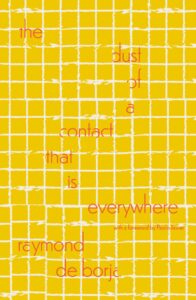
From the dust of a contact that is everywhere. Used with the permission of the publisher, Fonograf. Copyright © 2026 by Raymond de Borja

Gaby Iori
Gaby is a Baltimore-based writer, podcaster, and book publicist. Her last name is pronounced "eye-ori."