Colm Tóibín on What It Means to Return to an Idea 20 Years Later
The Backstory and Creative Process Behind A Long Winter
I wrote the story “A Long Winter” twenty years ago. In February and March 2005 I stayed in a small house in the landscape where the story is set. I witnessed the burufa, the surface snow that is swirled about by the wind to create the impression that there is a blizzard. Some days, as I walked along narrow roads and snow-covered paths, I heard the hunters. One day, a jeep came by with a trailer in which lay a few dead wild boars.
The wooden door into the yard often banged at night. One night, as I went out into the freezing dark to close it, I consoled myself by planning to put that small moment into the story once I started work again in the morning.
More than a decade earlier, with a friend, I had bought a run-down barn in a small village in the Pallars, in the Catalan province of Lleida, a village more than four thousand feet above sea level. We had set about making the barn habitable. We had a small yard, but no garden. Beside the house, there was a long wild garden space that seemed attached to no house. Eventually, we located the man who owned it. He was in his seventies and lived over the mountain. Going to see him became an annual ritual, as each year he refused to consider selling this small plot. But he was hospitable and polite, and the journey itself on an old dirt road high in the Pyrenees was beautiful enough in itself to make the journey worthwhile. Even the names of the villages had their own resonance: Ars; Civís; Os de Civís.
It should be possible to summarize, I thought, or indeed dramatize the material in any novel using the ballad stanza form. If it wouldn’t work as a ballad, then it probably wouldn’t work as a story.
In the summer of 2004, without notice, the man who owned the garden and his son came to visit us. The old man made clear that he wanted to sell everything he owned around the village. That would include two fields and a small part of the forest and a few other tiny plots of land. It would also include the garden.
Although we looked at the other land he wished to sell, it was only the garden that interested us. But the man was having none of it. He wanted us to buy the whole lot. And he had a price in mind. Nothing we could do convinced him to separate the garden from the rest, or to lower the price. His point was that we had come to him year in year out seeking to buy land from him. Now here it was, what was our problem? Were we not serious?
It would be easy to cut a door from the house into this garden that was like a long terrace. Toward the middle sat a small ruin of some sort, with no roof and a lot of earth and scrub inside the broken-down stone walls. There was nothing much that could be done with this.
That evening, when the deal had been done, we had a visit from a man who lived in a house lower down in the village. He went through the various fields and plots of land included in the sale. And, almost casually, he mentioned that the ruin in the garden was once a house, and the mother of the man who had sold us the land had been born and brought up in that house. “That was a terrible business,” he said, but would not expand. Clearly, something had happened in that house now ruined in that garden.
Over the next while, I pieced together the outline of the story. The mother of the old man who sold us the land had been born in that house. On marrying, she went to live in another village over the mountain. It is unclear if she really was a heavy drinker, but that became the rumor after her death, a death that occurred when she left the house in her husband’s village abruptly one winter day to walk to the village where she had been born.
The high Pyrenees are at their most dangerous on early winter days when the sky is blue and the sun is shining. It is on such days that the first snowstorm comes, and it can come very fast. And when the snow falls like this, it is there for the winter. The thaw might not come until April.
Thus, since she walked out of her house on a day like that, and since she did so alone, then the woman would be buried by the snow. And most likely her body would not be discovered until the spring.
The story stayed in my mind. It struck me that, as an outsider, I might never have discovered what the ruin in the garden was or had been. And if we were to restore it or make it habitable it would surely carry remnants, clues, echoes, traces.
But then I realized that really it wouldn’t. Ideas about the dead inhabiting domestic spaces belonged to ghost stories, imagined experiences, legends, and films. I could, if I wanted, write scenes in a story where someone—perhaps even this woman who died in the snow—made sounds—tapping sounds, low howling sounds—at night thus unsettling an Irishman who had the temerity to restore an old house. But such scenes would be manufactured, made up.
The story, nonetheless, remained in my mind. For a while, I had been thinking about the connection between the shape of a story in fiction and the shape of a ballad. Some lines and details in a ballad—“It was early in the spring”—offer a sense of the inevitable, the seasonal, the expected. And then the ballad can go anywhere. It should be possible to summarize, I thought, or indeed dramatize the material in any novel using the ballad stanza form. If it wouldn’t work as a ballad, then it probably wouldn’t work as a story.
For example, the opening stanza in “Middlemarch: a ballad” might read:
He was twice her age and buried in books
And suffered hard from nerves and gout
But she took a shine to him-o
And they were married before that year was out.
The story I began to imagine had winter and spring, it was set in a remote place, it had a body that could not be found, and a search for the body, first as an emergency and then as ritual. It had a mother and her son. It had a forest, it had snow.
He went out in the hardened snow. In those dark, forbidding days. She was deep in nature then. Hidden from his grieving gaze.
At first, I imagined all the family going in search of the mother. Then I decided to remove one brother from the picture in order to make the story starker and more intense. For a while, the perspective was the mother’s, the story was her walk in the snow. Sometimes, ideas like that would last a while and then they would fade, dissolve. And another way of seeing the drama or setting up the point of view would emerge. At that time, I had written some stories that would eventually appear in the volume Mothers and Sons. I had also written the first chapter of the novel that became Nora Webster.
It occurred to me then, almost as a way of making that title Mothers and Sons more solid, that I could give all the point of view to the son. This meant that everything would be seen by him, registered by him, known by him, noticed by him, remembered by him, felt by him. However, he would not tell the story; it would not use his voice. Instead, it would use the lens and the prism of his perspective. The style would be slow, immersive, third-person intimate. The theory of this is that the reader enters into the spirit of the protagonist after a few pages and begins thereafter to see the world as though they are him, or as though they are close to him.
I worked in longhand every day, at the beginning with much erasure and revision. And then sometimes I could write a few pages that would need hardly any changes. The very weather in the story was happening outside my window. The cold and the ice and the packed snow and the dulled sky looked as though they would never change. Some of the roads had been cleared by snowplows and some of the paths made easier by use. But walking on any slope was dangerous as there could be packed ice underneath. And the higher you went the deeper the snow.
At first, it seemed easier and more dramatic to allow the disputes between Miquel’s father and his neighbors to have their roots in the Spanish Civil War, but this eventually made no sense. And it made the story political in a way that I didn’t want. Instead, the problems between people in the village came from smaller, more local disputes about fences and water rights.
I asked a friend to find me a description of precisely what vultures do when they locate a carcass.
As I packed to come to Catalonia to write the story, I had removed some CDs out of their cases and put them into a CD holder for traveling. This meant that I had a CD of Bryn Terfel singing Schubert songs without the CD case and without the notes on the songs or the lyrics. I never played music when I was working, but in breaks or coming back from walks or at night, I began to play one Schubert song over and over without knowing even its name.
The idea that “A Long Winter” would remain hidden or live in the shadows satisfied me or impelled me to make it better or darker or more intense and exact.
A few months earlier I had interviewed Bryn Terfel in London for a magazine. He told me about coming to London from rural Wales to study when he was eighteen, taking no part in the social life of the city, simply practicing, working on his voice. In London, he worked with a single teacher on English art songs. He was meant to do nothing else. But he knew for some time that he would have to tell his teacher, a most sensitive and dedicated man, that he would have to expand his repertoire.
I wrote: “It was a tough decision to make after three years, and he still looks sad when he talks about it, to change teachers, to expand his horizons at the school. He dreaded those days, he says, leading up to the time when he had to tell Arthur that he was moving on.”
That move led eventually to Terfel’s work with those Schubert songs. The one I had been listening to is called “Litanei auf das Fest Allerseelen” (“Litany for the Feast of All Souls”). Its first stanza reads:
May all souls rest in peace; those
whose fearful torment is past; those
whose sweet dreams are over;
those sated with life, those barely born, who
have left this world:
may all souls rest in peace!
I had presumed it to be a slow, sad love song. Or a song about a stranger alone in a new place. I did not know it would be a prayer for the dead.
I was aware of the form “A Long Winter” would take. It would not be a novel. And it would not be a short story as I understood the term. It would live in a place in between. I smiled at the thought of a novella because I had come to the conclusion that a novella is something that no one wants.
Maybe no one would want what I was writing either. It was bleak, it was set in a remote place. If there was a gay man in the story, his sexuality seemed to lead to dull disappointment rather than excitement. Later that year, when the movie of “Brokeback Mountain,” based on Annie Proulx’s story, came out, I consoled myself that, like hers, my story was all mountain but, unlike hers, there was hardly any brokeback.
For some reason, the idea that “A Long Winter” would remain hidden or live in the shadows satisfied me or impelled me to make it better or darker or more intense and exact. It was published first as a limited edition. And then in late 2006 it was published at the end of the book of stories Mothers and Sons.
__________________________________
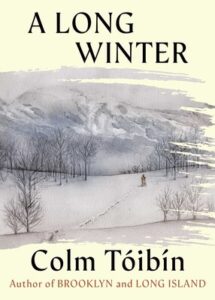
Excerpted from A Long Winter by Colm Tóibín. Copyright © 2025 by Colm Tóibín. Reprinted with permission of Scribner, a Division of Simon & Schuster.

Colm Tóibín
Colm Tóibín is the author of nine novels, including The Blackwater Lightship; The Master, winner of the Los Angeles Times Book Prize; Brooklyn, winner of the Costa Book Award; The Testament of Mary; and Nora Webster, as well as two story collections. He is the Irene and Sidney B. Silverman Professor of the Humanities at Columbia University. Three times shortlisted for the Man Booker Prize, Tóibín lives in Dublin and New York.