Colm Tóibín on Crafting a Collection of Irish Homecoming
Jane Ciabattari Talks to the Author of The News from Dublin
“It’s a complex business, going home,” says Colm Tóibín, the bard of the Irish diaspora, noted for eleven novels, including the iconic 1950s-era immigrant saga Brooklyn and its sequel, Long Island, which connect his own hometown of Enniscorthy with the immigrant population in the States. Reading Tóibín draws me back to my own roots, imagining my paternal great grandmother traveling by ship from Cork to Galveston, and stepping onto this massive continent. His masterful short stories revolve around distinctive characters with profound empathy and acute detail. His stories pull us away from the chaotic now of contemporary life and remind us what endures—love, grief, family connections. I read his third collection, The News from Dublin, during a perfectly timed power outage, absorbing the stories by candlelight, surrounded by darkness, with no diversions, simply caught up in the power of his storytelling.
I began our conversation by asking about a comment he had made during a recent talk at Portland’s Literary Arts. He had mentioned a time when he was living in Austin, Texas, and experiencing “the strange idea of being away from home, of missing home and realizing you do have a home, and it was Ireland.” How has the power of this idea been sustained over the years as the emotional backdrop to so many novels, and the stories in The News from Dublin?
“I don’t think about it much; maybe that is how its power is sustained,” he noted.
And homesickness, or missing home, or feeling an absence, are not part of a theory for me, they belong to a single character at a single time. Often the feelings of displacement hover in the background, as in my novel about Henry James, The Master, or are much sharper and painful, as in my novel about Thomas Mann, The Magician. But the drama around being away from home or returning home are there from the very first book, The South, and come up again in some of the stories in The News from Dublin. Part of the persistence of this drama comes from me directly.
The experience, for example, of coming back to Dublin in 1978 after three years in Barcelona was very powerful and memorable. And the experience of coming back from the United States is also powerful. I gave these feelings to some of my characters until I found that these feelings—emotion around exile, being away, missing home, feeling free away from home, feeling less than free on return—were all I needed for a narrative. They seemed to make other feelings less solid. They could take over a book or a story.
*
Jane Ciabattari: How did the stories in this new collection cohere? And over what period of time? How did you determine the order?
Colm Tóibín: The News from Dublin is a collection of stories, all with different characters and different dramas, written over a decade. They are not linked stories. So they don’t cohere, except that I wrote them all, but that is hardly a good alibi for coherence. I would hope that the differences between the stories is more apparent than what connects them. I didn’t determine the order, except that I wanted “The Journey to Galway” to come first and “The Catalan Girls” to come last. I left the rest to my editors.
I suppose this “quiet” happens when the main character is alone and something has happened or is about to happen so the quiet is memorable and exceptional.
JC: The first story in this collection, “The Journey to Galway,” begins with “an unusual silence—a stillness in the trees and in the farmyard, and a deadness in the house itself, no sounds from the kitchen, and no one moving up and down the stairs.” It seems quiet, but it’s the end of peacefulness in a mother’s life, that brief moment between “normal” life and “a single brutal fact” that brings grief that will last forever. A mother has lost her son, a fighter pilot, in the last year of the war, in Italy. And she must travel to Galway by train to inform her daughter-in-law and three grandchildren. This story reads like an elegy, each sentence a step toward that awful moment when she delivers the news. “She carried death with her, she thought, as she had once carried life,” you write. How did this story evolve? And what connection does it have to Seventy Years, the autobiography of Lady Gregory?
CT: It is the story of the news coming of the death of Robert Gregory, the son of Lady Gregory and the subject of “An Irish Airman Foresees His Death” and “In Memory of Major Robert Gregory” by W.B. Yeats. The story follows pretty closely Lady Gregory’s account of her journey from Coole to Galway to break the news to her daughter-in-law. I spent six months in 2000/2001 going through the papers of Lady Gregory in the Berg Collection in the New York Public Library when I was at the Cullman Cener there. Out of that, I wrote a short biography of her (Lady Gregory’s Toothbrush), a play that was performed at the Peacock Theater in Dublin (Beauty in a Broken Place), an opera libretto, the opera performed at the Wexford Opera Festival (Lady Gregory in America) and two short stories (“Silence” and “The Journey to Galway”). I hope to keep going with this.
JC: The title story sends Maurice, a school teacher, on a melancholy journey from Enniscorthy, where his younger brother is dying of TB, to Dublin, in hopes of convincing the minister of health to intercede to make it possible for the brother to try the experimental drug streptomycin. You make reference to key points along Ireland’s political timeline, as Maurice parses the order in which he should introduce himself (beginning with his father and the minister were jailed together in Frongoch after the Rising). There’s even a cameo appearance by Eamon de Valera. How were you able to distill the subtleties Irish politics with such nuance in the course of one short story?
CT: My father was director of elections for Dr. James Ryan, who was a Minister in many of the Fianna Fail governments in Ireland. My grandfather was in prison with Dr. Ryan after the 1916 Rebellion. My uncle, my father’s younger brother, died of TB. The story is fiction, but the political background is in my blood. I did not have to do any research for it.
JC: “Five Bridges” revolves around Paul, who is going home to Ireland after more than thirty years in America on a tourist visa. He’s been doing plumbing work in Northern California, but with a new president elected, he might be deported if he doesn’t head home. His only tie to America is Geraldine, his daughter, who is almost twelve. As a farewell gesture, at Geraldine’s request, Paul, her mother Sandra, and Stan, her stepfather, hike to the top of Mount Tamalpais for an overnight camping trip. You capture the awkwardness of Paul’s interactions with his former girlfriend, her husband, and his sense of class differences, as well as Paul’s fatherly love for his daughter. And Paul’s anticipation of who he will be once he gets home. How did you determine the order of the scenes in this complex tale?
CT: “Five Bridges” is one of the stories in this book that I had been toying with for years. (“A Free Man” is another, as is “A Sum of Money”). They were then finished quickly in the first half of 2025 when I was on leave from Columbia and had many long days to myself. I wrote the account of the hike on the very day it occurred (in fiction), which is the Saturday before Trump’s second inauguration. I worked all that actual day, as though I needed to get Paul of the country before the danger came. I had to set up his awkwardness and also how provisional and unrooted his life seemed, thus making his relationship with his daughter stand out more. In “Five Bridges” and in “A Free Man,” there is the figure of the manager of an Irish bar, the one who watches and notices. I structured the story by trial and error, trying to keep the structure as simple as possible and making sure that the story of the hike itself was clean and direct, moving a/b/c.
JC: There is a tenderness to some of these stories (in “Sleep,” for instance, and “Barton Springs”), a long-range perspective, that makes me wonder how the wisdom, expertise and polish you have gathered over the years has changed your writing?
A story needs a single thing, a single detail that sings or does something mysterious. But if you think about this too much, the idea you have for that single thing fades away or seem preposterous.
CT: From the very first novel (The South) I found there was a tone I could use—first-person, direct, moving from staccato to hushed, highly personal, private. The problem is that if you overuse it, it can move easily into a form of self-parody. I used it in The Story of the Night and in The Testament of Mary. I used it in the stories “Barcelona, 1975” and “The Empty Family.” I know it is always available. “Sleep” and “Barton Springs” are, like the two above-mentioned stories, personal, almost autobiographical. I am not sure about “wisdom, expertise and polish.” I think they are raw and almost shapeless. Something written down that is direct, as though there is not much time, and certainly none for literary flourish.
JC: What sort of research and first-hand experience of Argentina, Barcelona and Catalonia were involved in the writing of “The Catalan Girls,” the novella that completes this collection?
CT: I know that village in the Catalan Pyrenees, I have been going there since 1976. I especially know what it is like to arrive there for the summer. And I know the journey up there from Barcelona. Also, I lived in the guest cottage outside Buenos Aires that is in the story in the spring and early summer of 1986. More recently, I lived for a season in that flat that Montse’s lover rents for her. And the scene where the mistress joins the maid to watch tv in a tiny room under the stairs comes from a visit I made to the American photographer Deborah Turbeville in San Miguel de Allende in Mexico in 2005 (the house is now a hotel). The story is fiction, but the places and the rooms are real.
JC: Your conclusion, in this final story, “The Catalan Girls” (“Soon it will be all quiet. Soon there won’t be a sound,” in the sentence before the last paragraph), circles back to the sense of quiet that opens the collection in “The Journey to Galway.” How did you craft this arc? What does this quiet mean to you?
CT: I didn’t craft it. It happened by accident or maybe by magic. I hadn’t noticed it until you pointed it out. I suppose this “quiet” happens when the main character is alone and something has happened or is about to happen so the quiet is memorable and exceptional, or at least as an aura around it of something, something ominous, something that is not quiet.
JC: You’ve written eleven novels; this is your third story collection. How do you know when a story will end up in the long form or the short? Do you have a preference in form?
CT: A story needs a single thing, a single detail that sings or does something mysterious. But if you think about this too much, the idea you have for that single thing fades away or seem preposterous. It has to come on its own. It can seem like nothing much. A novel, on the other hand, is a thousand details. A different sort of venture. It is not just that it takes years, but it must cover years, or for me it must.
JC: What are you working on now/next?
CT: I have written two more opera libretti that are to be performed this year. And I am writing lyrics for songs. I have half a new book of poems. Where is the other half?
__________________________________
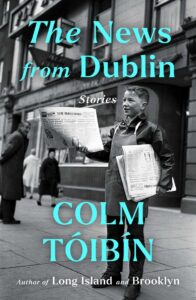
The News from Dublin: Stories by Colm Tóibín is available from Scribner, an imprint of Simon & Schuster.

Jane Ciabattari
Jane Ciabattari, author of the short story collection Stealing the Fire, is a former National Book Critics Circle president (and current NBCC vice president/events), and a member of the Writers Grotto. Her reviews, interviews and cultural criticism have appeared in NPR, BBC Culture, the New York Times Book Review, the Guardian, Bookforum, Paris Review, the Washington Post, Boston Globe, and the Los Angeles Times, among other publications.