Christelle Dabos on Empathy, Doing Good, and How We Fill Ourselves Up
“What if every human being were born with an irresistible need to do good?”
It’s Sunday morning, September 18, 2016. I spent the previous day signing books in Lille, in northern France. My head is still foggy. I am making myself a cup of hot chocolate when, at the exact moment the microwave dings, my eyes widen.
What if every human being were born with an irresistible need to do good?
Years later, that question would become the seed of my novel We. But where had it come from? Let’s jump back in time again.
I was living in a world where empathy was not a priority.
I’m in Nice, in the south of France, sometime in the 2000s. I’m taking the bus to the Faculty of Arts and everyone is scrambling for a seat. The students cling to theirs as if they own them—they won’t give them up to anyone, not even that old lady. It’s her fault, she could have taken the bus at another time. At the university, it’s the same story: everyone for themselves. A student insists on paying me because I shared my notes from a class she’d missed. She keeps repeating, “Nothing in life is free.” In the street, I start noticing the averted gazes (mine included), hands that never reach out to help (mine included), the excuses: too tired, none of my business, me first. These thoughts follow me home, to my parents’ house, to the bedroom where I shut myself away, a tiger poster taped to the door to signal, “Do not disturb.”
I was living in a world where empathy was not a priority.
What if I could change things? I wondered. Change myself? My savior complex, probably dormant until then, kicked in. I had seen The Matrix by the Wachowskis and Amélie by Jean-Pierre Jeunet—now it was my turn to break the cycle of everyday conditioning! From the desk in my bedroom, I founded an Order of Chivalry and drafted a charter whose number one rule was: “I pledge to help anyone in need.” Then I started looking for knights.
I recruited two members on MSN Messenger—voilà. I then left the French Riviera for Belgium. There, I met big-hearted people—generous with their time and quick to lend a hand—who taught me something not often practiced in France: the ability to laugh at oneself. I cast off the knight’s heavy armor.
But that “what if?” didn’t stop there. It patiently carved its path until that morning in 2016, in front of the microwave: What if every human being were born with an irresistible need to do good? A form of solidarity that wouldn’t be a choice, but an all-powerful force called “Instinct,” with a capital “I.” There would be different categories of Instinct: the feeders would have no choice but to feed anyone who was hungry; the protectors would have to defend anyone in danger; and many other types too—those who heal; those who listen; those who develop new drugs; those who retie untied shoelaces! Together, all these Instincts would connect human beings to one another through a collective consciousness: the We.
I had just watched the TV series Sense8 (the Wachowskis again!), in which eight people separated by thousands of miles begin to simultaneously perceive and feel what the others are experiencing. I had also just discovered The Power of Now by Eckhart Tolle, the famous spiritual teacher who describes experiencing the dissolution of the “little me,” and who led me to question everything I thought I knew about my own identity. Around the same time, I read Philip K. Dick’s Do Androids Dream of Electric Sheep? (which inspired Ridley Scott’s movie Blade Runner). Beyond its exploration of identity, I was fascinated by the concept of the “empathy box,” a virtual reality tool that makes it possible to share the same redemptive pain.
True empathy requires giving something up.
All these works, all these “what ifs?” fed my reflections—more than that, they set a whole inner process in motion.
I decided to push this line of reasoning to the extreme in We, where human beings are biologically programmed to help one another… Can we still speak of Good if there is no choice? Can we still talk about empathy? The characters in We are ambivalent on this point. Goliath saves lives even if it costs him pieces of his own body, but he acts alone and keeps others at a distance. Claire is a confidant who wants to solve everyone’s problems, but that comes from a void she’s trying to fill. I imagined a society built entirely on the system of Instincts, where the more lives you save, the higher you climb in the hierarchy. But in the end, the We itself is a very relative absolute, confined to the human scale. Besides, it doesn’t adapt, it doesn’t differentiate. It doesn’t take into account the aspirations of all the “I”s that constitute it, nor does it include the rest of the living world.
The further I got into writing We, the more I tested the limits of my little code of chivalry: acting nobly, speaking the truth, exercising self-control, harboring good thoughts, and (it is quite funny, given the contradiction) never depending on others. The young woman who wrote this code was primarily trying to improve her self-image. Seeing yourself as a savior is not the same as showing empathy. Fiction is filled with villains who believe they’re acting for the good of others. I’m thinking of the cult Japanese manga Death Note, which became hugely popular in the French-speaking world in 2008. The main character comes into possession of the notebook of a Shinigami (a god of death) and, overnight, gains the power to kill whoever he wants with total impunity. He sees it as an opportunity to bring justice to the world, but it’s only an excuse to feed his own ego.
True empathy requires giving something up. We let go of the “I,” we no longer look at reality from a single point of view (I think of all those comments on social media!) and that’s when we encounter the other. There’s a powerful scene in How to Train Your Dragon, DreamWorks’ animated film, in which the hero is about to kill the dragon to live up to his father’s expectations but sees the fear in the dragon’s eyes and decides to let him go. Later, he explains: “I looked at him… and I saw myself.”
A book takes us outside ourselves, yes, but once we look up from the page and return to our own little story, a bit of our loneliness has disappeared.
In the end, that’s what I’ve always wanted to write about—read about, watch, and experience. That’s what We is all about: the relative becoming absolute.
And as I write this, I realize that I’ve already experienced it. Hundreds of times, ever since I was very little—including on that bus between the train station and the university in Nice, where everyone rushed to grab a seat while I opened a book “just to pass the time.” That’s what happens every time we lose ourselves in a book, a movie, or any other “what if?” We forget our small, individual story to make room for someone else’s.
Or is it an escape?
At one point when I was struggling with my writing, I became deeply interested in The Anatomy of Story by John Truby. I was particularly struck by the distinction he makes between the hero’s desire (what they think they want) and their need (what they truly lack). This incompleteness is not only the defining trait of a character: it’s what we all have in common. We all feel an emptiness that we try to fill. We all long to feel connected—it’s no coincidence that we spend our lives online. One part of us is afraid of the other—it judges them, criticizes them, exploits them, conquers them, and protects itself from them. Another part longs to become one with them.
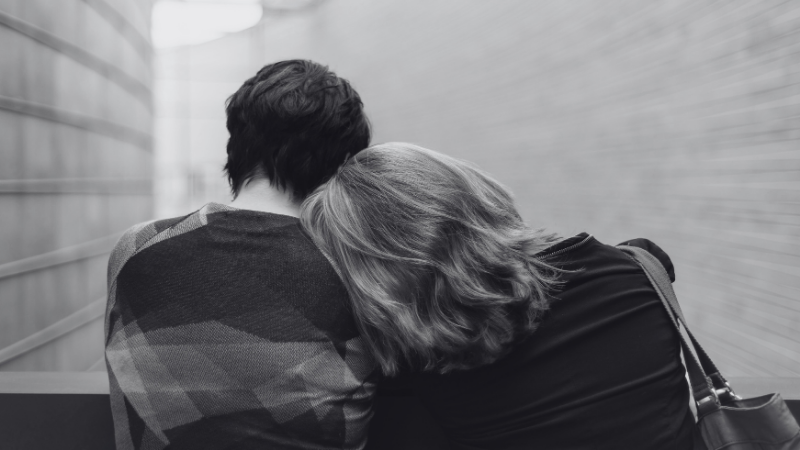
So, is reading an escape? A book takes us outside ourselves, yes, but once we look up from the page and return to our own little story, a bit of our loneliness has disappeared. A real encounter has taken place; we have understood and we have felt understood. Intimately. We have vibrated with the characters; we have suffered alongside them.
That’s Philip K. Dick’s “empathy box.”
__________________________________
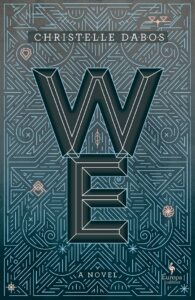
We by Christelle Dabos is available from Europa Editions.

Christelle Dabos
Christelle Dabos was born on the Côte d’Azur in 1980 and grew up in a home filled with classical music and historical games. She now lives in Belgium. A Winter’s Promise, her debut novel, won the Gallimard Jeunesse-RTL-Télérama First Novel Competition in France, and was named a Best Book of the Year by critics and publications in the US, including Entertainment Weekly, Bustle, Publishers Weekly, and Chicago Review of Books. A Winter’s Promise was also named the #1 Sci-Fi/Fantasy title of the year by the editors of the Amazon Book Review.