







An Interrogation of Reality: On the Legacy of Blade Runner
Joanne McNeil in Praise of Stephen Vaughan's Visual Chronicle of a Sci-Fi Classic
There are films that you seem to live inside. Ninety minutes and change of what transpires on the screen singes your mind’s eye and once it happens, it stays. When the lights switch on and the credits roll, you are left with ashes of memory like recollected experiences of your own.
Blade Runner is a film that I have lived inside. Some part of me stubbornly refuses to believe that I’ve never actually been to Taffy’s Snake Pit, jostling with the lowlifes for a seat at the bar, nor have I ever sought shelter from the rain with a steaming bowl of noodles before me at the White Dragon downtown. I have, in fact, been to the Bradbury Building—many times, always as a tourist—and each visit, it feels like returning to a place I used to go at a more restless time in my life.
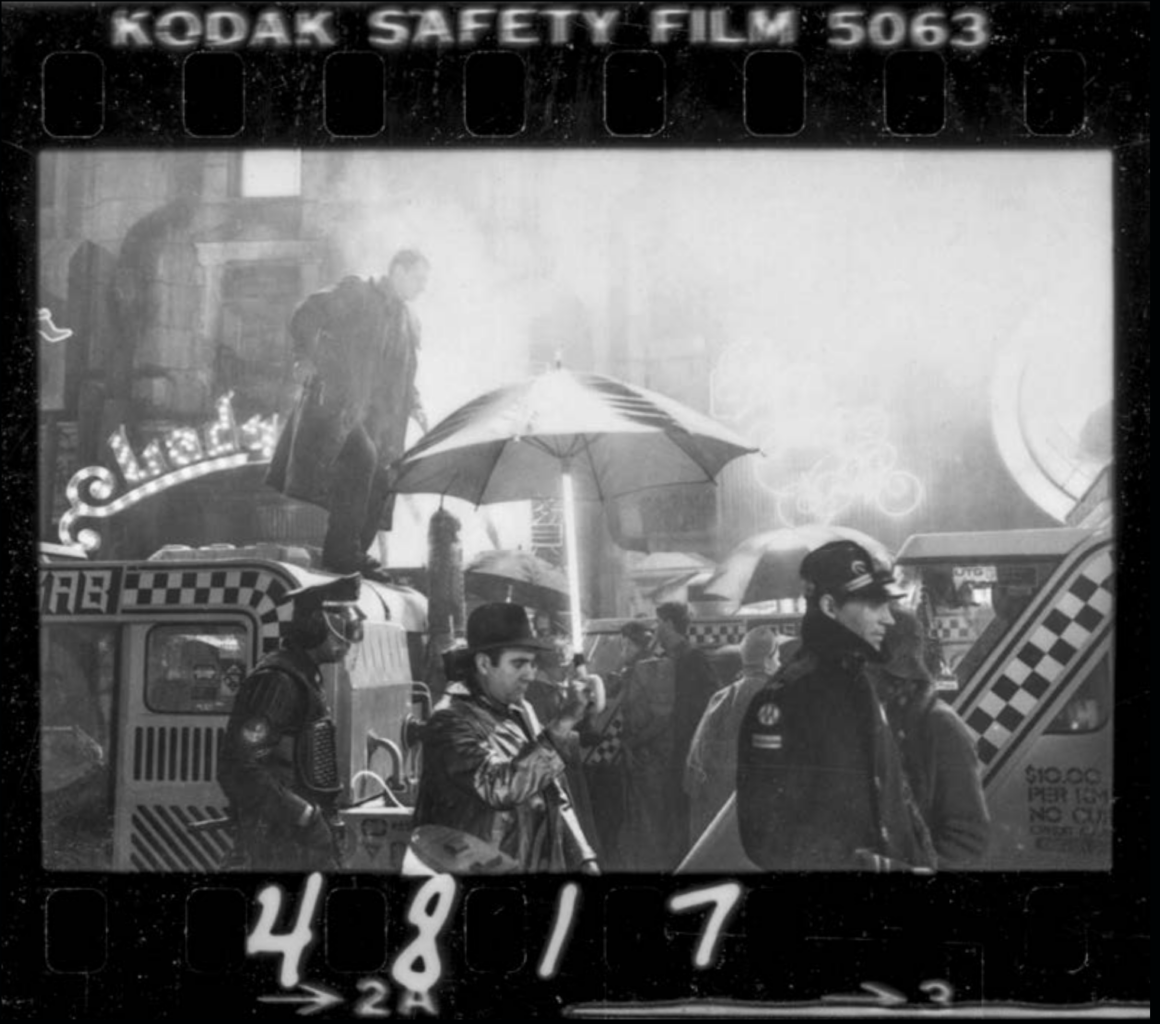
There’s a reason why Ridley Scott’s 1982 film burns so true. I see it in one of the photographs Stephen Vaughan captured on the set. Harrison Ford as Rick Deckard leaps between two futuristic taxi cabs. Behind him, the sign for The Snake Pit beckons in neon curlicue script. In the foreground are pedestrians styled in punk haircuts and black leather attire. Next to them are Hare Krishnas in orange robes. In the distance, there’s a man with a face and a fedora reminiscent of Philip Marlowe except he’s carrying an umbrella with a stem that glows.
If the power of the film is as the sum of its parts, Vaughan’s photography isolates these parts to reveal a city vernacular.
The camera will follow Deckard along his violent journey to retire an android “replicant” on the loose in Los Angeles, but Vaughan’s photograph lets us linger on the rich detail of the city where he lives: strange to the viewer, but ordinary to Deckard. As an image instead of a scene, a frozen moment instead of a sequence, the full breadth of possibilities and choices made by the filmmaker and his crew are contained for us to consider.
What would happen if we followed the punks or the Hare Krishnas to wherever they are going? What if we took a ride in one of those cabs? The extras, the costumes, and the sets are all varied the way that real cities are: with subcultures, countercultures, clashing architectures, and retro cliques. Every night is another opportunity to get lost in the fortuity of the city. Every alleyway and closed door in the world of Blade Runner entices with potential adventures that viewers will never see. Rather than wasted opportunities, the smallest parts and pieces shown on screen are particularized in such a way that to watch the film, you get the sense that you have arrived there.
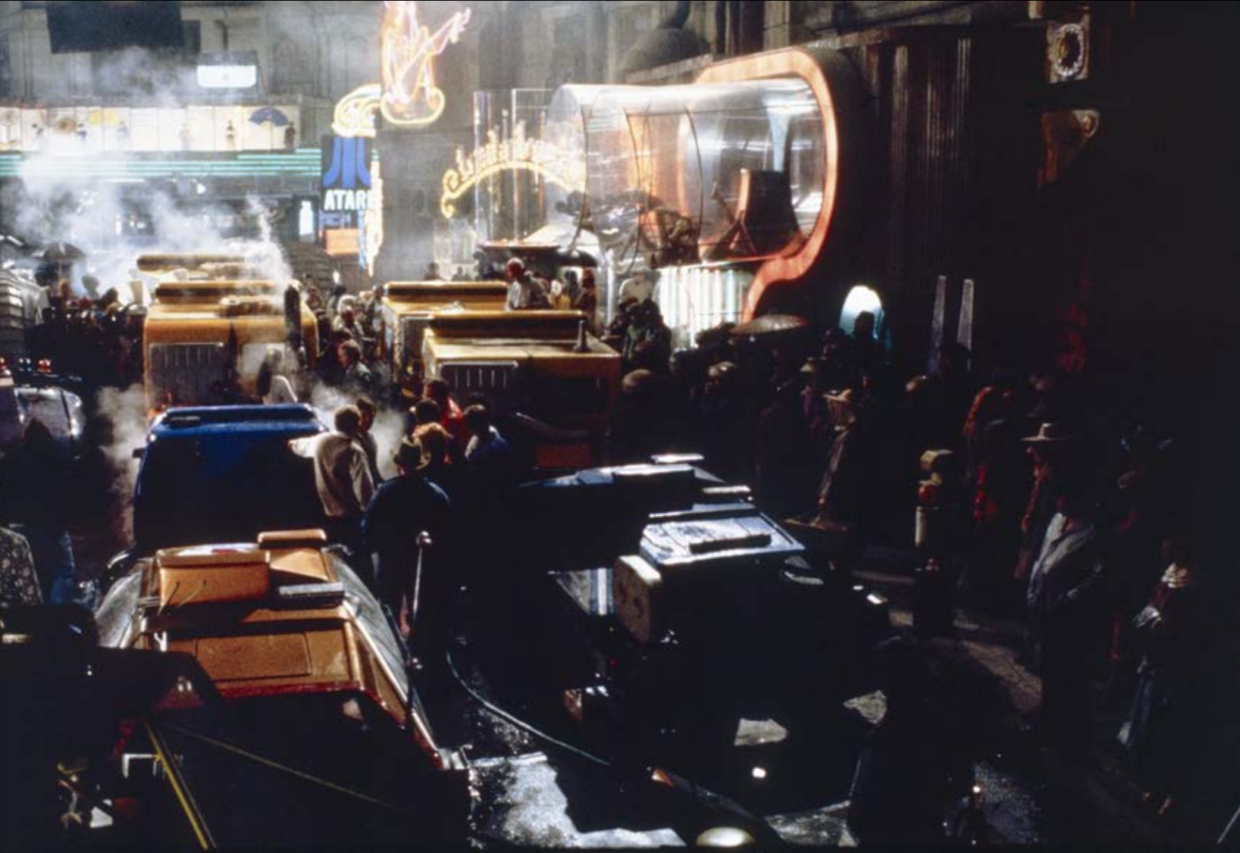
If the power of the film is as the sum of its parts, Vaughan’s photography isolates these parts to reveal a city vernacular. Whether the characters are lab-grown or born, these images capture the worlds that revolve inside each one of them.
In other photographs of Deckard, Vaughan preserves his stillness, his distance, and arch alienation played to perfection by Ford. When he isn’t on the job, he represents another kind of city‑dweller: the one who stays in, the adventures outside fail to lure him. Always, when we see Deckard, something is on his mind. He’d rather be alone. Until he meets someone—a light in the darkness.
*
The film, largely shot at night, asks the questions we might ask ourselves in the middle of the night: What is life? Why am I alone in it? Just how close can someone else get to understand me? Why am I like this? Was I hardwired for the life I have or did I become this way? What does any of it matter?
There is no sunshine in this film to relieve people of midnight questions about the matter of their souls and the fiber of their being. Surfaces glow with darting light, the beehive smoke and silhouettes and flickering neon lulls the viewer to a state conducive to such pondering.
*
Reality collides with the imaginary world of the film in a striking Polaroid that Vaughan took of Sean Young on a cigarette break. She’s wearing a white t-shirt and a textured pencil skirt that fans of the movie will immediately recognize. It’s part of the costume she has on in her first scene as Rachael where she takes the Voight‑Kampff test. Over the course of a hundred peculiar questions, which Rachael answers unfazed, Deckard discovers that she is a replicant.
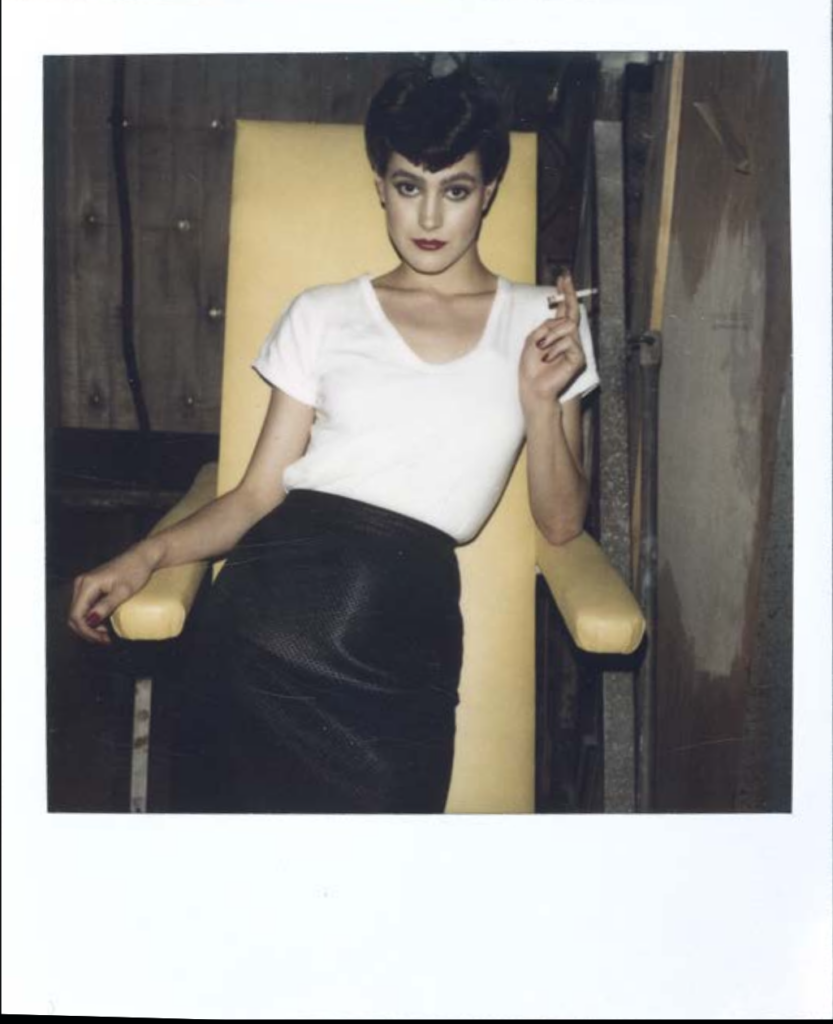
In the Polaroid, Young’s hair is done up and her makeup is set with her nails polished to perfection. Only her torso is out of character. Rachael, the android, always dresses formally, but Young, perhaps, had that t-shirt on under the stiff suit jacket that matches the skirt which she wears on screen. Her gaze at the camera —at Vaughan—is uncanny. It’s the look that defines her character. How much of Rachael’s unsettled dignity comes from Young, the actress, her remote disposition, and the intensity in her eyes?
*
None other than Philip K. Dick was “blown away” by an image Vaughan took of Young. He died three months before the premiere of the film based on his novel Do Androids Dream of Electric Sheep?, and only had the chance to view clips from the film and still photography. In a 1981 interview, Dick expressed his astonishment at how closely she resembled the character as he pictured her in his head. “I said, that’s Rachael! You could have hung pictures of a hundred different women and I would have unerringly picked out that one as Rachael. That’s not a simulation of Rachael, that is Rachael. They went and found her.”
She plays a young woman who discovers her entire world and her perception of it no longer matters—it never did. It’s not only that she had been living a lie; it’s whether what she is even counts as living. The actress’s expression in the Polaroid, the look she has on screen, is incredulous and vulnerable. Her scenes with Ford are pained and passionate, filled with the alchemy of two lonely people who get through to one other and find something like solace through desire.
*
Blade Runner is a very loose adaptation of Do Androids Dream of Electric Sheep?, yet it preserves the desperate mood of Dick’s writing and his lifelong interrogation of the human hunger to connect. In one of the novel’s most memorable lines, Pris, another replicant, reveals her inner world to a human who takes pity on her. Her short life has been an isolating one. “The androids,” she says, “are lonely, too.”
The nostalgia these pictures elicit comes from someplace vital—just as the film itself imparts: it doesn’t matter what if any of it was ever real.
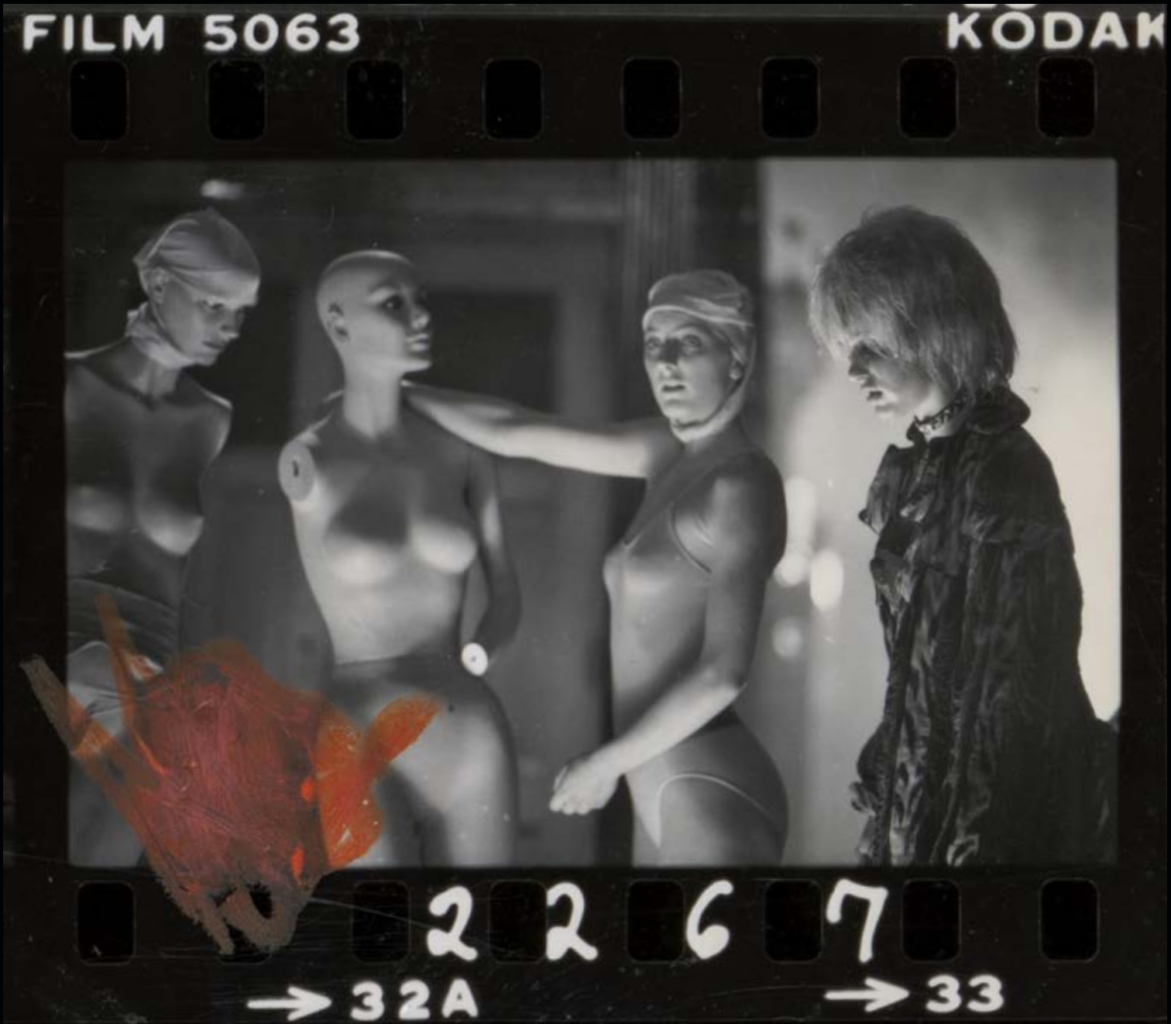
In his photographs of Daryl Hannah, who plays Pris, and her fellow androids played by Joanna Cassidy and Rutger Hauer, Vaughan draws out this loneliness. The replicants allegedly weren’t built to express empathy to humans or one another, but over the course of the film, their growing awareness of what they lack is hard to distinguish from the real thing. Vaughan captured Hannah standing beside mannequins in a striking image. Her oblique posture and downcast gaze suggests Pris might identify with these inanimate objects and for that, she feels ashamed.
*
The androids are lonely, too. In Blade Runner, who isn’t? The weather doesn’t help. Ridley Scott ported British precipitation to the Southern California imaginary, and as a result, the film conjures up a version of Los Angeles that no one has ever known: a future untethered. Downtown is wet, reflective, and slippery; full of crowds that will disperse with the sunrise.
The film was a vision of the future refracted through an imaginary past. From the Mayan Revival Ennis House where Deckard lives to Rachael’s Joan Crawford-esque tailoring, these magpie nods to history ground the the neon beating heart of Syd Mead’s set designs. You might have to squint to find the Argyle chairs by Charles Rennie Mackintosh, but Vaughan captured Sean Young sitting the stark objects—Art Nouveau from turn of the last century—in unused footage. Such is the power of Vaughan’s contribution to the film: his photography serves as version control across the several cuts of Blade Runner that have reached audiences, not to mention the deleted scenes and outtake videos that flourish on the internet.
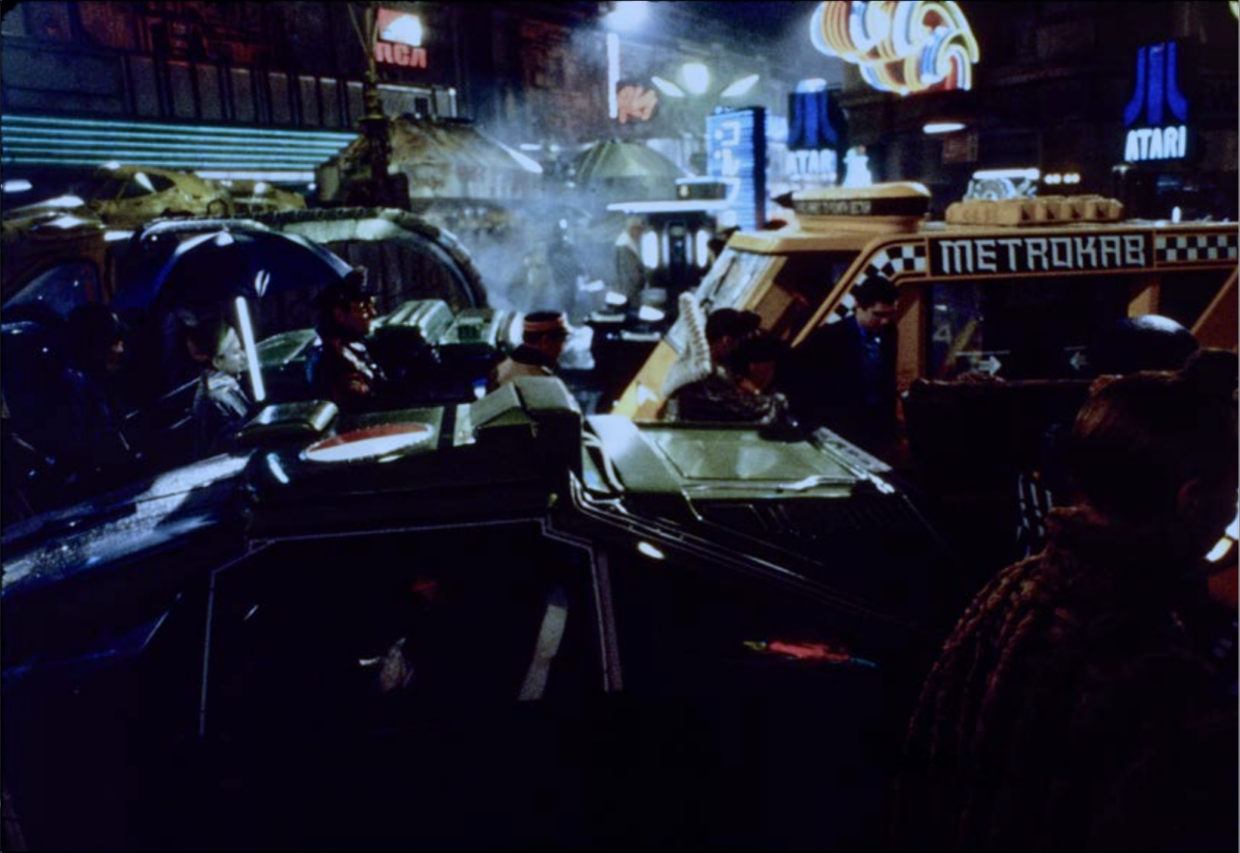
That numerous versions of Blade Runner have screened for the public over decades has added to the hallowed lore of the film. If you misremember a detail from it, or your take on it varies from someone else’s, perhaps the version you were thinking of wasn’t the same after all. It’s a film as a living document, a fluid cultural touchpoint demanding revision for the sake of accuracy. The journey from the theatrical release to The Final Cut, opening on the twenty‑fifth anniversary of the film in 2007, is akin to the struggle of historians to set the record straight.
“Little microcosms of society form when you make a film and then, all of a sudden—poof!—it’s not there anymore,” Sean Young told the science fiction fanzine Starlog upon the release of Blade Runner in 1982. Shooting had wrapped the previous summer. What happened in those months, has reverberated to the future where it is set, 2019, and to the present where we live, where that year too, is squarely in the past.
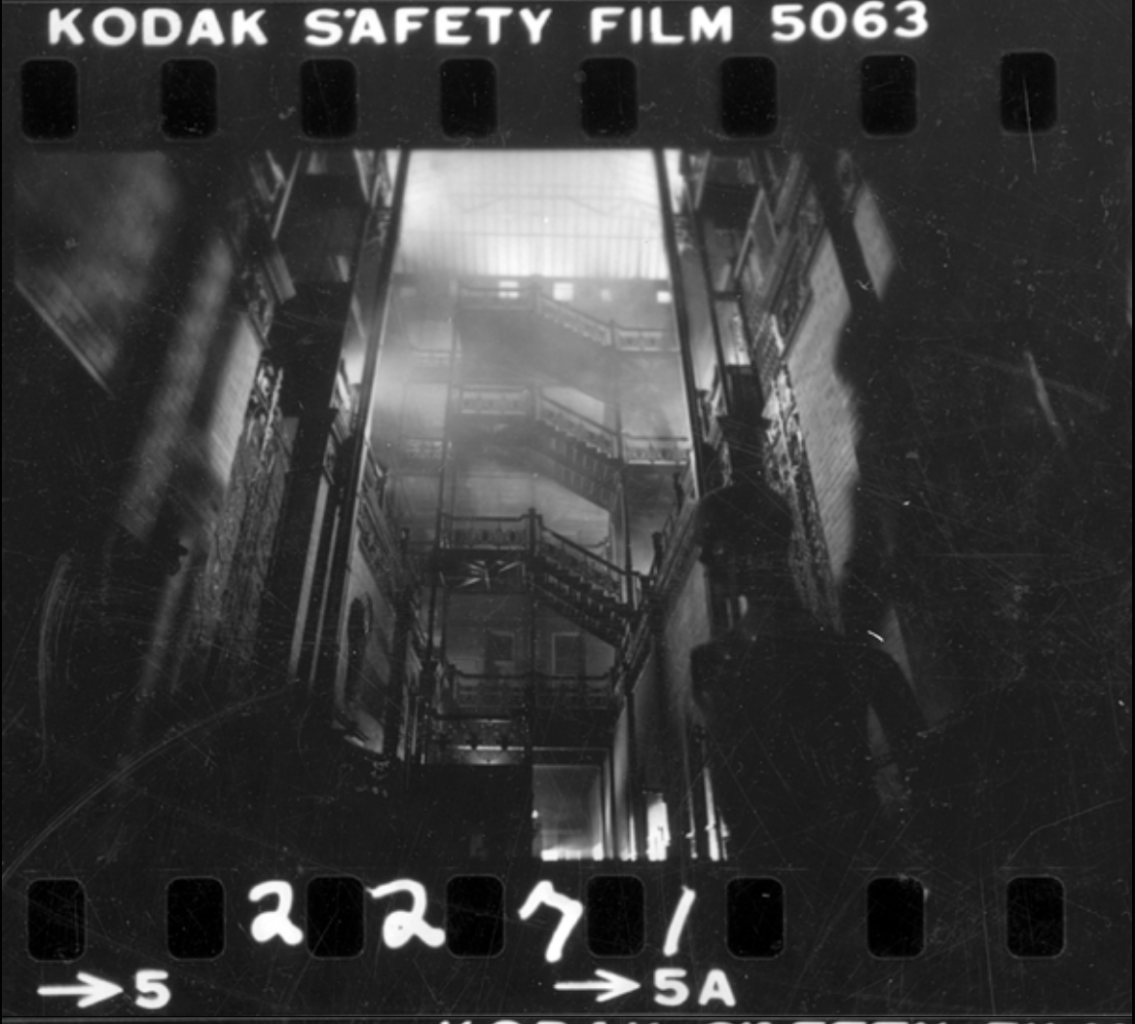
A chronological vertigo sets in to watch the film now. Once there was Blade Runner, and now it’s over. That’s what makes the set photography by Steven Vaughan definitive and venerable. His images break down the complexity of its world so that we might appreciate it on a granular level. The nostalgia these pictures elicit comes from someplace vital—just as the film itself imparts: it doesn’t matter what if any of it was ever real.
_______________________________
From The Blade Runner Contact Sheets by Stephen Vaughan. Copyright © 2026. Available from Hat & Beard Press.

Joanne McNeil
Joanne McNeil is the author of the novel Wrong Way (2023) and Lurking (2020). She was the inaugural winner of the Carl & Marilynn Thoma Art Foundation's Arts Writing Award for an emerging writer. She has been a resident at Eyebeam, a Logan Nonfiction Program fellow, recipient of the Warhol Foundation Arts Writers Grant, and an instructor at the School for Poetic Computation. She grew up in Brockton, MA and is currently based in Los Angeles.