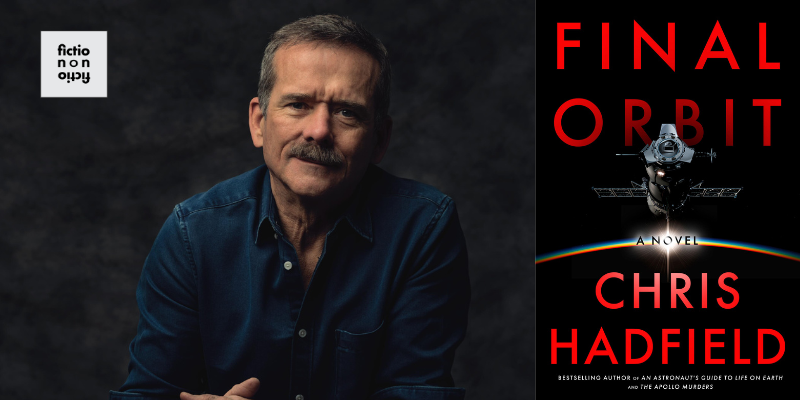
Chris Hadfield on Final Orbit, Artemis II, and the Future of Space
In Conversation with Whitney Terrell and V.V. Ganeshananthan on Fiction/Non/Fiction
Retired astronaut and novelist Chris Hadfield joins co-hosts Whitney Terrell and V.V. Ganeshananthan to discuss space exploration, geopolitics, and his new book, Final Orbit. Hadfield recalls watching the Apollo 11 Moon Landing as a child and considers how these historic missions capture public imagination. He explains the risks of reentry and splashdown for Artemis II as well as the scientific promise and political stakes of returning to the Moon in the future. Hadfield also reflects on the ethics of public versus private models of space travel and the possibility of future lunar settlement. Pivoting to fiction, he talks about using the real history of the Apollo-Soyuz Test Project, Cold War tensions, and China’s early space ambitions to build the alternative-history world of Final Orbit. He describes his research process and how he tackles plot, reveals whether the Apollo Murders series will have another installment, and reads from Final Orbit.
To hear the full episode, subscribe through iTunes, Google Play, Stitcher, Spotify, or your favorite podcast app (include the forward slashes when searching). You can also listen by streaming from the player below. Check out video versions of our interviews on the Fiction/Non/Fiction Instagram account, the Fiction/Non/Fiction YouTube Channel, and our show website: https://www.fnfpodcast.net/ This podcast is produced by Jennifer Maritza McCauley, V.V. Ganeshananthan and Whitney Terrell.
The Apollo Murders • The Defector • An Astronaut’s Guide to Life on Earth • You Are Here • The Darkest Dark
Others
Artemis II • Apollo-Soyuz Test Project • Star Trek • Project Hail Mary • Astra Carta | Sustainable Markets Initiative • “Coming Home May Be the Most Dangerous Part of Artemis II” | The New York Times, April 11
EXCERPT FROM A CONVERSATION WITH CHRIS HADFIELD
V.V. Ganeshananthan: So Artemis II is a flyby mission. But you were mentioning before that Artemis IV is going to actually land on the Moon in 2028 or so, which will be the first time in half a century. Why are we going back now? What’s the scientific and political significance of planning these missions in tumultuous times?
Chris Hadfield: It would be fun if the three of us were having this conversation in about 1912 and speaking about Antarctica. It would be the same sort of thing. Our technology was pretty weak to get there, and people were dying. The people trying to get to the South Pole had recently just died, and Shackleton was trapped with his crew for an extended period, because we were pushing our technology right to the edge. That was the early exploration phase. But then our technology got better, and we could get to Antarctica much more reliably. Airplane engines and navigation then became good enough that we could fly to Antarctica. And suddenly, now, this is just another place that people can live. Sugi, you’re in Minnesota today. No one could live one night in the winter in Minnesota without technology. It’d kill you. We’re not designed for that, but we take it for granted. We have mastered all of these technologies that allow us to have spread all over the surface of the world, including Antarctica, including the thousands of people that live there, and the 100 who live at the South Pole in the dead of winter, and even the 100,000 people that visit Antarctica on cruise ships every year.
This is the transition that’s happening in space flight right now. We have gone from when Whitney was a very young lad, barely being able to explore and get there, and we just about killed the Apollo 13 crew to now where, the technology’s better and if you peeled the Moon and laid it on the earth, it’s bigger than Africa. It’s enormous. And there’s no life. There is no biosphere to disrupt. It’s a largely unsurveyed and completely untapped mineral resource. So that has a lot of allure. In the last 10 years, we discovered vast reserves of water on the Moon, permanently frozen into the shadowed craters at the poles. So if you have water and you have solar power, always at the poles, then it’s not that much different than Minnesota. You just need the right habitat there, and you can live there.
I think it’s really important to look at it within the frame of history, as to, how do we incorporate the latest technology into the quality of human existence and to better understand the universe around us? That’s the stage we’re at with the Moon now, whether we can sustain the international agreements and the financing and all the other stuff that goes along with big projects, that remains to be seen. But I’m very excited that we’ve turned that corner, and that’s what’s happening right now.
Whitney Terrell: I love it that this is a government-led mission. I was very proud of what NASA did in the original space programs. There are things that I really love about international space: that governments share information; that it’s a joint project, we do these things together, and that’s how the International Space Station works, for instance, at least in my understanding. But we are going to also have private space companies now. I mean, SpaceX is having its IPO coming up here, which is a very different way of thinking about how to do space. I wondered what your opinions are on the differences between government space exploration, as we’ve done and as we’re doing today, and this future of private space exploration.
CH: So every spaceship I’ve ever flown was built by a private company, the lunar lander was built by Grumman for tremendous profit, and the space shuttle was built by Rockwell. The Space Station was largely built by Boeing and managed by Boeing. Space flight has always been commercial, right from the very beginning, with people making significant profits, but the cost was so high that the only client— you had to be a trillionaire to fly in space— had to be the Soviet Union or the United States. Nobody else could afford it. Eventually, all of the countries of Europe started.
What has happened, though, is the improvements in technology are such that a bunch of years ago, a private citizen could buy a flight into space from a private rocket company. The clientele changed. But the actual mechanics of flying in space, that’s always been privately produced. NASA doesn’t build rocket ships and build spaceships. They hire a company to do it. You mentioned SpaceX. They have hired SpaceX as a company to build the hardware that they then use in space and that’s slightly different. As the technology has gotten better, you can give more latitude to the company. You don’t have to tell them specifically where every bolt and screw needs to be.
The future, though, is interesting. What rules will apply on the Moon? Whose laws apply if you murder someone on the Moon? What court would you appear in and who has territorial rights in Earth orbit? We’re sorting that out, but how about on the Moon? Who’s responsible for orbital debris and all of those things? Technology always gets way out in front of regulation, but we’ve had to play catch up. When Henry Ford started cranking out thousands and thousands of Model T’s in 1915, think what chaos there was. There were no decent roads, road signs, stop lights, driver’s licenses, no infrastructure, no gas stations. But the technology was so good that people incorporated it, and then infrastructure and regulation caught up. The same with aviation. That’s the phase we’re in now in space flight, we need to do it responsibly. We’ve got to create rules that society likes, and then enforce those rules, just like we’ve done for thousands of years on earth.
Now we’re including the Moon in that. That’s why I’m working with King Charles on the Astra Carta, which is sort of a governing document, and his sustainable markets initiative. It’s why I’m the chair of the Open Lunar Foundation, which is a nonprofit working with governments and the United Nations and lots of companies to try and help set policy for how it is that we should settle the Moon. Should we settle it like we did North America? Should we settle it like we did New Zealand? Or should we settle it like we did Antarctica? All of those three were all very different, and it’s just purely human will with which we can move forward. It’s a really interesting time in history, not just technologically or scientifically, but geopolitically.
Transcribed by Otter.ai. Condensed and edited by Rebecca Kilroy. Photo of Chris Hadfield by Max Rosenstein.

Fiction Non Fiction
Hosted by Whitney Terrell and V.V. Ganeshananthan, Fiction/Non/Fiction interprets current events through the lens of literature, and features conversations with writers of all stripes, from novelists and poets to journalists and essayists.