








How AI Changes the Fundamental Structure of the Classroom—Especially the Segregated Ones
Kamau Bobb on Artificial Intelligence in Education and America‘s Racial Caste System
The 250th anniversary of the founding of the United States is the kind of milestone that forces the nation to look back and ahead—to consider yesterday and tomorrow. In the current environment where America is trying to make itself great again, there is the obvious question: Great for whom? Sadly, this anniversary pits discernment, critique, and learning past lessons against the frothing full-throated mantra of America First—the idea that the nation has only ever been great, regardless of the generations of people that have suffered enslavement, slaughter, and subjugation in its construction. Given that I am of the first free-born generation of Black people, from my point of view, there has never been a time when America was fully great. We’ve only ever been on the steady march to achieve a more perfect union.
Alongside criminal justice and so many other areas of American life, the long steady march is especially true in education for Black people. American educational history is overflowing with abuse, segregation, substandard structures, and smoldering scorn. Our tortured contemporary education is a logical outgrowth of its origin story. The very first educational edicts for Black people in this country were the nineteenth-century anti-literacy laws that made it illegal to learn how to read and write. Even saying that now, at the end of the first quarter of the twenty-first century, fuels a smoldering rage in me that just sits there like an internal spirit reminding me not to forget—it was against the law in America for Black people to learn to read and write.
To be here, in and of this country when it is at war with its founding principles, is an opportunity to be a part of a real battle for its future.
From then, through the seasons of rabid de jure school segregation, and ongoing de facto segregation today in places like Atlanta, where I live, and Brooklyn, where I’m from, the assault is ever-present. In some ways, it feels definitional to American education. That is how we recognize it—a perennial struggle to exorcise the ghosts of race that are embedded in its DNA, in the nearly fifty-five million individual students, teachers, staff, and district leaders that comprise American public education, and the history that has brought them all together.
The national milestone introduces a convergence of technology and racial backlash in education that is unique to this moment in time. Yes, tech tools have always been presented as catalytic—as tools that will push education ahead. Give everyone a calculator, and learning will be catalyzed. Give everyone a tablet, and learning will be catalyzed. Give everyone a laptop, and learning will be catalyzed. By now, it is fair to say, no one is convinced that any of those allegedly catalytic technologies have materially changed the outcomes of American education. Despite the claims and clamor, well into the twenty-first century, less than 40 percent of American twelfth graders are proficient in basic literacy. And the racial disparities are chronic. But now, the ferocity of regressive racial animus, coupled with the blinding enthusiasm around AI, make their confluence on the nation’s big birthday special.
I have to admit: It is a fascinating time to be an American and be a part of all this, as enraging and terrifying as it is. To be here, in and of this country when it is at war with its founding principles, is an opportunity to be a part of a real battle for its future. For people of my generation, this is a first. It is an opportunity to be in the comprehensive fight to protect and defend the founding principles, which, if adhered to, can, in fact, make this nation great. The milestone is inviting us to pause and look back at our shared history and reflect on who we are, who we have allowed ourselves to become, and more importantly, determine who we will be. It is demanding of us conviction and courage, the extent of which we have not had to consider in this, the most recent fifth of the American story. What will America be in its next season? To be clear, we’re experiencing a shocking return of racial animus, with leadership and language welcoming back American barbarism—one option for an answer to the question: Who will we be?
More specifically, this collision of AI in education and the resurgence of race demons makes for a precarious time in science, technology, engineering, mathematics, and computing (STEM) education.
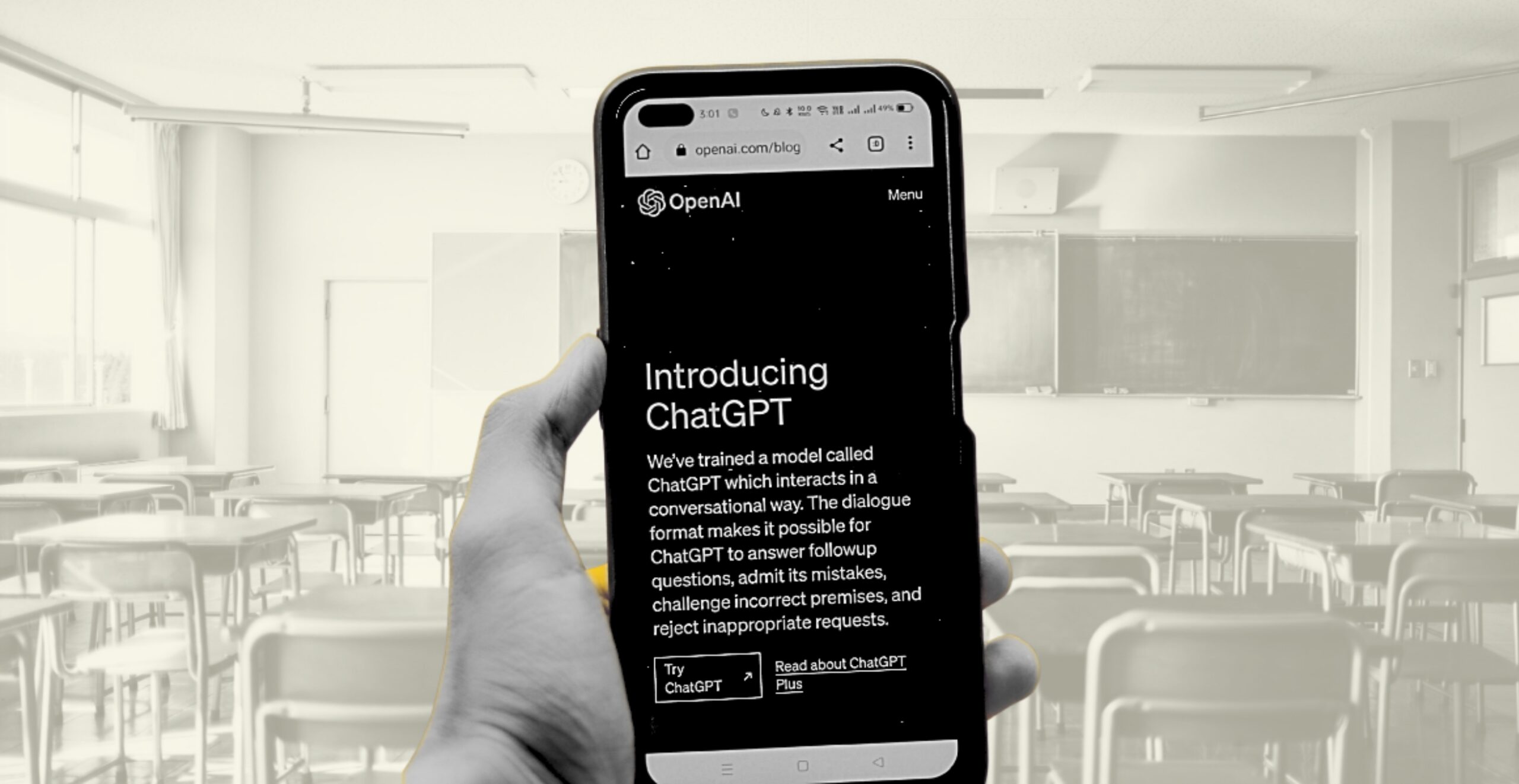
This struggle for national definition and the battle over the content and purpose of education are colliding with the arrival of AI in education. By now, the superlatives used to describe AI are endless—both as a path to a new day, and as a path to doomsday. It is still unclear where this will all settle. The list of descriptors of AI is so long it doesn’t warrant new attempts to capture its potential impact or gravity. In education, AI-enabled tools are already transforming what is taught and how. Whole schools are emerging that are AI-based, and virtual AI tutors are allegedly personalizing instruction and making teaching and learning more efficient and effective. Students are using AI tools to do more with mere prompts and less instruction.
It can all be considered revolutionary, as the Big Tech and edtech companies that make the tools suggest it is. Perhaps. But what do these tools do to change the fundamental structure of American education? What do they do to break the perennial correlation between race and academic achievement, or race and the quality of school students attend? What does a highly efficient AI-enabled school operating in a state that has banned the teaching of Advanced Placement (AP) African American Studies offer efficiency in? AI is helping those students be efficient at learning what? How does the application of AI-enabled tools affect educational outcomes in schools that are profoundly segregated? When the purveyors of these technologies claim that they will close gaps and improve the educational experience for all students, what does that really mean?
The instinct in the tech sphere is to suggest that it is not within the purview of Big Tech or the edtech companies to influence the foundational structure of American education. Rather, their role in education is to offer tools to make it better. However, their claims of revolutionizing teaching and learning, of unlocking the potential of education, and of transforming the institution of school suggest otherwise. The cynic would say their aims are financial, and the outcomes in education are merely incidental to that end. Regardless, we cannot have it both ways—claiming to revolutionize education but doing nothing about the core injustices that warrant revolt in education. That is how the awe of AI is luring our attention away from the slow and steady assault by America’s race demons. The enthusiasm, the words, and the clamor are a veil for vacuous neglect of the core justice fight at this critical milestone in American history.
More specifically, this collision of AI in education and the resurgence of race demons makes for a precarious time in science, technology, engineering, mathematics, and computing (STEM) education. For the better part of the first quarter of this century, the rise of Big Tech has made computer science (CS), and computing education more broadly, among the most popular subjects in American higher education. The rise of the FAANGs—Facebook, Apple, Amazon, Netflix, and Google—reconfigured the imagination of American young people.
Now, Nvidia has taken that allure to another level. While that enthusiasm is beginning to wane, in some ways because of AI, over the first quarter of this century, Big Tech solidified the equivalence of tech skills, wealth, and power. It produced men who would start their own personal space programs. It allowed mid-level employees to become millionaires. It enabled the manifest des-tiny of a generation of gentrifiers. The technologies became verbs in our lives. The allure was extraordinary. It was a pathway to the new working rich, a new gilded class in America. Computer science departments at universities across the country saw record enrollments. At the nation’s most elite universities, CS departments became impossibly selective. Only the nation’s absolute top students were eligible for consideration, let alone admittance.
In the K-12 world, STEM camps, STEM schools, STEM certifications, STEM students, and STEM curricula became the mileposts against which educational progress and value were measured. Parents of school-age children over the last several years can attest. The child studying English was met with loving lament, while the one pursuing computer science at Stanford University was the flag post of family pride. All this was happening with a coincident and successful assault of affirmative action in higher education. And now, a massive upheaval in the tech workforce has upended the assumptions we’ve held for the last two decades.
The question was never: What will happen to George Floyd if I do not stop to fight on his behalf? The question all along was: What will happen to me if I don’t appear as if I am?
All this at a time when the resistance to Black progress is not just the chronic low expectations of Black people born of the country’s origin story. The resistance is an ignited, unmasked, vengeful assault of a kind my generation has never experienced. Said another way, Black people are facing the threat of being recaptured into slavery in another form: digital slavery.
This is not an argument of fatalism, rather an homage to the sanctity of memory. We’ve been groomed in this century to seek bulleted recommendations, the seven steps to swift transformation—of anything, from weight loss to advanced manufacturing. We’ve become so solution-oriented that accurately identifying the parameters of a complex problem is becoming a dying art. This challenge doesn’t lend itself to swift transformation or an obvious solution. The average tenure of an urban school district superintendent in the United States is now 2.7 years; for Black women superintendents, it is 18 months. That isn’t long enough for a child to get from first to third grade. Transformation under what consistent leadership? The claims that AI in education and AI literacy will be transformative to American education and will elevate Black students and close gaps are absent memory. Only an explicit, committed fight for educational justice can do that. Those making the claims are not looking back, nor are those accepting them without critique. When the tech leaders professing to offer help, to offer AI in education, are the very ones standing by as we’re being publicly damned, there is an inherent hypocrisy at hand. Why would I trust their claims, or their professed interest in my well-being? That hypocrisy has long American roots, too.
Given the 250th national milestone, mention of the Constitution is relevant. Within that very document, the contradictions concerning Black people are spelled out in the original language that originalists are so devoted to. We are the “three fifths of all other Persons,” in a land where all men are created equal. In the era of George Floyd, when the Big Tech commitments to racial equity and justice were raining down like heavenly manna, in some circles, there was a sigh of relief—finally, the most powerful agents of our time were taking note and committing to racial equity and justice. One American season later, the race demons raged and all of those commitments are dropped. The language, the words, the people, the sentiment erased, the websites vanished, the funds dried, and the true spirit of self-interest revealed.
The question was never: What will happen to George Floyd if I do not stop to fight on his behalf? The question all along was: What will happen to me if I don’t appear as if I am? Memory is the anchor of discernment and offers clarity of sight to know which are the solid rocks upon which to stand. The glittering claims of what AI in education will do, offered by those who abandoned us in our hour of need, are not those rocks.
__________________________________

Excerpted from The Bullwhip’s Algorithm: Artificial Intelligence and America’s Racial Caste System by Kamau Bobb (Beacon Press, 2026). Reprinted with permission from Beacon Press.

Kamau Bobb
Kamau Bobb is the founding senior director of the Constellations Center for Education in Computing at Georgia Tech. He is the former director of STEM Education Strategy and Research at Google and a former program officer at the National Science Foundation in the Directorate of Computer and Information Science and Engineering. During his federal service, he served on President Obama’s MBK STEM Taskforce. Prior to his appointment, Dr. Bobb was the director of the STEM Initiative for the University System of Georgia. Kamau holds a PhD in Science and Technology Policy from Georgia Tech and MS and BS degrees in mechanical engineering from the University of California, Berkeley.