Captain America, Our First Antifascist Superhero
Peter Meineck on the Ancient and Modern Inspirations Behind the Heroes That Populate the Marvel Universe
The word “hero” is derived from the Greek hērōs, which means “protector.” In ancient Greece certain mortals who had achieved kleos (glory or fame) in life were venerated in death. Their burial places were viewed as offering protection to the community, and they were honored like saints with festivals and religious rites. Yet a hero was not divine but a mortal whose larger-than-life acts, both positive and negative, had been remembered and preserved in myth.
Those myths were conveyed through performance, sung in the great halls of the elite, recited at festivals all across the ancient world, staged at the theatre to large audiences, and displayed on wall paintings, mosaics, vases, and sculptures that adorned both sacred sanctuaries and city-states. The manners by which stories of heroes were conveyed in antiquity were not so unlike the comic books, movies and TV shows, games, and high-profile PR events of the Marvel Universe.
If a hero was remembered, they were said to live on after death in the blessed fields of Elysium, a place of beautiful meadows in the underworld. If forgotten, the hero became just another shade in Hades. Mythic memory offered the closest thing a human could get to immortality. To be sung, and now written, about was to achieve a kind of mythic divinity.
It’s clear Captain America was introduced for one incredibly urgent purpose: to galvanize American youth against the Nazi regime.
For the Greeks, being a hero did not necessarily mean that you did something good or noble, more that the deeds you accomplished during your life achieved kleos—fame or glory. The most famous Greek hero was Herakles (Hercules), whose name contains the term kleos. Herakles was the son of Zeus and the mortal Alcmene, and he was celebrated in many cities all over the Greek world, from Spain to Anatolia. Though a son of Zeus and incredibly strong, Herakles was human. At his death he was the only mortal to achieve divinity. Yet Herakles led a very troubled life. He was despised by Hera, the queen of Olympus and goddess of childbirth and marriage, because she saw his almost-divine powers as a threat to the fragile relationship between the gods and mortals. If a mortal hero was this powerful, why would the humans even need the gods?
Herakles was most famous for completing twelve impossible labors imposed on him by his cousin Eurystheus (“broad strength”) who ruled the ancient city of Tiryns, a fortified citadel where Herakles was supposed to rule. Instead, Hera held back Herakles’s birth so his cousin, now born first, would inherit the crown instead. Since then, Eurystheus did all he could to get rid of his powerful rival, fearing he would one day be overthrown. So far, this sounds like an archetypal heroic tale—the protagonist denied his rightful place and forced to undertake impossible tasks to win it back. But the Herakles story takes a much darker turn: Each time he tries to marry and start a family, Hera drives him insane. In a fit of madness the hero does that which we consider the most unheroic—he slaughters his family. In many mythologies the hero is a troubled character, and their stories can leave us with the sense that none of us would really want that kind of fame.
At least with Herakles we can feel sympathy for him as his madness is inflicted by a god. But then there is another famous hero, Oedipus, and his tomb at Colonus near Athens protected the city from its enemies. He was famous for unknowingly sleeping with his mother and fathering children with her, then railing against the gods when he found out the truth. Not very “heroic” by our definition. But having Oedipus’s reputation protecting your land is a lot like having the Hulk as a border guard. On the face of it, the Hulk defies the heroic stereotype due to the damage caused by his uncontrollable anger, but when directed by the Avengers he becomes a force for good.
Herakles fulfills a similar heroic role in Greek myth. He doesn’t turn green and inflate in size, but he is a terrifying berserker, a warrior who goes into a rage-fueled, altered state when fighting, and his eyes twist in his head and blaze like fire. Herakles uses his great powers for good, defeating monsters and tyrants, but he also destroys what he loves, including his own family.
While the kind of protection offered by Herakles or the Hulk comes with the risk of uncontrollable rage and indiscriminate destruction, and Oedipus seems more of a supervillain than a benevolent guardian, there was a kind of Greek hero that was seen as a defender. This was the Alexandros, which means “a protector of others” in the sense of repelling enemies. Alexander the Great is the most famous bearer of this illustrious name, but it was also given to Paris, the prince of Troy and lover of Helen, even though his actions brought war. More than any other Marvel superhero, Captain America fulfills this role.
Captain America was introduced in December 1940 by Timely Comics, the forerunner of Marvel. At that time Britain had been at war with Germany for seventeen months. Adolf Hitler’s forces had swept through Europe. The Nazis were setting up concentration camps for Jews, Romani, queer people, academics, political prisoners, and anyone whom the regime considered “degenerate.” Britain was being relentlessly bombed by the Luftwaffe, Germany had invaded France, Belgium, and Holland, and the concentration camp at Auschwitz had opened. America was still a year away from entering the war.
From the beginning Marvel was defined by its superhuman characters set against the background of the coming war. Its first comic book, Marvel Comics #1, had been released by Timely in August 1939 and introduced several characters. There was the Human Torch, the Angel, Namor the Sub-Mariner, the Masked Raider, and a Tarzan-like figure called Ka-Zar. By issue #2, the Angel was shooting down Nazi bombers over Poland. Then in issue #3, Namor was sinking German U-boats. Right from the start Marvel’s characters were responding to real events in the world—and what’s more, they were taking a stand.
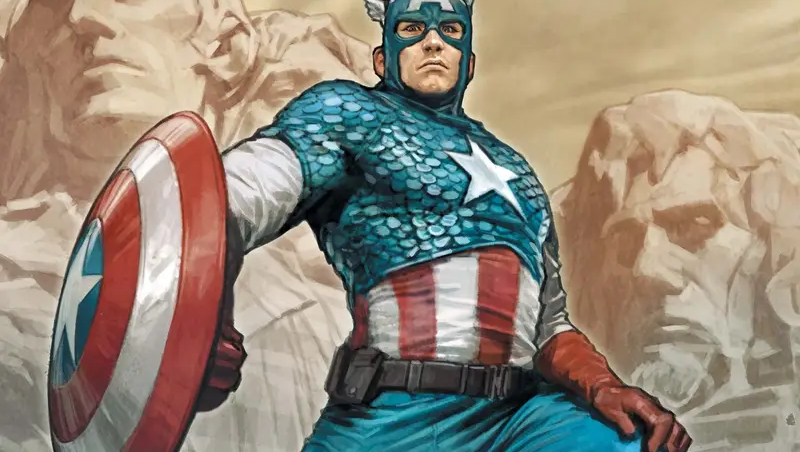
At the foundation of the Marvel universe lies something essentially heroic. Almost two years before America entered the war against the Axis powers, Bill Everett was telling stories about a superhuman figure from Atlantis doing battle with the Nazis. Then came Captain America in 1940, a new hero billed as “against those who would conquer the United States” and the “sentinel of our shores.” Readers were encouraged to sign and become one of Captain America’s United States Junior Sentinels. Then they would receive a membership badge and an ID card. The Captain was introduced bedecked in his red, white, and blue stars-and-stripes costume. He carried a kite-shaped shield, which resembled the one on the great seal of the United States, and wore a blue half mask emblazoned with a distinctive white “A” and edged with small wings.
Captain America’s creators, Jack Kirby (born Jacob Kurtzberg) and Joe Simon (Hymie Simon), were sons of Jewish immigrants from Europe and aware of the dangers of the Nazi regime. In The Human Torch #3, released in December 1940, a story by Carl Burgos (Max Finkelstein) already has the Torch battling a Hitler look-alike named “Hiccup.” In one brilliant panel a tendril from the Torch’s fiery wake singes off Hiccup’s Hitler moustache. In that same issue Namor helps the US Navy defeat a surprise seaborne attack by the Germans and is rewarded with a ticker-tape parade in New York City.
It’s clear Captain America was introduced for one incredibly urgent purpose: to galvanize American youth against the Nazi regime. When Captain America burst onto his own comic book cover that December, Kirby and Simon did not hold back. Now there were no euphemisms for Germany’s leader. Steve Rogers the supersoldier from Brooklyn is punching Hitler in the face with a mean right hook. The Nazi dictator falls on a map of America and a book marked “sabotage plans for U.S.A.” There was no doubt what Captain America was fighting for.
The publication of Captain America Comics #1 was a heroic act. In early 1941, in addition to the isolationist movement, there were others who were politically sympathetic to Hitler’s far-right government. The America First Committee had more than 800,000 members and 450 chapters across America. This organization included highly influential figures such as automaker Henry Ford and aviation hero Charles Lindbergh. Kirby and Simon must have known that Captain America was going to piss off a lot of very powerful people.
Jack Kirby described how the Timely office regularly received anonymous death threats against its staff because of Captain America’s anti-fascist content. One Nazi sympathizer buzzed threats through the intercom. Kirby said he rushed down to the lobby to confront him, but the man was gone. The story itself is emblematic of the real risks the early Marvel creators faced by introducing Captain America at such a politically charged and divided time. Things got so bad that the mayor of New York City, Fiorello La Guardia, gave Simon and Kirby police protection. Once the USA entered the war, Simon, Kirby, Burgos, and many other Marvel artists enlisted and went on to see combat. Not all heroes wear capes.
Captain America would develop from WWII anti-Nazi fighter to the leader of the Avengers. With his round American star shield, he epitomizes the archetype of the protector. Steve Rogers grows up in Brooklyn as a puny but resolute child. He stands up to bullies but does not have the physical strength or stature to defeat them. When World War II begins, he is determined to join the US Army despite successive medical rejections. Then he agrees to be injected with the superserum and is transformed into a much stronger, more athletic version of his former self. From then on, both in the comics and the later movies, Captain America stood as a symbol of American ethical behavior, even if sometimes that role edged the character toward the Greek philosopher Aristotle’s warning in his famous treatise on drama, Poetics, that a character should possess a mixture of both virtues and flaws.
Despite what Aristotle says, there are times we have needed Captain America’s ethical certainty and inherent goodness. A poignant reminder of this occurred in the 2012 movie The Avengers. Loki, the brother of Thor, has crashed a high society party in Germany. After a bold show of violent domination, he forces the fleeing guests to kneel before him. He tells them that this is their natural state and that he will be their ruler. But one elderly man resists Loki and refuses. Although not explicit, the implication is that he is a Holocaust survivor. Loki responds by aiming his mace to obliterate the old man, ready to snuff out his act of defiance. He fires—and the blast is suddenly deflected by Captain America’s Vibranium shield. Steve Rogers has arrived in the nick of time. He tells Loki that he’s seen this kind of thing before in Germany. Here is the defender in action, protecting humanity against harm, while reminding us of Marvel’s own genesis in the bold stories of its Nazi-busting heroes.
Captain America’s ethical constancy then became a dramatic foil for conflict over how a hero should conduct themselves in the modern globalized world.
Jack Kirby imbued the characters he created with traits that spoke to him directly, saying in an interview in the late 1980s, “I feel that my characters all have some part of my character. I feel that they are in me in some way.” Later in 2011 he said, “A character can’t be contrived, they have to have an element of truth.” There’s no doubt that Kirby would’ve loved to have swung that powerful right hook at Hitler on the cover of Captain America Comics #1.
Characters are at the heart of Marvel. The ancient Greek word charassein contains an element of what Kirby was taking about—that the creation of a character is in some way one of personal transference, a kind of mythological wish fulfillment. In Greek the term charassein means “to carve out” or “to engrave something distinctive.” This could be a sign on an embossed seal or coin, or the features of a dramatic mask carved by a highly skilled mask maker and worn in the Greek theatre. Charassein is to make a recognizable visual signifier, which was for Kirby and other Marvel creators the first step in realizing a new character, before any narrative was worked out. When Jack Kirby talked about “feeling” for a character and then sketching them out and creating a recognizable iconography, he was operating within the realm of ancient mythical opsis (spectacle).
Marvel was always a visual medium, from the first illustrated comics in New York to the international blockbuster movies that are viewed all over the world. In Poetics Aristotle said that it was the visual element (opsis) that was the best conveyer of muthos in the theatre. As “theatre” means “seeing place,” this makes sense, but he goes on to say that opsis is the element that can’t be explained as an art form or technique. Instead, it is the preserve of the mask maker, implying something mystical, ancient, and almost sacred.
The other definition of character is also derived from a Greek word, ethos, which means “the inherent quality of a person.” Kirby instinctively placed charassein and ethos together, seeking to communicate what his characters stood for through their visuality. There’s a vivid portrayal of this in the 2014 movie Captain America: Winter Soldier. The ethos of Steve Rogers won’t allow him to participate in SHIELD’s massive new surveillance program as he feels it is depriving people of their personal freedom. When he learns that the Nazi organization Hydra has infiltrated America’s government and counterterrorism programs, he knows he needs to embody the character of Captain America to inspire people to follow him. “If you’re going to fight a war, you need a uniform,” he says, before stealing his vintage, WWII-era red, white, and blue mask and costume from the Smithsonian Museum.
In Poetics Aristotle tells us that a character should be consistent, but even if they are inconsistent, they should at least be consistent in their inconsistencies! As Captain America transformed from a hero created to respond to the threat of Nazi domination to the leader of the MCU’s Avengers, those character consistencies, stronger in Captain America than perhaps any other Marvel character, seemed antiquated in the ethically challenging and increasingly culturally divided America in the 2000s. Captain America’s ethical constancy then became a dramatic foil for conflict over how a hero should conduct themselves in the modern globalized world.
In Winter Soldier, screenwriters Christopher Markus and Stephen McFeely emphasized Steve Rogers’s mythic status as a man out of time, a member of the “Greatest Generation” in his nineties, but with the biological appearance of a man in his prime and the strength, speed, and power of a supersoldier. Here America’s iconic warrior fights not only the deeply embedded conspiracy of Hydra, but also the growing use of AI technologies for surveillance and warfare. The film reflected contemporary fears about our dependence on technology and the power of an algorithm to decide the fate of millions of people at a swipe on a touchscreen.
__________________________________
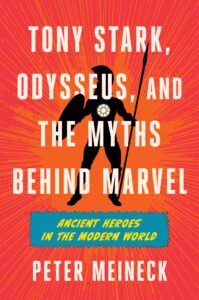
From the book Tony Stark, Odysseus, and the Myths Behind Marvel: Ancient Heroes in the Modern World by Peter Meineck. Copyright © 2026 by Peter Meineck. Published on February 17, 2026, by William Morrow, an imprint of HarperCollins Publishers. Excerpted by permission.

Peter Meineck
Peter Meineck holds the endowed chair of Professor of Classics in the Modern World at New York University. Originally from South London, Meineck trained with the Royal Marines and later discovered the theater, working as a technician, designer, producer, and director, from rooms above pubs to the Royal National Theatre. He founded his own company, Aquila Theatre, to mount bold new stagings of the classics, including a public program that works with veterans and refugees through Greek drama. He holds a PhD in Classics, has published widely on ancient performance, and has been teaching mythology for nearly thirty years.