Can Zohran Mamdani Survive at the Intersection of Identity Politics and Democratic Socialism?
Mychal Denzel Smith on the New Mayor’s Uncertain Relationship With New York’s Black Voters
For the next four years, Zohran Mamdani will be the most scrutinized politician in the United States. Part of that is the nature of being the mayor of New York City, the financial and media capital of the country. There’s more at stake here, more attention paid. It’s also because he is a political phenomenon, rising from less than one percent name recognition to become mayor of the largest US city, and in the process defeating the disgraced former governor of New York Andrew Cuomo (twice).
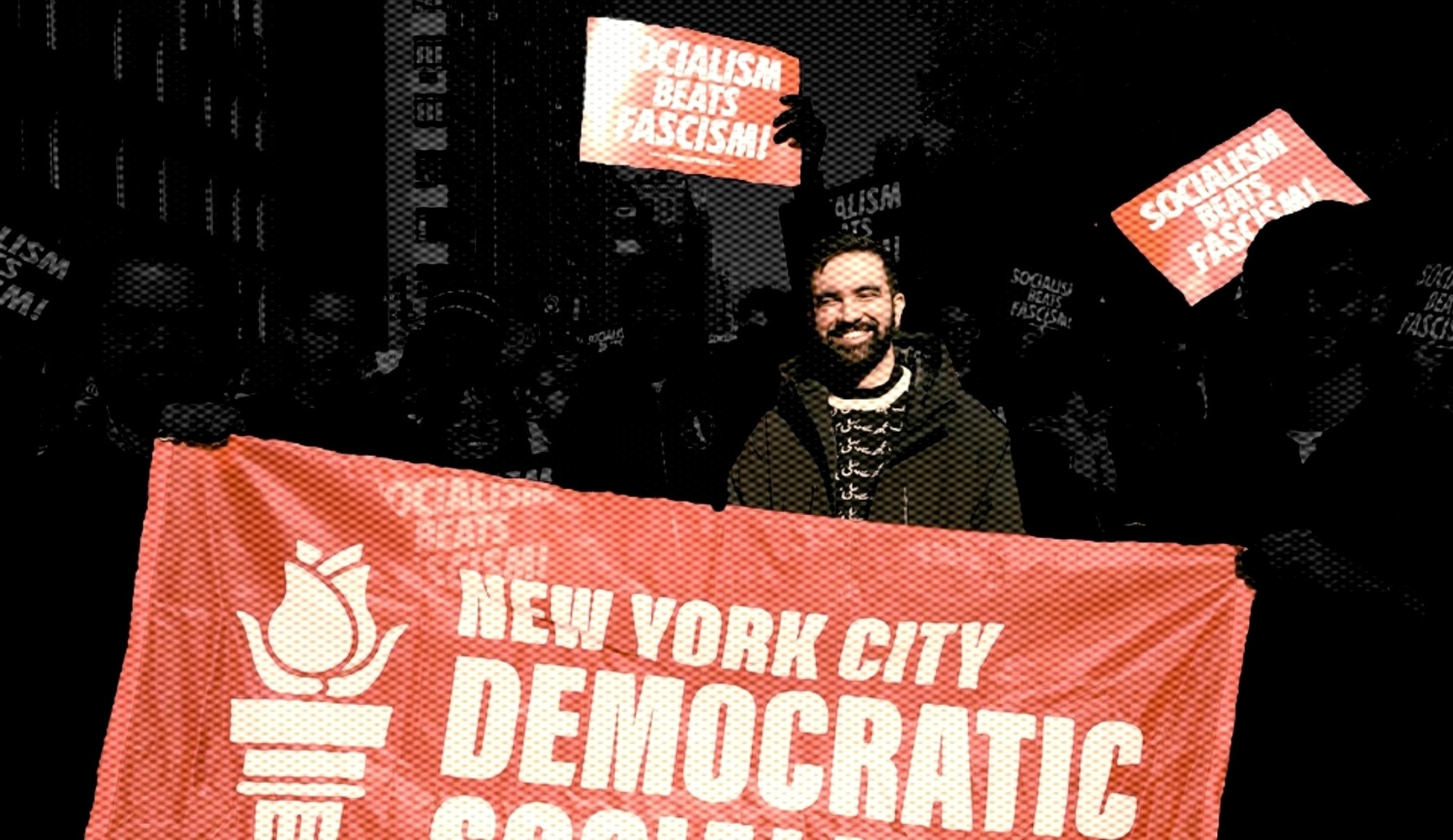
And then, of course, there is the fact that he is a democratic socialist—his is the most significant electoral win for the revived Democratic Socialists of America, of which he is a member, at a time of their growing membership and influence. Everyone, for different reasons, will be watching to see if this experiment in democratic socialist governance in a city as diverse and unwieldy as New York City will succeed or fail.
Mamdani will (and already has) receive criticism from left, right, and center. The right and center can largely be dismissed for what they are: fear of the emergence of a new world, one in which the traditional powerbrokers who have served at the behest of capital are no longer relevant, supplanted by those with genuine interest in improving the lives of working class people. The left is trickier.
There is an inevitable clash in the priorities of the left and the realities of day-to-day governance, especially when those priorities are not shared throughout the existing political system. Concessions will (and already have) be made to keep the government functioning. The left will have to decide which of these concessions are betrayals and which are necessities.
The other complicating factor is that, in the US, “the left” remains ill-defined; it’s a soft coalition of those who might be considered liberals, progressives, socialists, communists, anarchists, and every variation therein, with their own competing ideologies and priorities. Each decision made by the Mamdani administration threatens to upset and alienate one or more parts of this coalition, which he will need to remain intact in order to have any chance of enacting his agenda.
Mamdani struggled with “the Black vote,” or at least with older Black voters, Democratic party stalwarts who were unfamiliar with the young politician and distrustful of his affiliation with the DSA.
You can see this playing out in an early critique lobbed at him from some of New York City’s Black political class. In a recent story in the New York Times, several Black leaders voiced their disappointment that Mamdani has not chosen any Black deputy mayors. During the Democratic primary, Mamdani struggled with “the Black vote,” or at least with older Black voters, Democratic party stalwarts who were unfamiliar with the young politician and distrustful of his affiliation with the DSA—which is sometimes viewed as a project dominated by the political concerns of the white gentrifiers displacing longtime Black New Yorkers. He was able to recover Black support in the general election, but it is tenuous at best, with this early critique showing how easily it may fall away.
“He already doesn’t have the best relationship with the Black community,” the political consultant Tyquana Henderson-Rivers told the Times, “And it seems like he’s not interested in us because there’s no representation in his kitchen cabinet.”
It’s not true that there is no Black representation in Mamdani’s cabinet—Kamar Samuels has been appointed schools chancellor, Jahmila Edwards is the director of intergovernmental affairs—but there is no Black representation at the level of deputy mayor, a point which rankles those Black leaders who have made representation the focal point of their advocacy efforts. It’s an approach that has been derided or embraced under the term “identity politics,” though its current use bears no resemblance to the original theory put forth by the Black feminist group the Combahee River Collective, whose 1977 manifesto coined the term and defined it as part of their commitment “to struggling against racial, sexual, heterosexual, and class oppression.” For them, the way to identify these struggles were to look at their own identities—Black, queer, working class, women—to know which systems of oppression were operating and how to organize against them. “If Black women were free,” they wrote, “it would mean that everyone else would have to be free since our freedom would necessitate the destruction of all the systems of oppression.”
As it operates now, identity politics is little more than an assurance that a marginalized identity group will have representation, a spokesperson, placed within existing systems of power, ostensibly to represent the interests of the marginalized identity group they are the appointed spokesperson for, though that part is often immaterial. Mamdani’s predecessor, Eric Adams, himself the second Black mayor of New York City, appointed Black deputy mayors; one of them has gone on to work for ICE. The Adams administration was besieged with corruption at every level—the Blackness of the perpetrators was of no solace.
It’s a now old and tired refrain: too much focus on race distracts from the real economic issues wrought by the excesses of capitalism, which affect us all across racial categories.
Identity politics has fallen prey to what the political philosopher Olúfẹ́mi O. Táíwò has deemed “elite capture.” In his 2022 book, Elite Capture, he writes: “In the decades since the founding of the Combahee River Collective, instead of forging alliances across difference, some have chosen to close ranks—especially on social media—around ever-narrower conceptions of group interests.” And not just on social media—this has been the case with the professional Black political class for decades, a greater and greater narrowing of Black political concerns to whether or not a Black person, or a few, are present in decision-making rooms, with little-to-no concern about what those Black people are actually saying inside those rooms.
It’s an easy enough politics to critique, since it focuses so much energy on the who and not the what—the actual material consequences for those who have not been appointed the representatives. Indeed, it comes under fire often, but not always with good faith or understanding. In a recent Times op-ed, the writer Zaid Jilani, a strident opponent of the new identity politics, warns that:
…many Democrats hang on to a racial progressivism that will prevent the party from assembling a broad enough coalition to expand on its recent electoral successes and address America’s historic and contemporary injustices.
It’s a now old and tired refrain: too much focus on race distracts from the real economic issues wrought by the excesses of capitalism, which affect us all across racial categories, even whites, and signals the exclusion of white people from a potential coalition to fight against economic injustice. Jilani writes:
Research by the Yale University political scientists Joshua Kalla and Micah English has shown that framing progressive policies including increasing the minimum wage or Medicare for all around how much they benefit minorities or achieve racial justice makes it less likely that people will support those programs.
Democrats should instead think about selling candidates and policies as they would a consumer product. Would you buy something if its commercial told you how good it was for everyone except you?
Which would seem a sensible question, if you are a selfish person who has never purchased anything for anyone other than yourself. We buy things for other people all the time… if we care about them.
What some critics of “identity politics,” like Jilani, often want to direct us toward is a politics that does not consider race as a salient factor in US life at all—despite acknowledging the racist terror brought about by the current right-wing regime. Our response, they suggest, needs to be rooted in the shared concerns of the working class, the overthrow of our capitalist oppressors, because that is the primary engine through which all other forms of oppression operate. And it’s true, these systems work in concert with one another—the Combahee River Collective pointed us toward this understanding. But it is not the case that upending capitalism alone undoes all the other forms of oppression. If we won Medicare for all, or universal healthcare, tomorrow, this would be a great victory—but what would it serve a Black person who could finally go see a doctor who doesn’t believe they feel any pain?
To ignore race—or gender, or sexuality—while attempting to build working class solidarity is to say that there are some concerns of working class people that do not matter.
“The working classes [are] so much more than people who work,” the labor historian Robin D.G. Kelley writes in Race Rebels, and acknowledging should not be an impediment to multiracial organizing efforts, but rather a way to see what working class people across different ideas actually need. In her book Women, Race & Class, Angela Davis supplied this critique of the suffrage movement that is applicable here:
Susan B. Anthony should not, of course, be held personally responsible for the suffrage movement’s racist errors. But she was the movement’s most outstanding leader at the turn of the century—and her presumably ‘neutral’ public posture toward the fight for Black equality did indeed bolster the influence of racism within the NAWSA [National American Woman Suffrage Association]. Had Anthony seriously reflected on the findings of her friend Ida B. Wells, she might have realized that a noncommittal stand on racism implied that lynchings and mass murders by the thousands could be considered a neutral issue.
To ignore race—or gender, or sexuality—while attempting to build working class solidarity is to say that there are some concerns of working class people that do not matter.
Unfortunately, from critics like Jilani, the messaging around working class solidarity seems to always trend toward “accept more racism” rather than “be less racist.” Non-white people are expected to organize alongside and excuse white racists because of our shared interests in defeating capitalism, with no assurances our particular concerns around white supremacy addressed. And in the absence of a working class coalition that reckons with this issue, those elites who have captured identity politics are able to step in and siphon off more support for their inept agenda because it does at least acknowledge the salience of race.
What Táíwò suggests as an antidote to this is a “constructive political culture” that would “focus on outcome over process—the pursuit of specific goals or end results rather than avoiding complicity in injustice or promoting purely moral or aesthetic principles.” Matters of representation are not wholly inconsequential, but they are not the ends—the specific goals must remain significant material change in the lives of all working class people. But those goals can not be so narrowly defined as to exclude any issue that is not a purely economic one, even if the expense is the loss of support among those who refuse to see beyond their own racism, heterosexism, and queerphobia. We must demand the world we want.
The Mamdani administration is already carrying an immense weight of expectation, but in this there is also a unique opportunity to show how democratic socialist governance can go beyond an insufficient politics of representation, while also expanding the notion of what can and should be working class concerns. It will not be perfect. Mamdani will face criticism at every turn. But the hope of the new era he is helping usher in is not perfection, simply the will to try.
Mychal Denzel Smith
Mychal Denzel Smith is the New York Times bestselling author of Invisible Man, Got the Whole World Watching, and a Knobler Fellow at The Nation Institute.