“Bridget Jones meets Slavoj Žižek.” And Other Wild Book Pitches From My Inbox
Maris Kreizman on What Makes a Good Publicist Pitch
When I’m looking for topics for this column I try to identify what book-related thoughts have been top of mind day after day. What am I constantly thinking about? The answer, more often than not, is book pitches.
On a normal weekday I receive about 40 to 50 email pitches from publicists; I try to read them all even if I can’t respond to all of them. Sometimes even reading them all is difficult; I have other jobs I need to do, after all. But I know that behind every pitch there’s an author and an editor and a bunch of other interested parties who are invested in my response, and I try to take this responsibility seriously.
When I feel like my life is out of control it’s often because my inbox is near bursting with pitches, and I realize how few of these books will receive the attention they deserve. It’s especially overwhelming because there are approximately four traditional media outlets remaining that cover books at all and I’m just a freelancer; I don’t make any larger editorial decisions. I only have control over what I read.
There are some components of a pitch that will immediately draw my attention. I’ll always stop to read a pitch for a book if it has been written by an author I know, which, after covering books for as long as I have, is many. Sometimes a clever title will stop me (“Dear Monica Lewinsky” stands out as a recent one), or a book cover that is particularly eye-catching—most recently I was drawn to the cover art for Burnside by Devyn Defoe, a novel coming from Astra House this August.
Publicists these days have a really tough job.
I will always take notice when I hear from a publicist who knows me and who knows what I like, and who sends me things based on my taste. Something like, “You raved about X literary novel, Y literary novel should scratch those same itches.” Or, “You like narrative nonfiction with a social justice component, here’s a great new one.”
I’ve already written about how unhelpful the construction of an X meets Y pitch is, where X and Y are both popular television shows or films or, like, big megabestsellers whose popularity would be more than difficult to replicate. For comparative titles, the more detailed and realistic the better.
Why don’t I show you some good examples?
“Booksmart meets Kristen Arnett’s Mostly Dead Things meets Karen Russell’s Swamplandia!”
Another one that made me stop what I was doing: “What Mary Gaitskill would be writing if she were a member of Gen Z, what Emma Cline would write if she were in the mood to get sloppy, or Jen Beagin if she traded the bee-filled countryside for the sticky dive bars of LA.”
One more: “Bridget Jones meets Slavoj Žižek.” I have no idea if this book will be for me, but you have to admit the premise is intriguing.
I won’t give you any bad examples because, once again, publicists these days have a really tough job. See: traditional media is crumbling and every single person on the ground in corporate publishing is doing the jobs of two or three people. But here are some of the names I still see thrown around in pitches that don’t particularly excite me: Not every twisty domestic thriller is the new Gone Girl. Not every young author who writes about disaffected young protagonists is the new Sally Rooney.
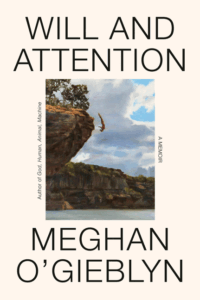
Then there are the practical details that should be but aren’t always included in every pitch: I always want to see a cover, preferably as low-res as possible so it doesn’t take up a lot of space in the inbox. ISBN and publishing date and imprint are also all crucial information. I can look them up, but, as I said, I get 40 of these a day. Help me save some time!
I don’t feel morally obligated to give every single pitch my attention, of course. I’m quick to delete pitches for books that are 100 percent outside my wheelhouse. No, I don’t want to read a former CEO’s debut self-published memoir about how they climbed up by their bootstraps to conquer the world of real estate. Same goes for the three separate books that were pitched to me at the same time by the same publisher, all themed around why OJ Simpson is innocent.
Still, no matter how much triage I do in my email inbox, great books with great pitches will inevitably still fall through the cracks. I hate this and wish it could be different. It’s really tough out there.
So to the publicists who send me great pitches, and the authors they represent: I see you. I may not be able to read you, let alone cover you, but I see you.

Maris Kreizman
Maris Kreizman hosted the literary podcast, The Maris Review, for four years. Her essays and criticism have appeared in the New York Times, New York Magazine, The Atlantic, Vanity Fair, Esquire, The New Republic, and more. Her essay collection, I Want to Burn This Place Down, is forthcoming from Ecco/HarperCollins.