Bret Anthony Johnston on Listening to the Unconscious
In Conversation with Mitzi Rapkin on the First Draft Podcast
First Draft: A Dialogue of Writing is a weekly show featuring in-depth interviews with fiction, nonfiction, essay writers, and poets, highlighting the voices of writers as they discuss their work, their craft, and the literary arts. Hosted by Mitzi Rapkin, First Draft celebrates creative writing and the individuals who are dedicated to bringing their carefully chosen words to print as well as the impact writers have on the world we live in.
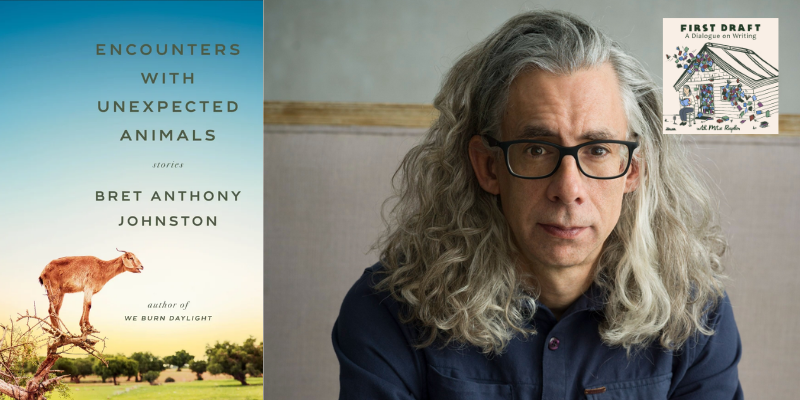
In this episode, Mitzi talks to Bret Anthony Johnston about his new story collection, Encounters with Unexpected Animals.
Subscribe and download the episode, wherever you get your podcasts!
From the episode:
Mitzi Rapkin: I’m very fascinated about – I guess you would call it the unconscious, but maybe you have a different word for it – when your characters start telling you what to do, because it is something you can’t really teach. Maybe you can really make students aware of paying attention to their instincts and even what’s going on in their physical body when they’re writing. How do you explain that your characters telling you what to do?
Bret Anthony Johnston: You and I are on the exact same page about this, because I really talk about it and implore students to think about it in terms of paying attention. And the amazing writer Amy Hempel, she has this phrase that she’ll offer to students and to me – and Amy’s a dear friend and one of the first readers of everything I write – but she has this kind of mantra where she says, What do you have in the story that’s already enough? Whereas a lot of writers, especially emerging writers, people who are just learning their craft, their default impulse is to constantly reach for something new, of like, Oh, I’ve already set a scene in this room. I’ve already had this character say this. I’ve already had had this other character do that. So, I need to do something new. I need to set this next scene in a different room. I need to have them go somewhere else. I need to have them do something else. And Amy’s advice is, what do you already have that’s enough? Which is a way of saying what can you what can you bring back that’s going to reward the reader’s attention, because they saw this thing before. So, I think about it in in terms of attention, of where has the reader’s attention been up to this point? When we’re drafting stories, where has your attention been? What are the things in the story that have a certain kind of heat or mystery around them? Give yourself permission to pay attention to those even if they weren’t in your original plan, even if they didn’t seem important to you because they don’t fit into this model of what you want the story to be. And I feel like each draft we take things through as a writer it should rinse the writer a little bit more out of the draft so that the writer takes up less space and the characters take up more space. So, you’re paying attention to what matters to the characters, as opposed to what matters to the writer.
***
Bret Anthony Johnston is the author of the award-winning short story collection Corpus Christi, the novels We Burn Daylight and Remember Me Like This and the editor of Naming the World: And Other Exercises for the Creative Writer. His short stories have been published in anthologized in New Stories from the South: The Year’s Best; The O. Henry Prize Stories and The Best American Short Stories. His work has been widely translated and appears in The New Yorker, The Atlantic, Esquire, The Paris Review, The New York Times Magazine and Virginia Quarterly Review. He is the Director of the Michener Center for Writers at the University of Texas at Austin. His new short story collection is Encounters with Unexpected Animals.
First Draft: A Dialogue on Writing
First Draft: A Dialogue on Writing is a literary podcast produced and hosted by Mitzi Rapkin. Each episode features an in-depth interview with a fiction, non-fiction, essay, or poetry writer. The show is equal parts investigation into the craft of writing and conversation about the topics of an author’s work.