Beyond “Women’s Fiction...” On the Quiet Brilliance of Barbara Pym
Kerry Clare In Praise of Writing Stories Attuned to the Details of Everyday Life
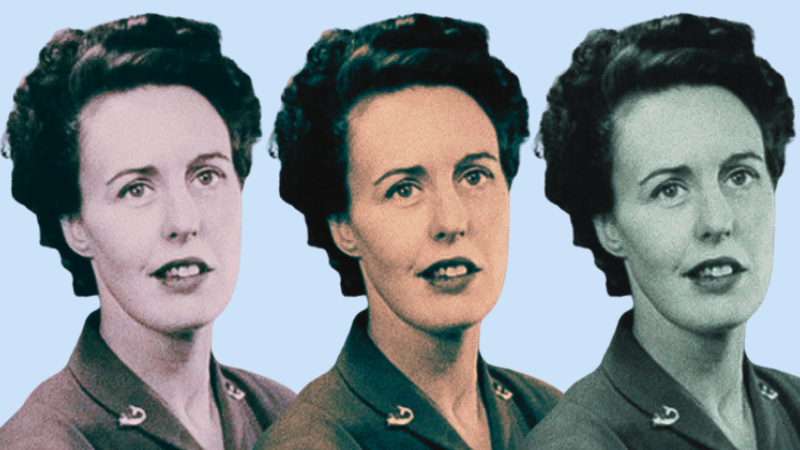
Photo by kind permission of the Barbara Pym Society.
I was first drawn to Barbara Pym for her idiosyncrasies, fancying the idea of reading about jumble sales, pale curates, and squabbles over floral arrangements on church altars. The incongruity of her fictional world with my own was charming, and I also appreciated how its crises tended to be the kind at least partly mitigated by somebody putting on the kettle. (According to the protagonist of No Fond Return of Love, “Life’s problems are often eased by hot milky drinks.”)
Pym’s comic novels, on the surface, are simple, sometimes even silly, stories about sisters, village life, petty church and office politics, and the quiet lives of maiden aunts. But underneath, these are novels about love, loneliness, and longing; social connections, or lack thereof, plus that curiosity about others which is fuel for gossip; and the precarity of an unmarried woman’s place in society—made even more precarious by the fact that Pym, unlike Jane Austen, to whom she’s often compared, didn’t hinge her plots on marriage, which is perhaps a twentieth-century author’s prerogative.
Pym’s revival came about not because she had finally managed to connect with the times, but because the quiet brilliance of her novels about ordinary women’s lives, and the value of such stories, were finally being recognized.
Although in almost every other way, Pym was never so au-courante. Her characters were situated outside of time and fashion, and this—along with how dismissible women’s stories have always been—was what led the once-bestseller to fall from favor mid-career in the 1960s. By then, Pym’s novels of spinsters, vicars, and mousy academic researchers seemed fusty and staid, and her books might have remained out of print forever were it not for their storied rediscovery in 1977 when Pym was named not once but twice in the Times Literary Supplement—by Philip Larkin and David Cecil—as one of the most underrated authors of the twentieth century. Soon after, Pym’s seventh novel was published, her previous books returned to print, and she found a publisher in America for the first time. A Quartet in Autumn was nominated for the 1977 Booker Prize, and Pym would manage to complete two more novels before her death from breast cancer at age 66 in 1980.
Pym’s revival came about not because she had finally managed to connect with the times, but because the quiet brilliance of her novels about ordinary women’s lives, and the value of such stories, were finally being recognized. (It certainly helped that two eminent male writers were the ones doing the recognizing.)
The Barbara Pym universe is rendered in small-scale, and the details are what matters. “Life was like that for most of us—the small unpleasantnesses rather than the great tragedies; the little useless longings rather than the great renunciations and dramatic love affairs of history or fiction,” remarks Mildred Lathbury in Excellent Women, a post WWII novel that barely mentions the war, and which is instead about the often invisible women whose labors keep the wheels of the world turning. And it was as a tribute to these women, to this labor, and to Pym’s literary legacy, that my novel Definitely Thriving found its focus.
It started as a challenge—could I write a Barbara Pym book, but situate it in the present day? There would be some updates—instead of a spinster, my protagonist, Clemence Lathbury, is a divorcee. In place of a London bedsit, she moves into a Toronto rooming house. I did provide her with a traditional Pymmish occupation—after the closing of the magazine she’d spent her career writing for, Clemence starts working as an indexer, which is still not entirely anachronistic in 2026, although her friends meet the news with disbelief: “People still do that? I assumed it’s all automated.”
But it’s not, or not always, and the notion that people are still necessary (for indexing and all things) is essential to Definitely Thriving—just as it was to Pym’s novels, each of which are careful considerations of community. We all need people, however much our own little worlds might be quieter, tidier, and less complicated without them.
Clemence is reminded of all this when she becomes involved in her new local parish, her lack of religiosity notwithstanding, thanks to an overbearing landlady, who coerces her into helping to organize the church’s holiday jumble sale. Because one cannot attempt fiction in the tradition of Barbara Pym and not include a jumble sale. Jumble sales—rummage sales in North American parlance, at which the contents of one’s own private corners are put out to mingle with those of others, to be picked over by neighbors and strangers—are absolutely an exercise in intimacy and absurdity, and the one in my book is also hugely consequential, raising funds for a new roof for the church building at which hundreds of people line up weekly to receive food bank items, the last layer in a tattered social safety net.
Bedsits, jumble sales, heartaches assuaged by hot drinks—it turns out that Barbara Pym’s touchstones are as resonant as ever.
My story would also require a love interest, however unorthodox. Fortunately, Clemence’s outrage at the dusty local second-hand bookshop’s insistence on cataloging all female novelists under “Women’s Fiction” instead of “Literature” brings the pale young bookseller into her orbit. He proves ideal as “an unsuitable attachment,” which is a Pymmian notion and also just the thing for a woman resisting the romantic conventions by which she had previously been strangled.
And the matter of the cataloguing itself launches Clemence’s personal crusade against that age-old difference of value applied to men’s and women’s stories. “This is an important book, the critic assumes, because it deals with war,” wrote Virginia Woolf in A Room of One’s Own almost a century ago. “This is an insignificant book because it deals with women in a drawing-room. A scene in a battlefield is more important than a scene in a shop—everywhere and much more subtly the difference of value persists.”
And so it has continued to persist in my fictional bookshop, just as it had when Pym’s work went out of print 60 years ago. This difference of value leads to the minimization of women’s stories, to diminutive distinctions like “chick-lit” and “chick-flick,” to the relegation of any rom-com to “guilty pleasure”, instead of an intelligent book with a great story and important things to say about the world. But what all this also means is that there’s been something subversive about “women’s fiction” all along, whatever the term happens to mean to you. These sometimes deceptively simple books are quietly powerful demonstrations that the stories of ordinary women are significant, worth telling, and also a pleasure to read. That a book needn’t be, as per Kafka’s rather dramatic prescription, “an ice-axe to break the frozen sea within us.” A good book can be a comfort, a blanket, a friend.
Bedsits, jumble sales, heartaches assuaged by hot drinks—it turns out that Barbara Pym’s touchstones are as resonant as ever. Her legacy indeed lives on in Definitely Thriving, a book which dares to treat the small canvas of an ordinary woman’s experience with seriousness and respect, all the while maintaining that necessary sense of humor which makes the whole thing—life itself—mostly bearable.
__________________________________
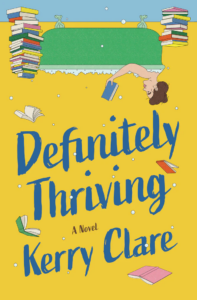
Definitely Thriving by Kerry Clare is available from House of Anansi Press.

Kerry Clare
Kerry Clare is the author of the novels Asking for a Friend, Waiting for a Star to Fall, and Mitzi Bytes; and editor of The M Word: Conversations about Motherhood. Her essays have been nominated for National Magazine Awards. She edits 49thShelf.com, a website about Canadian books, and writes about books and reading on her longtime blog, Pickle Me This. Kerry Clare lives in Toronto with her family.