Beyond Memoir: A Roundtable on Health, Identity, and the Invisible Injury We Aren’t Talking About
A Conversation Between Molly Gaudry, Carmen Giménez, and D/Annie Liontas
My new memoir, Fit Into Me, is about trying to write Fit Into Me: A Novel in the aftermath of a mild traumatic brain injury. It documents the years of my life, from the end of my MFA program into the beginning of my PhD coursework, when I was unable to concentrate or focus for any length of time, and ultimately, this book is about finding my way back to reading and to writing. I can’t say exactly when I first began writing about my brain injury, but I’m certain I did so in order to try to process my grief.
The hardest part for me was how long it took to accept the death of my former self. I could no longer read or write or comprehend at the pace I was used to, and I could no longer walk through or just exist in any kind of crowded public space. It would take years before I could confront these limitations in my work.
One of the most important parts of my recovery was finding the right medical professional, in my case a vision therapist who was the first person who understood what I was going through. But that was nearly twelve years ago now, and while I’ve come a long way in my recovery, the idea for this roundtable emerged after I crossed paths with Carmen Giménez at the Southampton Writers Conference this past summer, where she began telling me about her recent brain injury and the novel, Larry, that she was writing about it.
It took me years to accept I was someone else before what was seemingly a mild brain injury.
Talking to Carmen, I felt so much less alone. And during our conversation, I suggested she read D/ANNIE Liontas’s memoir Sex with a Brain Injury, because reading it also helped me to feel less alone. After the conference, I reached out to D/ANNIE, who generously agreed to join Carmen and me for this conversation. Before we begin, I just want to thank you both for being willing to share more here about what it means to lose and rewire our relationships to language, to literacy, and to our literary identities after brain injury.
—Molly Gaudry
*
Molly Gaudry: How did you come to begin writing about your concussions, and how is it that Sex with a Brain Injury and Larry became your first public-facing books about your experiences?
Carmen Giménez: One symptom after I hit my head was visceral: anything head-injury adjacent made me dizzy and nauseous, so writing about it felt impossible. I didn’t write much for a long time anyway. Then I found the right container, the right character for all this weird liminal place. Larry is a novel about a middle-aged woman named Gloria with a traumatic brain injury who becomes obsessed with the conspiracy theory that two One Direction members are secretly in love, while she’s also experiencing a queer awakening and the end of her marriage. The book braids her brain breaking down with heartbreak, and her descent into this fandom called Larry Stylinson to escape what she describes as a world with a billion sensory channels.
That didn’t happen but Larry Stylinson was the type of bland succor I could have used when I was first injured. She has to live in a world that asks little of her and this fandom does just that and more. It’s about what’s hidden and what’s performed, which is also what it feels like to live inside a damaged brain, trying to convince people, including myself that something fundamental has changed.
I was also moved by you, Molly, naming the death of a former self. It took me years to accept I was someone else before what was seemingly a mild brain injury.
D/Annie Liontas: I remember hearing the phrase “living in the basement” for the first time. I was at a conference in Philadelphia, sitting in on a panel about brain injury and language, telling myself that I was there to do “research.” I was writing a character who had been hurt very badly. He had to leave school, go home to live in his mother’s basement. The world was too much for him: sunlight, leaves in the wind, the sound of traffic. When the presenter explained that many brain injury survivors live in the basement—not just physically, but emotionally, spiritually—I burst into tears. Someone behind me handed me a napkin that smelled like ham, and that’s when I realized: I wasn’t there for my novel, I was there for me. In that moment, I was so grateful to finally have language for what had been happening to me. But I was frightened, too.
I had to ask myself—What does it mean to be a writer, divorced not only from my sense of self, but from words, imagination? For me, writing is about making the unseen seen, and there is almost no experience as invisible as brain injury. I knew I wanted to write this book for the thousands of people who feel isolated, alone, trapped in the basement.
I thought I would never write again.
MG: I think—in an environment like a conference, with all the lights and movement and extra demands on paying attention—that if someone handed me a napkin that smelled like ham, I might have had to hide in my hotel room for the rest of the day and night. But it took years for me to learn what I can and can’t handle, what triggers I’m most likely to encounter in different environments, and to what extent I am willing to risk exposure when entering public spaces. It took time to get more comfortable saying, “No,” too.
I’m curious about what it’s like for you two, and what continues to be a frustration in your personal or professional lives, post-concussion?
CG: I need a great deal of time to recover from stress, from being around people. Before I hit my head I didn’t even really believe that overstimulation was a thing. I lost some sense of smell and have vision problems. My memory could work better. Early on I would feel helpless and aphasic even after an hour of being in the world, and the only analogy was an infant who needs a nap. I can have much longer days now, but once I hit the edge of that frustrated infant-like helplessness, I have to stop because then it’s just messy. Like I’d see myself launched into orbit. I was teaching my son to drive, and he’d have the music going, and the level of hypervigilance it required would make me lose my mind. I didn’t understand how keeping my eyes on the road not only made it impossible for me to do anything else but also made it that one new channel would send me over the edge. The self-doubt is hard; I wouldn’t believe myself, like self-gaslighting. I saw a neuropsychiatrist and was like, is this a thing, and she said, you could have died. Because it’s not just about scale.
I thought I would never write again. I could edit older work, but I couldn’t recover the ephemeral vibration that led me to new work. This foggy dullness from the day chipped away at the precious dregs of brain energy I had on any day. I’d revise poems wondering who this person was who could do language so much better than I could. That’s not a humblebrag. Another frustration is what I left behind, what I couldn’t make because of losing time and brain space. So when Larry took shape as a project, I was relieved and working at that level I could relish in the different brain. I just can’t hurtle anymore, which is great for novels. It’s also very lonely.
D/AL: Ongoing vulnerability is something I struggle with, as do most people with brain injuries. We have a higher rate of injury (you’re twice as likely to get a second concussion after you’ve gotten the first, and the odds only go exponentially up from there), and recovery takes longer. So you look okay, and sometimes you are okay, but then you hit your head, or you overdo it on work or outings, and you’re back in bed.
Brain injury affects every part of your life—work, sex, friendship, writing, relationships. I’m nearly ten years out from my first concussion, and that’s still true. It means constantly asking for help or accommodations. It’s a fight to take up that kind of space for anyone raised as a girl or woman. There is so much doubt surrounding our disability! We get it from our doctors, our partners, our employers. Unsurprisingly, there are historical roots for this, based in the insurance industrial complex and expressed today by other special interests. As a trans genderqueer person, doubt for me is a large part of the invisible struggle—as it is for the queers, women and BIPOC brain injury survivors I’ve spoken with.
How do you two experience doubt?
We don’t realize that nearly one in every two people involved with the criminal justice system has had a brain injury—before they ever step foot into a cell.
MG: One of the most frustrating things for me, all these years later when I’m as strong and healthy as I may ever be, is having to remind the people closest to me that I am often physically unable to do the things they keep inviting me to. For instance, I live on Long Island, about an hour and a half from NYC, but I can’t drive it easily because I avoid highways (tracking so many moving cars at that speed on the Long Island Expressway makes me nervous, and taking the service highway would double the commute time) and I avoid public transportation because the train is loud, bumpy, and can be counted on to smell bad.
After an hour and a half of this, I’m supposed to then go to an event? A loud, crowded concert? A literary reading in a bar with neon lights? To art galleries? And then take that train back home again? Everyone forgets that while they’re gaining a day in the city, I’m losing the day to the hard work of staying present, and then I’m losing at least the entire next day to rest and recovery.
And yet, I think that living with brain injury has taught me to slow down, to rest more, to say no. So I wonder if there is anything good, or in some way surprising, to come out of your experiences?
CG: I do a lot less “too much” now. I am deeply compassionate to people who’ve had TBIs. My father had a serious car accident, which I write about in Larry. Retrospectively, I see that he was suffering the aftereffects for years, and the instability was, in some way, physiological.
Annie, what you wrote about incarcerated folks and TBI was so deeply affecting to me, how something that is so common and overlooked can be so destructive. I experienced a great deal of doubt about the severity even though I was living it, sometimes really incapacitated. I thought that because I didn’t end up in a hospital in a coma, like the severity of the head injury informed the length of recovery. Then I saw a neuropsychiatrist and she said, you could have died. Because it’s not just about how it presents. I had a friend call me and tell me he hit his head on a dryer door and was knocked sideways for a long time and that was such a gift.
D/AL: Thank you, Carmen, I really appreciate that. We don’t realize that nearly one in every two people involved with the criminal justice system has had a brain injury—before they ever step foot into a cell. This is some of the work I’m hoping that Sex with a Brain Injury can do in the world, as a way to resist erasure.
I think of my injury like a trap door. I fell through it, and suddenly I have this glimpse into the human experience that I never expected (or wanted!) I thought I was an empathic person before all this–but the truth is, I wasn’t, not really. I was superior in my impenetrability and perfectionism. I could be hard on people. Now I think I hold the suffering of others in a more meaningful way.
I’ve been thinking a lot about how literary fiction, nonfiction, and poetry are positioned to create new narratives around brain injury. We’re having new conversations, bringing to light those experiences often overlooked or dismissed. How do you see that happening in your own work, or in the work of others?
I’m realizing that the metaphor of the time loop is not just about her grief, but also about the neverending experience of brain injury.
CG: My mother had early-onset dementia, so I witnessed the degradation of a brain over many years. It’s not a direct path and it’s not just forgetting. I had dinner a few nights ago with someone who suggested that memory, our past, is not behind us but ahead because of how it shapes our decisions, which form our lives, so if that’s true then your memory machine is disrupted. I read a lot about the brain as an ideal, like Catherine Malabou who offered the model of destructive plasticity to understand and make peace with how my mother was becoming another mother, a series of them.
Larry is also about what if I had a do-over. Gloria is actually a terrible patient, but she’s much better than I was: she goes to a few of her appointment, she rests. TBI is also very lonely. On the other side of infant edge, I’d be in the real but it wasn’t fun. The most important work I did in Larry was document how totalizing it was on a person’s health. Revisiting it, finding metonymies and metaphors to describe what it was like sort of made it real. I didn’t imagine the dog cone of hurt radiating around my head; as I wrote her story, the ghost of that pain stirred up.
MG: Actually, Sex with a Brain Injury is the first memoir about brain injury that I was able to read (and then, I didn’t just read it, I inhaled it). I think this is not unrelated, actually: as a transnational adoptee, I’ve long struggled to read others’ adoption memoirs; but the one I was able to read recently is Woman of Interest by Tracy O’Neill, because her search for her biological mother is written like a detective novel.
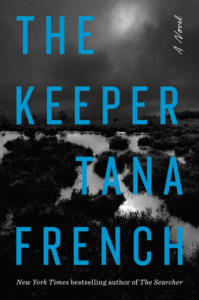
Similarly, your brain injury memoir, unlike mine, goes beyond the personal, goes beyond memoir, and becomes more, becomes reportage, becomes scholarship, and so because of all of your research I was able to read, and to learn more about this subject that I’m really only just beginning to enter into. After reading your book, I became braver, and when a friend asked me how accurately Tana French depicted brain injury in The Witch Elm, I was able to just pick up a copy and read it. And while reading that book, too, like yours, I felt less alone, I felt less unstable, I felt like there were others out there who understood what this feels like.
Recently, I completed a new novel, The Time Loop: A Speculative Memoir, about an assistant professor trying to write a spec-memoir about getting stuck in a time loop as a metaphor for being stuck in grief. This narrator, who at nine years old had only recently been adopted, is the only survivor of a car accident, and so she has to start another new life all over again, while growing up and struggling with lifelong post-concussion issues that plague her into her early career. I think, in the context of your question, I’m realizing that the metaphor of the time loop is not just about her grief, but also about the never-ending experience of brain injury.
D/AL: Time loop—that’s such an apt image! It makes me think about how many stories about brain injury have yet to be told. How the experience of brain injury has been so warped by culture, politics, fiction, history so as to make our current conception of it entirely false—and when that happens, who gets left out? I’m grateful to be doing this work alongside you both, deepening our understanding, helping people feel less alone.
__________________________________
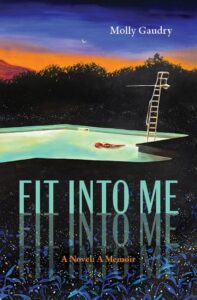
Fit Into Me: A Novel: A Memoir by Molly Gaudry is available via Rose Metal Press.

Molly Gaudry, Carmen Giménez, D/Annie Liontas
Molly Gaudry is the author of the verse novel We Take Me Apart, which was a finalist for the Asian American Literary Award and shortlisted for the PEN/Osterweil. Desire: A Haunting, its sequel, and Fit Into Me: A Novel: A Memoir, are further explorations of the same storyworld and characters. Molly holds master’s degrees in fiction and poetry from the University of Cincinnati and George Mason University, respectively, and a PhD in experimental prose from the University of Utah. An assistant professor at Stony Brook University, she teaches nonfiction and poetry in the BFA and MFA programs. Summers, she teaches fiction at the Yale Writers’ Workshop. Carmen Giménez joined Graywolf as Publisher and Director in August 2022. She was the founder and publisher of Noemi Press. She is the author of six collections of poetry, including Be Recorder, which was a finalist for the National Book Award in Poetry. She recently completed a novel called Larry. D/ANNIE LIONTAS is the trans-genderqueer author of the crip-queer memoir Sex with a Brain Injury: On Concussion and Recovery, which won the ALA’s 2025 Stonewall Award for Nonfiction and was shortlisted for The Athenaeum of Philadelphia’s Literary Award. They are a recipient of the 2025 Lambda Literary Córdova prize, and their debut novel, Let Me Explain You, was selected as New York Times Editors Choice. They co-edited the anthology A Manner of Being: Writers on their Mentors, and their work has appeared in The Atlantic, The New York Times, BOMB, McSweeney’s, Oprah Daily, and elsewhere. An Associate Professor at George Washington University, LIONTAS helped secure a Mellon Foundation grant on Disability Justice to bring storytelling to communities in the criminal justice system. They write the Most Anticipated Queer Books list at Electric Literature and live in Philadelphia with their wife, dog, and Email the rabbit.