Beyond Closure: On the Importance of Naturalizing Grief
Nancy Howard Cobb: “Grief is not a problem to be solved, but an essential human passage to be honored.”
When I first wrote In Lieu of Flowers in 2000, grief was still largely a private matter, something we carried silently within the confines of our homes and hearts.
What strikes me most, reading these pages after a quarter century, is how the essential truths of loss and grief endure, even as our ways of expressing them evolve over time. Permission to grieve on our own terms, in our own time frames, is essential to the often messy, confusing, and harrowing process. The stories shared in these pages continue to remind us that grief is not a problem to be solved, but an essential human passage to be honored. If we have loved, then we will grieve. As the heartache eases, memories often heal and illuminate.
When a person dies, a relationship does not end—it changes and continues, just as the living do.
Somewhere along the line, perhaps in an attempt to comprehend the incomprehensible, or to put a cap on the devastation that accompanies loss, the word closure attached itself to the shocking aftermath of death, particularly unexpected and catastrophic death. Closure has become a catchword, an attempt to explain or contain people’s search for meaning and their need to bear witness as they grieve, as they pray for a sign or a miracle: brothers and sisters, lovers and friends, mothers and fathers, milling around horrendous wreckage somewhere on the planet, stunned, helpless, holding out the hope that the person they love is only missing.
But anyone who has ever grieved knows there will be no closure for these families; there will be only an opening, a void where someone was and now isn’t. The disbelief often gives way to obsession: the last words spoken over breakfast, a momentary expression of love or even irritation, the roast chicken that was served the night before, the talk of an upcoming soccer match, the rise of the nearly full moon on a clear September night. Finally, inevitably, the natural need to know—how death happened, what it was like, when it occurred—breaks through all rational and irrational thought, looping around the mourner, who cannot help but envision the imagined images of the beloved’s last moments: the foreknowledge, the terror, the suffering, and finally the hope that death was swift and painless.
The anguish for the living often begins with these internal pictures, and they are hard to shake. Telling stories, voicing the worst, questioning any and all who will understand and listen, who may have stories of their own to tell, is where the faintest glimmer of healing begins. Grief is ongoing and individual. It can take weeks and months and years to fathom on a personal level, on a national level, on a global level.
When a person dies, a relationship does not end—it changes and continues, just as the living do. The bond, like the grief, is ongoing, ebbing and flowing with the passage of time, but enlivened in every memory cherished and in every story told. With each telling, the living not only connect with one another, they reconnect with the dead, and in so doing they honor the alliance. So in lieu of closure, I think what we really mean is connection. Closure suggests completion. Rather than closure, we long for continuity, for one last chance to tell the person how much they were loved and will be missed, or for the smallest remnant—a watchband, a comb, a notebook—from a life once lived. We are desperate to keep that bond alive. Our grief is the natural opening where the link between the living and the dead is forged, and once we are able to incorporate it into our hearts and souls, we understand that grief is an integral part of life.
The celebration of the dead—recalling memories, personality traits, and quirky anecdotes that need to be heard and repeated—is not only key to sanity and survival, it keeps alive the essence of those who once thrived among us. Grieving is as natural as breathing. We must grieve, in our own separate ways, for as long as it takes, until that grief becomes a part of us, a grief that will end only with our own deaths, when the eternal cycle of mourning begins again.
Three years ago, my friend’s son was murdered. Somewhere between having a beer, chatting with friends at a party, and heading back to his university dorm room, someone killed him, and then, as far as the police can tell, placed his lifeless body on the railroad tracks nearby. A train, in spite of the conductor’s frantic attempts to sound the whistle and activate the brakes, hurtled over this young man lying in the fetal position between the rails, and when it was over, there was nothing left but a piece of his finger. The crime has never been solved.
Grieving is as natural as breathing. We must grieve, in our own separate ways, for as long as it takes, until that grief becomes a part of us.
My friend’s faith has been a solace, but she still cries every day, searching her memory for a sign in the last months of her son’s life. She hopes he will come to her in a dream, as he has to her husband and daughter. She wishes he could have known their grandson, his first nephew. She welcomes every opportunity to talk about her son, about his love for children and basketball, about his belief in God. Because of her own experience, she has learned to reach out to other parents who have lost children, even years after these children have died. She knows that the first days and weeks—when people come to visit, bake pies, sweep the floors—are short-lived. She knows of the isolation that sets in six months down the road and how most people think, Maybe we shouldn’t bring it up anymore, maybe it will only make her sad. But, in fact, even though it is sad, it pleases her to remember her only son, to keep his kindness and character out in the world by remembering the short life of a boy she will cherish forever.
Like my friend, I too am always looking for signs, and most often I find them in nature. Two weeks before September 11, 2001, my friend Judy died of a brain aneurysm as she and her twin sister crossed the bluff above Joshua Cove overlooking Long Island Sound in Connecticut. She was fifty-one years old. Her son had just been married there, and the twins were to begin building new houses and studios on the bluff the following month.
Instead, days later, Judy, an abstract painter whose source of inspiration was the natural world, was memorialized in her lush garden by friends, family, and most particularly by her twin, Betsy, who read passages from a letter Judy had written her the previous summer. The letter was lyrical, recapturing scenes from their shared youth—limbs, once entangled in the womb, growing, going on to stir mud, crush berries, make potions, collect stones—and a final line was read by Betsy in a trembling voice: “Oh sister, what a past we have to look forward to.”
Later that afternoon, as I was folding laundry, I glanced out the window and saw a sticklike creature perched on the leaves of a geranium. I opened the door, bent down, and peered more closely at this marvel of nature, which peered right back at me: a praying mantis. I had seen only one before in my life, when I was about ten. Bulging eyes, head swiveling from side to side, a tiny ET, a minute being from a heavenly body. I watched it for a long time, then went back in and finished folding the laundry, carrying it up two flights of stairs to my bedroom.
When I reached the stop step, I glanced out a small window that looks out onto a lake. And there, on the screen, was another praying mantis. I knew it was a different mantis because I ran down to check my geranium mantis, just to make sure. Good God, I thought, a sign. Two of them. Praying. A prayer for Judy, a prayer for all the innocent victims around the world, for those who continue to love in spite of hate. A prayer that we may not always live in despair and in fear, a prayer that we will move through a state of grief toward a state of grace.
__________________________________
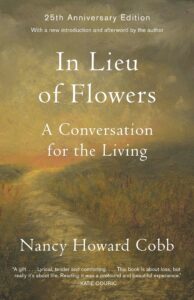
From In Lieu of Flowers: A Conversation for the Living by Nancy Howard Cobb. Reprinted by permission of Pantheon Books, an imprint of the Knopf Doubleday Publishing Group, a division of Penguin Random House LLC. Introduction copyright © 2026 by Nancy Howard Cobb.

Nancy Howard Cobb
Nancy Howard Cobb has interviewed poets, writers, and adventurers in print and on public radio. In Lieu of Flowers was a Books for a Better Life nominee and was featured on the Oprah Winfrey Show. Cobb has spoken about mourning, grief, death and dying, in hospices, medical schools, bookstores, conferences and has written for The New York Times, HuffPost, More, House Beautiful & Medium.