Benjamin Hale on How to Expand a Magazine Article Into a Book
Navigating Structure, in Fiction and Nonfiction
This first appeared in Lit Hub’s Craft of Writing newsletter—sign up here.
The short answer to “How did you expand an article into a book?” is simply that I had such an abundant wealth of material, in a way the book was easier to write than it had been to pare things down for the original article, even with the very generous 15,000-word count ceiling that Harper’s gave me for the article that became my book, Cave Mountain: A Disappearance and a Reckoning in the Ozarks: it was like the difference between a fish swimming in the sea versus swimming in an aquarium.
When I write fiction, I’m usually very deliberate about structure when first starting to work on a project, because if I’m not, I tend not to finish it. Supposedly Haruki Murakami just wings it with no outline whatsoever; he says he doesn’t know what’s going to happen next any more than the reader does. I admire such adventurous trust in one’s intuition, but I couldn’t possibly work like that. When I’m embarking on a work of fiction, I use a method for outlining I learned from William Melvin Kelley and modified to suit my own habits of working and thinking, which I call the nine-box grid method. Draw a grid of nine squares:
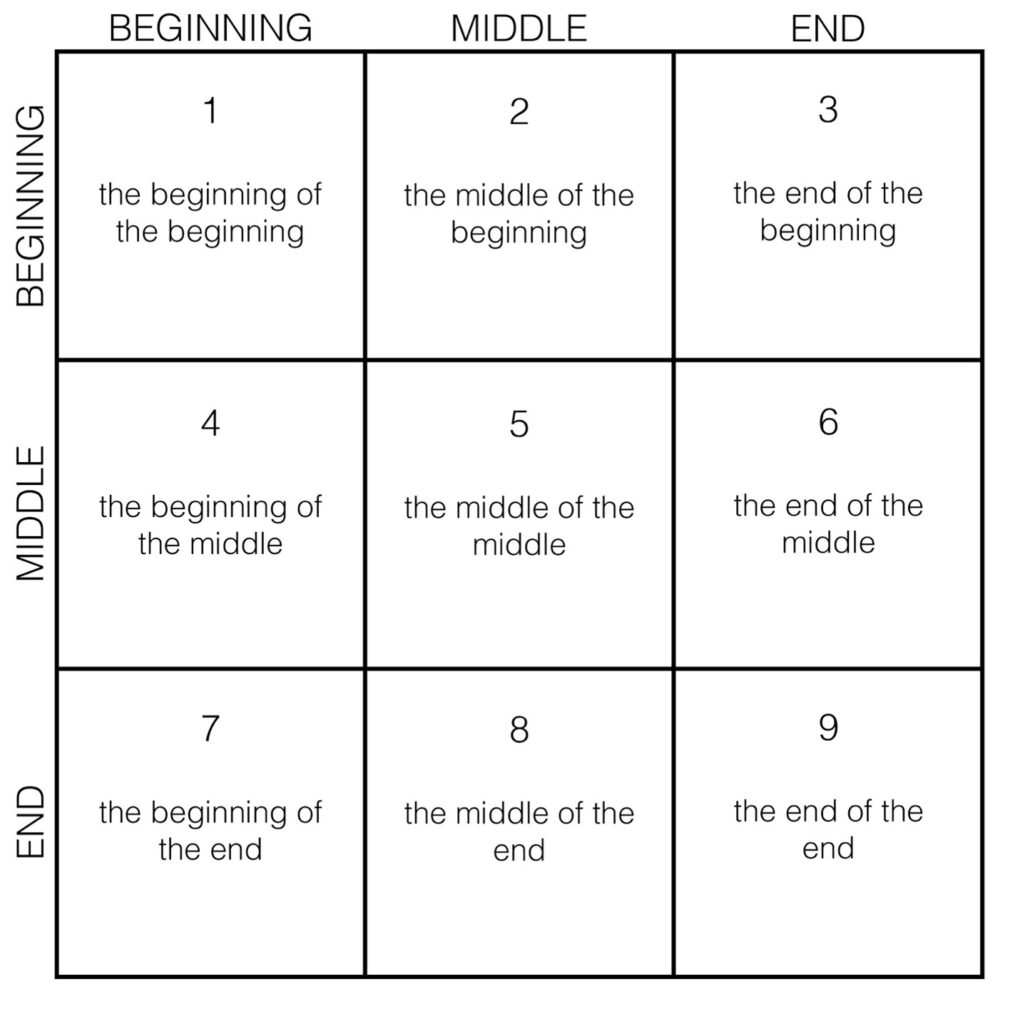
Each of these boxes is a leg of the story; they’re not “chapters” yet because this method is for much earlier in the process of writing, when you’re just trying to get the whole story down on the page for the first time—I just call them “chunks” of narrative. Narratives work well in threes. The structure of a joke is (1) setup, (2) satisfy the listener’s expectations once, (3) the punchline—i.e., subvert the listener’s expectations. Similarly, the structure of a magic trick is: (1) the pledge, (2) the turn, (3) the prestige.
Especially in light of this solipsistic, lame, and tiresome “autofiction” fad that’s been going about fifteen years strong and still refuses to die, I would like to encourage writers to venture far away from the places—both geographical and psychological—where they feel most comfortable.
This nine-box grid method builds a three-act structure into the story, and each of the three acts should contain its own smaller narrative arc. A major part of the art of storytelling is introducing things, letting the reader kind of forget about them for a while, and then bringing them back at the right time. Put more elegantly, Jorge Luis Borges writes in the essay Narrative Art and Magic that a novel (or, I would add, a longish short story) “should be a rigorous scheme of attentions, echoes, and affinities.” I think two cycles of narrative is the perfect amount of time to allow the reader to kind of forget something, and two appearances of a thing is the right number for the third appearance to feel magical. So, the motifs—they could be images, objects, lines of dialogue, etc.—that first appear in box 1 should return in box 4, and again in box 7. Likewise for the other two columns: 2-5-8 and 3-6-9. Now jot down the key things that need to happen or characters or pieces of information that need to be introduced or reintroduced in each of the nine squares.
Now you have an outline. Before beginning to write, I usually spend at least a few days just honing this outline as close to perfection—or my satisfaction—as I can get it. When I sit down to start writing the sentences, I have a roadmap for the story I can follow. I swear by this method, and I highly recommend it. It’s probably the single most useful tool I have on my workbench. I have used it at the earliest stage of composing pretty much every work of fiction that I’ve ever finished.
I never use this method for structuring nonfiction because I don’t need it, any more than I need an outline for writing a letter to a friend. As Gertrude Stein said to Ernest Hemingway, the only way to say it is to say it. When writing nonfiction, I just say what I need to say in the order in which things occur to me.
When I wrote the Harper’s article I followed the same order of presentation I would use in the many years before when I would verbally tell people the story, except I had done a lot more research with which I could vastly flesh out the details, and also correct some of the factual errors the story had accrued over the years—some of which I inherited from other tellers of the story and some of which I probably added myself. A work of fiction needs that “rigorous scheme of attentions, echoes, and affinities” because fiction needs to be believed, whereas I didn’t need such a scheme to write this book because it’s all true, and truth doesn’t need to be believable.
One element of researching and writing nonfiction that is different and much more fun than the process of researching and writing fiction is simply getting out into the world and talking to people. I made many research trips to Arkansas, and following leads also took me to Louisiana, Tennessee, and Georgia—tracking people down, trying to win their trust, and interviewing them. At one point I was at the Newton County Sheriff’s Office in Jasper, Arkansas looking for records of what happened in 1978, finding that they didn’t appear to have any, and the officer who was helping me said, “You know, Ray Watkins used to be the Sheriff back in the ’80s, and he was a deputy for a good while before that. He might know something about what you’re looking for. These days he works at the hardware store. If you go down there now you might catch him.” So I drove the five minutes’ journey over to Bob’s Do It Best Hardware & Lumber just outside of Jasper, and found a nearly ninety-year-old man sitting behind the cash register. I asked him if he was Ray Watkins—he was—and I asked him if he knew anything about the cult that murdered a child on Cave Mountain in 1978. “Yep,” Ray said, “I was the one who arrested ’em.” What followed was one of the most astounding—and indispensably useful—interviews I’ve ever recorded, which was periodically interrupted whenever a customer needed to buy something.
I suppose I’ll end on that note. Especially in light of this solipsistic, lame, and tiresome “autofiction” fad that’s been going about fifteen years strong and still refuses to die, I would like to encourage writers to venture far away from the places—both geographical and psychological—where they feel most comfortable. To writers who are looking at a blank page casting about for something to write about—whether they’re writing fiction or nonfiction (or, in the case of “autofiction,” neither and both, I guess)—it’s really not hard to get out of your home, get out of your own head, get out of your own life, and get out into the world. The world abounds with incredibly strange and fascinating stories, some of which you might hear from an old man working in a hardware store in Jasper, Arkansas.
_____________________________________
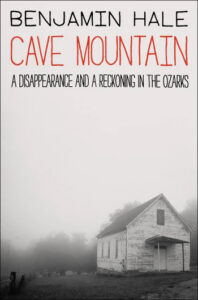
Cave Mountain: A Disappearance and a Reckoning in the Ozarks by Benjamin Hale is available via Harper.

Benjamin Hale
Benjamin Hale is the author of the novel The Evolution of Bruno Littlemore and the collection The Fat Artist and Other Stories. His writing has appeared in Harper’s Magazine, The Paris Review, The New York Times, The Washington Post, Conjunctions, and has been anthologized in Best American Science and Nature Writing. He is a senior editor at Conjunctions, teaches at Bard College and Columbia University, and lives in a small town in New York’s Hudson Valley.