Benjamin Franklin Was One of Many Early Americans Who Spread Genocidal Propaganda About Indigenous Nations
Paul C. Rosier on Racial Conflict in the Early Republic
During the Revolutionary War, colonial military and political leaders desperately sought the support of Indigenous nations. Colonial negotiators’ treaty with the Delaware Nation, signed on September 17, 1778, was the first of a series of treaties they designed to secure alliances with friendly Native leaders. The treaty was notable for several reasons.
For one, it represented the Delaware as “citizens” of their own nation and established equality between the “laws, customs and usages” of each “nation.” The treaty also supported the idea of the Delaware acting as the leader of a coalition of other Native nations that would join the colonies as a state with representation in Congress when the war ended. The treaty thus seemed to promise the Delaware people inclusion in the new American nation as citizens with their own political representatives.
The following year, Delaware diplomats asked George Washington to provide schoolteachers and farmers to educate their youth, noting that they had already sent three of their principal chiefs’ children to a school at the invitation of Congress and were eager to expand the number in order to “become one People with our Brethren of the United States.” Washington in turn thanked the Delaware leaders for their allegiance and their desire for brotherhood.
As the Cherokee Phoenix opined fifty years later in remembering the massacre, “It was enough that they were Indians.”
The language in the treaty and the exchanges between Delaware leaders and Washington expressed friendship and prospective citizenship. But Congress never ratified the treaty, and the promise of representation was never extended. And the promise of comity was dramatically torn apart.
In March 1782, American militia operating in the Old Northwest (Ohio) massacred ninety-six Delaware and Mohican living in the Moravian settlement of Gnadenhütten (“huts of grace”). Despite knowing that they were peaceful Christians and “good Indians,” the militia raped women and girls in the snow and then herded thirty-nine children, twenty-nine women, and twenty-eight men into two huts they called “the Slaughter Houses,” methodically beating them to death with copper mallets and then scalping them over a two-day period before setting fire to the buildings and the bodies.
The militia had first interrogated the Delaware and Mohican about the location of their material possessions before killing them to ensure a successful plunder of pewter, tea sets, furs, and clothing. It continued its rampage by killing four other Native Americans, including two Continental Army captains sheltered by American soldiers at Fort Pitt. A group of Delaware later found a message written in coal on nearby trees: “No quarters to be given to an Indian, whether man, woman, or child.” As the Cherokee Phoenix opined fifty years later in remembering the massacre, “It was enough that they were Indians.”
What led to such a violent end to the friendship between the Delaware and the colonists? For one, Indigenous people resisted American colonists’ expansion into their ancestral homelands, raiding their farms and settlements in the Ohio Valley. American militia sought revenge for these raids, skeptical of Christian Indians’ claims of neutrality as the war ground on.
More broadly, the French and Indian War (1754–1763) had encouraged many colonists to view all Indigenous people as enemies, and thus deserving of violent subjugation, because most Native nations had supported France’s failed effort to retain its colonial presence in North America. The Revolutionary War cemented these views, which became embedded in founding documents of the American nation and in propaganda campaigns designed to eliminate Indigenous nations as bulwarks against western expansion during and after the war. When the Second Continental Congress issued its Declaration of Independence in July 1776, it accused the king of Britain of employing “merciless Indian savages.”
Earlier that year, Thomas Paine had accused the British of using the “Indians and Negroes to destroy us.” Campaigns to secure new lands, especially in the Ohio River Valley, gave birth to the first wave of Manifest Destiny beliefs soon to animate US historical narratives.
American colonists seized on Indigenous peoples’ support of the British to envision taking all Indian territory, using the propaganda power of that association to engender an exterminationist ideology that justified the efforts of “independent Citizens of America” to establish their own empire in that territory. This ideology contaminated Native-white relations for generations.
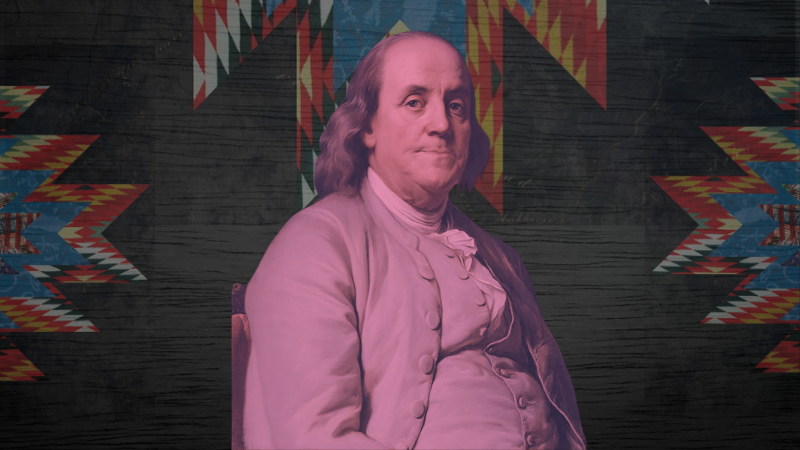
As Americans shifted their attention to both British enemies and Indian enemies, these propaganda campaigns became more strident and generated debates about racial characteristics. Benjamin Franklin, among others, made great hay by propagating stories of alleged Indian savagery, such as his tale of “Prisoners kill’d and Roasted for a great festival where the Canadian Indians are eating American flesh, . . . an English officer Setting at table.” Distinctions between friendly Indians and unfriendly Indians became harder to draw. Just as all British became painted as corrupt as part of their national character, so too did all Native people become seen as savage by their biological nature.
Violence in the backcountry between Americans and Native people intensified, fueled by rhetoric justifying atrocities and the expulsion of Indigenous nations to address Americans’ demand for new land. Frontier whites called for a government campaign to “extirpate them from the face of the earth.” Such genocidal language in placing all Indigenous people together would have deadly consequences for many of them, including those who had adopted Christian life in settlements such as Salem, Schönbrunn, and Gnadenhütten, Moravian mission towns that had tried to maintain neutrality throughout the war.
But white settlers’ hatred of Indians and desire for their lands percolated on the American frontier, while visions of territorial expansion reigned among national leaders.
The Gnadenhütten massacre became not a stain on the American people’s conscience but a spur for the “extirpation” of all Indians. As one American commentator put it after the massacre, “The Country taulks of Nothing but killing Indians, & taking posession of thier lands.” Other propaganda compared Native people to buffalo, cats, dogs, and devils. One influential account reprinted in various pamphlets posed the question: “Are not the whole Indian nations murderers?”
An editorial in Philadelphia’s Freeman’s Journal echoed the dehumanizing rhetoric that emerged following the massacre, justifying the taking of valuable land from “indolent Indian savages” who had “little or no hopes of their ever becoming men, much less christians” because they were incapable of using land in a “civilized” manner.
And it captured the core argument that would drive subsequent incursions into Indian territory and justify the forced removal of Native people from their ancestral lands into the twentieth century. The editorial posited the biological limitations of Native peoples’ capacity to become farmers and Christians, ignoring the fact that the Christian Delawares at Gnadenhütten and elsewhere had embraced that life, to such an extent that the wealth they created became a motivation to force them to move or to kill them.
Marshaling such anti-Indian discourse, American politicians worked to remove Native nations in the Ohio Valley and then in the South. Using the legal language of the 1783 Treaty of Paris, which ended the war between the Americans and British, American officials would assert sovereignty over Indian lands in a series of treaty negotiations with Native diplomats beginning in 1784, telling them that they would have to either move west or accept American dominion and agree to allot their lands within smaller territories. Native leaders were not inclined to agree to such terms, and the American state initially could not afford to go to war to compel them.
But white settlers’ hatred of Indians and desire for their lands percolated on the American frontier, while visions of territorial expansion reigned among national leaders. Thomas Jefferson and other politicians, many of them land speculators, would pursue Native land cessions for both personal and political gain into the 1800s.
The point is not that Indigenous people, even those allied with the American cause or raised in Christian communities such as Gnadenhütten, would seek citizenship in the new American nation but that no “Indian,” however Christian or supportive of American interests, stood a chance of rising above a new sociological classification deemed savage by character and then dehumanized to a biological classification as animals. The Gnadenhütten massacre created a harsh dividing line between Americans and Indians. As one Native Moravian convert said, speaking for many others, “No one shall take me to [the white people]; nevermore will I come to you and live with you.”
__________________________________
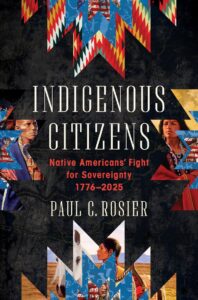
Excerpt from Indigenous Citizens: Native Americans’ Fight for Sovereignty, 1776-2025. Copyright ©2026 by Paul C. Rosier. Used with permission of the publisher, W. W. Norton & Company, Inc. All rights reserved.

Paul C. Rosier
Paul C. Rosier is professor of history and director of the Lepage Center for History in the Public Interest at Villanova University. Author of Serving Their Country: American Indian Politics in the Twentieth Century, he is a recipient of the American Indian National Book Award. He lives in Doylestown, Pennsylvania.