Beneath the Wallpaper: On Art, Photography and Hidden Everyday Violence
Sarah Minor Considers How Different Ways of Seeing Can Implicate Spectators and Subjects
From the linen a squall rises and the bones of Norman horses line the channel. The storm, like the needle, has a round and guiding eye. WILLIAM’s fleet lands at England’s southern shore, short a couple ships. Here the Normans go a-pillaging. Here the stitchers get bored without horses to sew. HIC, a brown cow about to be slaughtered. HIC flames which of course are also thread, an English house on fire. Here the artists sew a conquered woman holding her child’s hand, begging for humanity. Here, in scaled armor, William’s soldiers hold a feast. In the margin, staghounds clean their paws with oiled tongues. Here they build trenches from Caesar’s ruins only to leave them behind.
*
In the space between every slide, darkness flicks like a cursor. There the professor is a teenager running miles in the basement of her father’s suburban tract, an unfinished room furnished with a treadmill, a weight bench, and a three-sided sunset mural. There are no mirrors, just a tube TV, a cement floor, and the silhouettes of four palm trees lit like a black hole. Planet Earth plays on DVD from a long-armed TV attached to the wall with naked studs. This year the screen is beginning to change teenagers, who stare blindingly for hours on end. After years focusing on images an arm’s-length away, the muscles of their eyes will gradually weaken, flattening the globe, so that some will begin to lose their faraway vision and the human eyeball, for TV viewers in the United States, will become gently oval, shaped like an egg laid on its side. As the future-professor runs, she gazes far away, into Google Earth, into the near screen, across far continents and horizons, but her plucked eyes would reveal where she lives.
Perhaps the palm-tree mural emphasizes the open windowlessness of the subterranean, or the flat color dulls exertion.
*
Somehow she can run “further” in the concrete basement, cover more miles on the infinite belt, than she can on open asphalt. Perhaps it’s the Planet Earth, or the belt semi-propelling itself. Perhaps the palm-tree mural emphasizes the open windowlessness of the subterranean, or the flat color dulls exertion. The paint job is by the previous owner and carries a legacy of Midwestern aspiration, the stone boat’s collateral, the excesses of utopia, all brands of we-have-it-here-too.
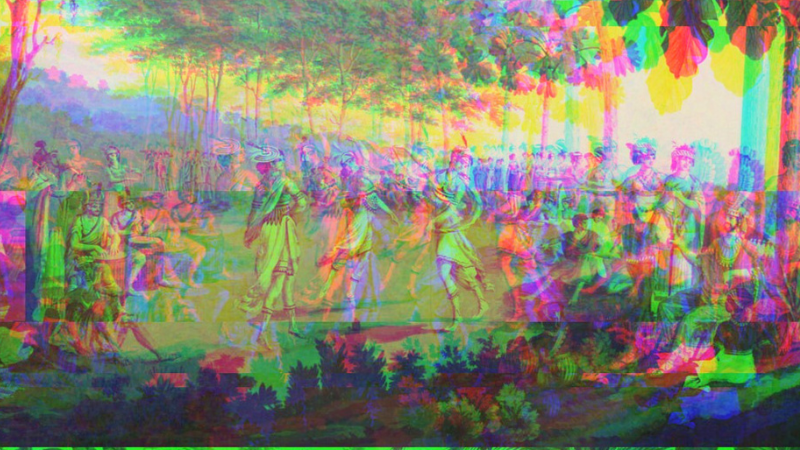
In 1806, in lieu of windows, Joseph Dufour printed a wall-sized view of paradise. The advances of balloon aeronauts who required reams of silk had made large-scale rolls of fabric available to textile artists, making wallpaper cheaper than custom tapestries or murals for the parlor. The sequential palms in Dufour’s “wallpaper without ends” told the story of Captain Cook’s three “scientific” visits to Pacific islands between 1768 and 1779, where he recorded the transit of Venus across the sun, following a theory illustrated by Edmond Halley, of the comet. Cook collected palm fronds, snapped his foremast, attempted a kidnapping, and was eventually killed in a scene that Dufour oddly preserved in panels 8 and 9 of the wallpaper, where, far away, an imagined volcano smokes in the background as Cook is stabbed in the back.
*
Dufour mass-printed his wallpaper, entitled Les Sauvages de la Mer Pacifique (Savages of the Pacific Ocean), with woodblock scenes designed to “excite the imagination without taxing it.” European clients ordered the domestic panorama in custom sizes for the parlor and hung twenty-two arrangeable panels of distant islands and homogenized races draped in foliage and Neoclassical dress—the first garden, before knowing arrived. The sweeping success of Les Sauvages betrayed the long-held Western nostalgia for a wholly invented time and place. Below ground, the future-professor’s shadow runs hard against the palm trees, roving nowhere. On the floor is a Beach Body VHS, a vintage ThighMaster, a rank coffee mug. Outside, feet of snow.
*
“Photographs did not work as we had been taught,” wrote John Berger, revising his argument, explaining that what the photographer aims to capture is rarely what the beholder sees. On the teaching screen is a photo from Shepton Mallet Prison, says the professor, which captures Victorian inmates walking the round yard “widdershins,” anticlockwise, in a symbolic effort to reverse time. Each man wears a woven sack cloth over his head, a rough fabric that pricked and shamed him while shielding the prisons’ neighbors, the warden and his family, from the eyes of those imprisoned. The photo was taken fifty years after William Cubitt’s first penal tread-wheel was fitted with partitions to force inmates to stare at a wall as they climbed, at first milling corn or pumping water. Later, prisoners on the “atonement machine” walked to their death without purpose, “grinding air” on an infinite wheel for ten hours a day, every day, before the machine broke enough men that the treadmill was banned as an implement of torture. In images of the group at Shepton Mallet, whose atonement takes on the materiality of duration, the hooded men now appear to be walking into a future in which they’ve already been executed, a finite point when their atonement will cease to require time.
*
The professor’s right knee aches. The screen’s heat is dull against her shoulder. In 1887, she tells the class, the writer Charlotte Perkins Gilman was treated for postpartum psychosis and advised to “never touch pen, brush, or pencil as long as you live.” Three years later she wrote a story about a woman who has been diagnosed with “temporary nervous depression—a slight hysterical tendency,” and confined to “rest,” who drags herself around and around the circumference of a room, leaving a continuous, dark stain along the base of the wall. Scholar Karin Littau, who writes about the cinematic qualities of texts that predate the moving image, considers “The Yellow Wall-Paper” a story about reading in “a period of media transition.” “Life is very much more exciting now than it used to be,” writes Gilman’s confined narrator, engrossed by the wallpaper. “You see, I have something more to expect, to look forward to, to watch.” Littau explains that the narrator “has discovered…that the hallucinatory power of reading, which allows us to read between the lines in books and dream images from the words inscribed on them, has been supplanted by the cinema of the wallpaper.” The greasy line Gilman’s “creeping woman” leaves behind is the psychological horizon of confinement. On the other side of the wallpaper, down the street and through the square, a panoramic dome performed the news in the city center. Inside, we can read in her long stain the “all-seeing” medium, and perhaps also its interior grind, a mind inscribing itself ever elsewhere.
*
One student looks into the eyes of his neighbor. On the stud-mounted screen is an image that looks like a child’s handwriting, but Lorina Bulwer was fifty-five in 1893, says the professor, when her brother committed her to a workhouse for “elderly women.” There in Great Yarmouth she and the other “lunatics” spent up to ten hours a day thinning their fingertips by unraveling stiff, tarred ropes to re-seal the country’s leaky wounds and sailing ships. In her remaining daily hours, Bulwer took up the needle and embroidered wool through cotton scrap, stitching those scraps together to make twelve- and fourteen-foot embroidered texts full of gossip and fury. Her scrolled embroideries have since been described as tirades, rants, and screeds—no horses or cables, just the language pummeling the eye. Perhaps Bulwer was permitted the needle after work because it kept her silent. In her stitches, at least, she’s a walker. “I MISS LORINA BULWER WAS EXAMINED BY DR PINCHING OF WALTHAMSTOW ESSEX,” she stitch-writes, “AND FOUND TO BE A PROPERLY SHAPED FEMALE.” Her texts are unpunctuated, uppercase, underlined for further emphasis. The work would have been slow going and highly readable—white wool on green backing, red thread stitched to white, yellow on red, mauve on pink, blue on purple, pink on black.
*
Her version remembers that Venus, the planet Banks and Cook tracked across the sky to advance ocean navigation, was a metaphor for the live Venus they pursued and chained in the belly of their ships.
Bulwer’s work records gossip from the workhouse, disgust about her living conditions and who there was to blame. She liked to use full names. “THIS CHARLOTTE STREET BROTHEL WORKHOUSE THE FELLOW ORDERING EVERYTHING HERE IS HUNTER BUNTER LANGHAMSON OF JOHN AND SUSAN ROSS LANGHAM TRAINED AT CAMBRIDGE FOR A TRICK MAN.” Bulwer’s longest sentences bend to fit into her narrow cotton margins. She slipped forgotten words in sideways rather than undoing her work. Her “samplers” expounded in a breathless form that could never be framed, running horizontally with a claustrophobic intensity that pushed physically against confinement. “I MISS LORINA BULWER,” she sewed, fingerprints raw from unraveling, “AM FREE.” She escaped by dying of influenza at seventy-four and was buried in a cemetery near the workhouse.
*
From the corner of her eye, while she is speaking, the professor watches a student pulling off her false lashes one by one then saving them on a piece of Scotch tape. The teaching screen’s caption reads “The Prophetic Perfect.” The images there are from an installation staged 120 years after Dufour’s Les Sauvages de la Mer Pacifique. In 2017, Rachelle Dang used her iPhone to photograph nine of the wallpaper’s original twenty-two panels in the museum where they hung. Over the course of a year, the artist digitally collaged those snapshots, blowing them up to blur and warp the figures. In Dang’s finished installation, a collage of ocean skies and palm fronds papers all four walls. At center stand two cages modeled after nineteenth-century shipping containers that carried Pacific breadfruit to Europe for study and consumption. Strewn around the edges of the room are ceramic casts of the pocked fruit, brown and desiccated like a pile of skulls.
*
One student is bouncing his dominant knee so hard he shakes his neighbor’s desk. Another student has arrived straight from work in an ironed uniform. Two years later, the professor tells the class, after representing New Zealand at the 2019 Venice Biennale, the artist Lisa Reihana’s massive “panoramic pantomime” remade Les Sauvages de la Mer Pacifique again in Toronto, Sydney, and Auckland. This time the wallpaper was digitally animated, made of 1,500 layers, more than three trillion pixels. Reihana’s strategy extended the original wallpaper’s long leer by emphasizing its fantastical composite, retelling the same story with footage of living islanders and recordings of several Pacific languages.
*
In later iterations, Reihana retitled the panorama In Pursuit of Venus [infected], for the astronomy project and rape joke at the heart of wallpaper’s story. Her version remembers that Venus, the planet Banks and Cook tracked across the sky to advance ocean navigation, was a metaphor for the live Venus they pursued and chained in the belly of their ships, the kind of woman they’d name Venus because it was her beauty, they confessed excitedly, that made Cook’s men “lose control.” Afterward they immortalized Venus, the multiple Venus, on woodblock, draped like a Greek goddess emerged from the sea.
____________________________
From Carousel: An Essay on Seeing by Sarah Minor. Copyright © 2026. Available from Yale University Press.

Sarah Minor
Sarah Minor is the author of two previous books, Bright Archive and Slim Confessions: The Universe as a Spider or Spit, as well as the chapbook The Persistence of the Bonyleg: Annotated. She teaches writing at the University of Iowa. Minor lives in Iowa City, IA.