Ben Fountain on Rasputin and Trump’s Coming Third Term
In Conversation with Whitney Terrell and V.V. Ganeshananthan on Fiction/Non/Fiction
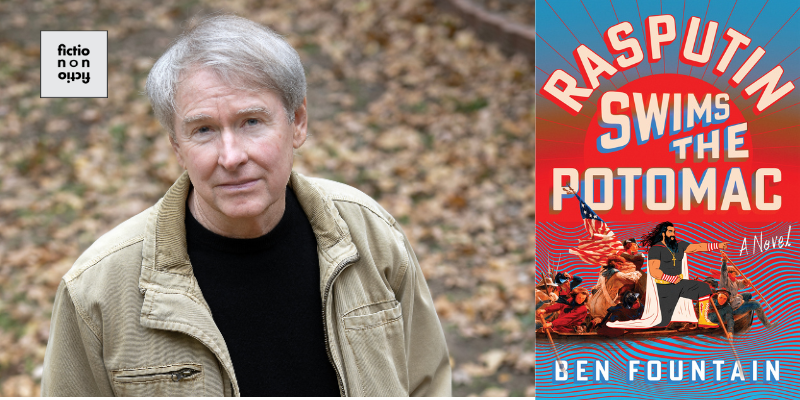
Novelist Ben Fountain joins co-hosts Whitney Terrell and V.V. Ganeshananthan to discuss his new book, Rasputin Swims the Potomac. Fountain’s satire, set in the not-to-distant future, describes the furor, scandal, and hysterical “weeping sickness” that arrives in the wake of the fictional President’s decision to seek an unprecedented third term. Fountain talks about the technical choices he has made to fictionalize Trump, including the decision to redact his name. He also reflects on the roles of the other characters in the novel, including Clarence Thomas Jr., a Black reporter unrelated to the Supreme Court Judge; Faith Spack, the President’s loyal aide; and Rasputin, a professional wrestler who can cure the “weeping sickness” and begins to rival the President in popularity. Fountain explains how the political times of the original Rasputin increasingly mirror our own and reads from Rasputin Swims the Potomac.
To hear the full episode, subscribe through iTunes, Google Play, Stitcher, Spotify, or your favorite podcast app (include the forward slashes when searching). You can also listen by streaming from the player below. Check out video versions of our interviews on the Fiction/Non/Fiction Instagram account, the Fiction/Non/Fiction YouTube Channel, and our show website: https://www.fnfpodcast.net/ This podcast is produced by Christian Barter and Whitney Terrell.
Rasputin Swims the Potomac • Devil Makes Three • Beautiful Country Burn Again: Democracy, Rebellion, and Revolution • Billy Lynn’s Long Halftime Walk • Brief Encounters with Che Guevara: Stories
EXCERPT FROM A CONVERSATION WITH BEN FOUNTAIN
Whitney Terrell: I wanted to talk about some technical innovations that you have in this book. First of all, the president’s name is redacted throughout, yet everything else seems pretty familiar to me. You mention MAGA voters, you talk about Stephen Miller. I have a theory as to why it was useful to cut Trump or put a blank square there, but I wanted to talk about why that was a necessary device in your opinion.
Ben Fountain: Well, it’s not for legal reasons. I mean, if the First Amendment doesn’t protect us as we criticize, satirize, or even mock and ridicule the foolish actions of a foolish president then what does it protect us from? So it wasn’t for legal reasons. Working on the second draft of the book, I realized I was really tired of looking at this guy’s name, and I didn’t want to play any kind of silly game like changing his name to Stump or Rump, and the Epstein files were going hot and heavy at the time, and lots of games were being played with redactions, who’s redacted, who’s not, and I thought, “Well, let’s just redact his name and see how that feels.”
So basically, I was just tired of seeing his name. I think his name is too much with us. I think he’s too much with us. I think something is wrong with us when politics consumes so much of our lives, our collective life, our individual lives. There’s so much more to life than just politics. So, I thought, “Well, let’s take that name away. Let’s just redact it wherever it appears.” As I started working through it, I thought, “Also it adds a bit of friction to the reading.” Whenever we see the name Trump, such a complex of baggage and associations is connected with that name, it almost numbs our brains out. I liked the way it read to me with his name redacted. It’s a little bit of a speed bump, a little bit of a hitch in the reading. That micro jolt hopefully makes the reader a little more aware of what’s going on in the book, and what we’re talking about.
WT: I don’t know how this was for you, Sugi, but for me it actually allowed me to create my own voice for the character when he’s speaking, and not do it in the Trump accent, which was helpful. I like to imagine my own president there. Sugi, how did it work for you?
V.V. Ganeshananthan: I thought that Ben did such an amazing job of channeling Trump’s voice, that I appreciated not seeing the name, but the voice is so on. It’s really just an incredible version of him that you know, all of the catchphrases, all the syntactical fingerprints that we as writers recognize, they’re also present in his strange little exchanges and monologs. So, for me, I would have loved to invent my own president, Whitney, but I didn’t succeed, because Ben was too good at conjuring that voice. There’s a part in the book where a character talks about how everybody wants to not name the problem, even though everyone knows what it is. This device also stands for that in a certain way. I can’t help but recognize that distinctive speech, the person who’s always saying, “Thanks for your attention to this matter” or whatever little tick you put in.
So, last year Steve Bannon, among others, claimed that Trump would definitely get a third term, despite the 22nd Amendment making that impossible. Your book opens with this court decision to allow this, and I’m curious about your relationship between writing about a fictional campaign for a third term and the actual public discourse. Do you think he’s going to try to do this?
BF: I started writing this book in April of 2023 and I had a feeling back then that Trump was running for a second term, and he had a really good chance of winning. So when I start the book, that’s the given. He’s getting close to the end of his second term, and just who he is, given his history, his personality, of course he’s going to try for a third term. This is not an individual who’s going to go quietly into the post-presidential sunset. Just another given of the book is we’ve had this Supreme Court decision where, despite the clear language of the 22nd amendment, the Supreme Court has said, “He can run.” Believe me, if this court wants to reach that result, they will find a rationale, and as a former practicing lawyer, I can think of several avenues of attack where you could go at the 22nd amendment. I’m writing about this in 2023 and 2024 and then he wins the popular vote, and I’m still writing this book, and, and I feel like, “Okay, this is a live possibility.” My feeling is, of course, he’s going to try to run for a third term, and so then it’s going to be up to the Supreme Court, and it’s going to be up to the people as to whether that happens.
WT: I don’t know if it’s really a technical innovation to say that Trump’s running for a third term, but that is a given important plot fact of the book. The other thing that was really interesting is this weeping sickness that Sugi described in the beginning. First of all, it only affects white people so that to me is a real interesting fictional and metaphoric complication. And the person who describes this first scene that Sugi was talking about is a character, Clarence Thomas Jr. who’s black, and shares the name of the famous Supreme Court Justice who does exist in this world, but has no bears no relationship to him? I wondered if you could talk about Clarence as a character, how you invented him, and why his perspective is so crucial with this story.
BF: As you’re stalking a novel, people start to manifest in your head, and often they’re very hazy, and then as you think about it and you make notes, hopefully they start to crystallize. For me, he had to be Black, and he needed to be a Black man of a good degree of worldly experience in education. This is a man who is looking very alertly at our world and trying to make sense of it, and he’s got the personal experience and the education, formal and otherwise, to go a good ways toward trying to answer some of the questions, such as why is the world the way it is? Why is America at this point? What brought us to this point? What is it in our character and our history that’s brought us to this point? He’s trying to make sense of this very confusing situation.
He had to be Black. That’s the way he appeared in my head. He brings a certain level of detachment and skepticism to the mainstream American narrative. As for his name, I felt like, because of his name, and the fact that he shares it with a Supreme Court justice whose judicial philosophy and history is anathema to him, he moves through the world with a little bit of extra friction. There’s something always coming at him which never allows him to relax. Also, that name allows him to get into places where he might not otherwise get into. Just in terms of the internal character, him dealing with the burden of this name, number one, and number two, there are times when all he has to do is say “I’m Clarence Thomas,” and the doors open.
Transcribed by Otter.ai. Condensed and edited by Rebecca Kilroy. Photo of Ben Fountain by Thorne Anderson.

Fiction Non Fiction
Hosted by Whitney Terrell and V.V. Ganeshananthan, Fiction/Non/Fiction interprets current events through the lens of literature, and features conversations with writers of all stripes, from novelists and poets to journalists and essayists.