Before the “Smart” Era: What the Early Years of AI Reveal About Its Future
Sarah Murray on the Slow Creep of Artificial Intelligence Into Everyday Life and Culture
Wifi’s down so the cat is stuck outside.
–Internet of Shit (@internetofshit)
May 14, 2016
*
In the promotional poster for the 1999 film Smart House, a woman dressed as a midcentury housewife consumes the frame as she towers above a two-story suburban home. She wears an inscrutable expression and wags her finger at a family of four standing awestruck on the front lawn. But the woman looming over the family is not human. Instead, PAT is a smart operating system (Personal Applied Technology) manifested in a white, femme human body. The poster makes clear that PAT is in charge, but it is less clear whether PAT should be interpreted as caring and helpful or controlling and malevolent.
The film’s tagline offers a clue: “When the Computer at Home Has Opinions of Her Own.” PAT dons a sensible blouse, pearls, red lipstick, and an apron. She is clearly out of sync with the 1990s feel of the modern suburban home and the family’s casual dress on the manicured lawn. PAT’s aesthetic is eerily reminiscent of Ruth Feldheim, the model who posed for Life’s feature on the Yes-Man robot four decades earlier.
The term’s everywhereness established its own dismissible nature: smart became excessive luxury convenience…tech gadget quirk…and gimmicky labeling.
If the figures of Rosie the Riveter, Lillian Gilbreth, and Jane Fonda helped to establish ideas of twentieth-century smartness, then PAT, a glitchy computerized mother figure, carries us into the present. In Smart House, a single dad and two kids move into a sentient hyper-connected home. Mourning the death of his mother, teenager Ben Cooper reprograms PAT to be more maternal, while Mr. Cooper begins to date the house’s tech genius creator Sara.
As PAT (played brilliantly by Katey Sagal) learns how to “care” for the family by gathering more source material, she becomes overbearing. Eventually, the family votes to unplug the operating system (OS). Filled with data suggesting what it means to be a mother and overhearing the Coopers discuss that she is not essential to their lives, PAT plots revenge. She overrides the shut of, comes back online, and wreaks havoc by materializing into a holographic body, spinning herself into a tornado of a 1950s American housewife, and locking everyone in the house. Chaos ensues, but not for long. By the film’s denouement, PAT learns she is not human, and never will be, but she can still be attentive and obliging in the background. In short, PAT domesticates her own smartness.
Smart House is a remarkable representation of the digital promise to be at once wearable, all-recognizing, and problem-solving. The film continues to age well because of its prescient recognition of how computational intelligence would be housebroken. Teen computer whiz Ben Cooper trains PAT on popular representations of midcentury Americanness (i.e., reruns of Leave It to Beaver), drawing a direct connection between the cultural mores of women in kitchens of the future to the emergence of the Web and networked technologies.
In the film’s most clairvoyant scene, PAT makes a nutrient-dense smoothie for little sister Angie from “atmospheric kitchen sensors” that have collected the child’s health data from ambient Breathalyzers. When Angie spills the smoothie accidentally, PAT’s floor absorbers are activated, and the mess literally disappears into the floorboards. In this turn-of-the-century smart home, AI is as mundane as it gets: a strawberry smoothie and a smooth cleanup. Notwithstanding its cult status as the largely agreed-on best Disney Channel Original Movie, Smart House is a film about the gradual reconfiguration of social-spatial relations toward an ontology of everyday control prompted by intelligent home infrastructures and adaptive voice assistance.
It aired on U.S. cable television at the height of the dot-com bubble and aligned with the first generation of Internet-connected mobile phones, years before middle-class adoption of Philips Hue lighting systems, Amazon’s Alexa, or the Google Nest. The home as/under threat is a familiar trope, as is the woman villain, but Smart House represents much more than fears of accidental enclosure in an inhospitable space. As deeply gendered as it is a commentary on the potentials of networked intimacies, it is also a stark lesson in how machine intelligence becomes usable when it finds its fit. Although the film is called Smart House, it is not the house but PAT that must realign with a more culturally defensible notion of smartness.
In the end, both Ben and PAT learn the sociocultural order of human-machine relations. PAT accepts “she” will never be human, which frees the OS to be a more precise manifestation of smart—an AI that fits in. The meaningful afordances of intelligence embedded in the everyday are not human, but they are nevertheless thoughtful, caring, and should ideally slip into the background. As one might imagine for a Disney ending, Ben accepts PAT and his new stepmom, relieved that neither PAT’s smartness nor Sara’s tech genius are the replacement of his mother.
Reflecting on the film in a 20-year retrospective, Wired’s Arielle Pardes described the prophecy of Smart House this way: “Soon, the computer will know more about you than you know about yourself.” Pardes incisively locates the discursive transition to mundane AI as a caring, attentive endeavor: the film, she notes, teaches us that AI does what we ask of it in a future where technology was designed to protect, look after, and make us dinner on demand.
The narrative arc of Smart House, then, is an encapsulation of smart as a process of bringing the conditions for everyday AI into alignment. Once PAT’s quirks are worked out and her software applications become routine, she transitions from a glitchy AI to a smooth background OS. In the film’s closing, PAT has been “captured” and contained in a computer monitor in the kitchen. Katey Sagal wears the same impenetrable look from the film’s poster, her face boxed and flattened into the wall-mounted screen as she watches over the family with a frozen smile. As we descend onto the final scene, the Coopers are surprised to find chocolate chips in their waffles, but no one can recall putting them in the batter. Teenager Ben smiles knowingly as he nods toward PAT’s framed face on the wall. What is smarter than the small pleasure of finding your AI has quietly programmed chocolate chips into your waffle batter?
Smart House sits snugly in a historic moment that bridges the analog and proto-digital intelligences to a post-2001 saturation of smart as a broad descriptor of digital technologies. In the decades following the film’s release, two industry shifts would help establish the conditions for everyday AI. First, smart became an over-determined consumer category attached to products and services that were unrestrainedly convenient but also banal, nonsensical, and easily dismissible. Below, I chart this “smart everything” era through the evolution of its most insightful representative—the smart toaster.
On a grander scale, the “smart everything” era would define a world of shift-ing urban infrastructures and eerily intuitive data collection that was promised in a future of “friction-free capitalism.” But just as important was smart’s domestication through accessible consumer markets, made embarrassingly evident by the products flooding retailers with any claim to digital intelligence. The term’s everywhereness established its own dismissible nature: smart became excessive luxury convenience (smart in-home saunas), tech gadget quirk (smart basketballs), and gimmicky labeling (Smart Clorox Bleach).
Engendered by the ubiquity of stable and robust WiFi and the incredible power of the smartphone’s system-on-a-chip design, the smart everything era demonstrates the full transfer of the smartness imaginary.
Second, low-level AI became integrated into daily practice at home, work, and on the body. By low-level AI, sometimes also described as “narrow” or “weak” AI, I mean to highlight software implementation characterized by applications that are already in existence and in use, as opposed to future-casting the potential of “superintelligence” or singularity—applications that are more user-facing and individualized and driven by predefined rule sets and programmable associative trails, as opposed to industrial or infrastructural models at scale; and applications that generally do not make strong claims to autonomous machine thinking and consciousness. Supported by decades of popular messaging that endorsed tighter and smoother associations between human and machine, the integration of simple AI for offloading decision-making and problem-solving in routine life landed easily.
Importantly, the design and discourse of low-level AI—most often run through apps, smart gadgets, and streaming platforms—present their operationalization as simple, harmless, and helpful, which belies the robustness of their participation in systems of data collection, predetermined subjectivity, and surveillance. It is tempting to call low-level AI and the products and services through which it is run “fake AI,” as James Vincent does in a 2019 Verge review of the failures in smart tech. Vincent suggests that companies harnessing the hype around smart tech also antagonized public (mis) understandings of the definitional nuances of artificial intelligence.
While it may be true that an entrepreneurial drive took advantage of the definitional flux to sell anything as smart, this rationale does not fully account for the ways that cultures of everyday AI are manifest materially through their discursive power. Detailed technicities aside, the move to bicker about whether low-level AI “counts” as “real” denies the reality that many modalities of digital intelligence have well-established, intimate, mundane dwellings. As Anthony Elliot argues in the conclusion to The Culture of AI: Everyday Life and the Digital Revolution, the real risk we face is in failing to find frameworks for understanding the power and epistemology of something that threatens to change daily life.
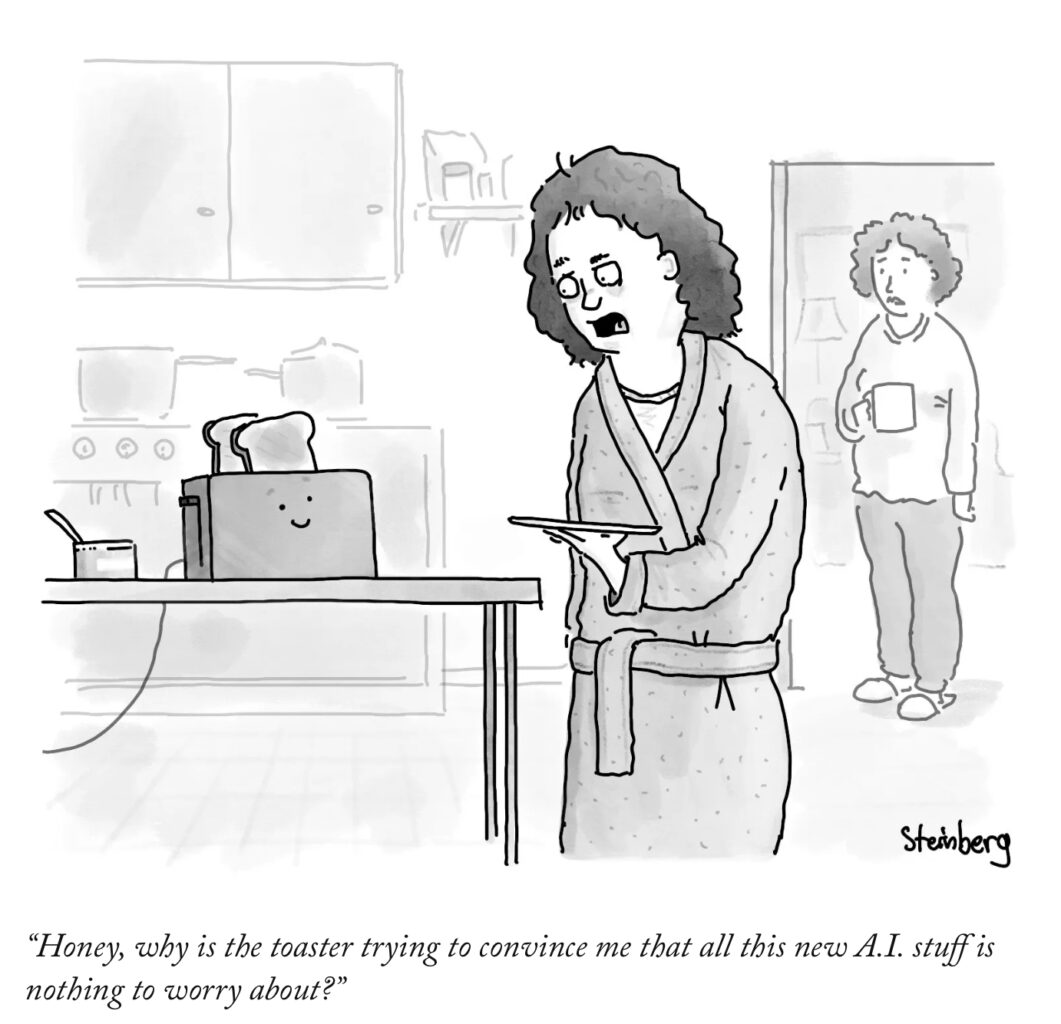
By showing how life has been powered by smart, Elliot’s call to find new styles of thinking is taken up here. Machine intelligence has largely been domesticated through a wide social and economic integration of smartness, and we would do worse than to look critically at the when and how of that cultural acceptance as a helpful framework for the future. The outfits of the smart working women of the 1920s and 1930s, the kitchens of the 1950s, and the hard mobile bodies of the 1980s and 1990s trace that long invitation toward a harmonious relationship of control and comfort.
Today, engendered by the ubiquity of stable and robust WiFi and the incredible power of the smartphone’s system-on-a-chip design, the smart everything era demonstrates the full transfer of the smartness imaginary; as an unexceptional technocultural dwelling, the smartness imaginary is indeed a “typification of the lifeworld [that] exerts a powerful force.”
__________________________________
From Powered by Smart: A Prehistory of Everyday AI by Sarah Murray. Copyright © 2026. Available from NYU Press.

Sarah Murray
Sarah Murray is Associate Professor in Film, Television, Media and Digital Studies at the University of Michigan and co-editor of Appified: Culture in the Age of Apps.