A sole photograph from Beckomberga: I found it in one of Lone’s albums. I have a hat on my head and the old fox-fur boa hanging round my neck. It must have been Edvard who took the photograph on one of her rare visits to Beckomberga, and, strangely, a white butterfly has wandered into the picture and been locked in, sitting forever fixed beside my braid – at first glance you might think it a bow in my hair. There were so many butterflies in those days, and birds; they were everywhere. In the photo we are standing a little apart, as if unaware of the others in the picture, or as if we are just about to go our separate ways. Behind us, scattered clouds are reflected in a window. Lone is moving out of the picture; she has never liked being captured in a photograph. I have bent to pick something off the ground and am covering my hat with my hand so it does not blow away. Jim is the only one standing still, staring straight at the camera with his intense, dark-blue eyes.
Sometimes I think Marion is like Jim; they walk in the same way. Loose, fast, and slightly jerky steps, a sudden joy sweeping through the body like a wind. A current that makes Marion run through life and makes Jim keep on moving, never staying still, never stopping to rest. Marion came to me one stormy night; in the early hours that November morning six years ago I sat in the hospital with a blood-soaked bundle in my arms. He lay wrapped in blankets and blood-stained towels, the room enveloped in a smell of animal and foul water. Out of the bloodstains shone a pair of bright blue eyes, and a heart was beating under the pallid skin that looked several sizes too big. I remember wondering if his eyes had gleamed like that in the darkness inside me.
When Jim comes he jokes with Marion for a few minutes and then forgets he is here. Marion’s light voice eludes him, as if children exist in a frequency to which Jim is not attuned. Marion likes it when he is here, nonetheless; he looks at him with delight in his eyes and asks when he is coming back to us.
“I don’t know,” Jim answers. “Maybe I’ll never come back.”
“Why won’t you come back?”
“Because life is hard and living just gets harder with time. You should be glad you don’t know what’s in store for you, Inspector Belmondo.”
Just before I fall asleep I can smell smoke. I search through the apartment, ashtrays, the gas oven, old burnt-out candles, but nothing is on fire and I have learned to sleep regardless. Just below the surface of my consciousness is a trail of purple smoke and at night comes terror: a cold band around my chest, a liquid chill running down my spine, seeping through my veins, like snow, like dry ice. I wake again in the night and imagine that the earth is about to collide with a star; I wake because I am falling. I am afraid that the block of flats will topple over, I am afraid that everything will be gone when I rise, I am afraid of the slow advance of wars across the world. It is our long night, Jim’s and mine, opening up beneath me like the dark vault of heaven; and I go in to Marion and look at him, spreadeagled like a little cross on the bed, his hair dark with perspiration. I wish I could protect him against the night, against my face and my gaze; I wish I could carry him still, inside me.
*
On the ends of tree branches in Clock-House Park hang large transparent drops that shatter when they lose their grip on the bark and fall to the ground, wasted, destroyed. Within each droplet is a mirror and in each mirror a solitary world: patients who walk amidst the crashing of waves along the beach below Sankta Maria; unmarked graves at the edge of the hospital grounds and the dead from so-called Lunatics’ Castle, without kith or kin, floating in cement tanks filled with formaldehyde before ending up on the dissecting tables of medical students; Jim in the ambulance on its way over the bridges to Beckomberga; and Sabina dancing backwards through the dim light of Ward 6 in a faded petticoat. And it is not painful: it is simply that the situation has a special clarity about it. The pattern in the trunks outside the window is as clear to me as if I were holding a magnifying glass in my hand.
“Did you really want to leave all this, Jim?” I ask. “I mean, die. Did you really want to do that?”
“I suppose I did. I thought there wasn’t anything left.”
“But . . .”
“Jackie, it’s not as bad as all that. Sometimes there just isn’t anything left.”
“Don’t you want to come home?”
“I’m already home.”
On visits later in the spring of my fourteenth birthday, Jim holds court on the small bank under the birch trees outside Stora Mans. The first white butterflies zigzag between tall blades of grass and from far away we hear him telling stories and singing outside the little ward by the birches, surrounded by staff, patients and relatives. We approach slowly under the droop of leafy coronets, Lone still in coat and boots despite the summer warmth, while birds shriek crazily in the trees, their long cries dark with torment. Jim has always hovered over the abyss with a smile, drunken and invincible, always making people laugh. It is his gift to us.
*
It must have been night when they brought him here. He had been found in the snow by the motorway heading to the airport, and after his stomach had been pumped at Sabbatsberg Hospital he was taken to Beckomberga. A few hours earlier he had checked into a hotel in Norrtull, where he had swallowed all his sleeping tablets and helped them down with a bottle of brandy. Then he walked out onto the motorway in the direction of the airport with the aim of catching an aeroplane somewhere, anywhere at all, Paris, St Petersburg, Moscow, and by the time he reached his destination he would be dead. But he never got that far. A few hundred metres from the hotel he fell down asleep in a snowdrift.
Before me I see birds of prey waiting by Jim’s lifeless body at the side of the road and the last of the sky above as it slowly disappears between the black tops of the pines. In the distance the sound of sirens, of footsteps in clogs, keys, doors slamming behind Jim as he is rushed down brightly lit corridors; and then the immense blackness surging out of the old blood-red hospital building on Beckomberga Avenue outside Stockholm.
And it must be I who asked, long ago, in another age, when we were still standing under the leafy birches outside Stora Mans.
“Jimmie?”
“Yes?”
“Wasn’t there anything to keep you in this world that time?”
“What might that have been?”
“I don’t know . . . me, maybe . . .”
“Remember this, Jackie,” Jim said, laughing. “The stuff that makes other people happy has never made me happy. And you have always been free. You’ve never needed a dad and you’ll never need a husband.”
*
He was lying asleep on the grass outside the Royal Library with several empty bottles beside him. A German Shepherd I had never seen before was sitting next to him. At first I thought he was dead, he was sleeping so deeply. I crouched down beside him and after a while I could see a faint pulse in his neck, as if a tiny lizard were trapped inside the fragile skin. I was scared the dog would attack me, but it sat absolutely still, as if it had not noticed I was there. A book lay open near the bottles and my eyes fell on some of its lines. What damages a human being is sin. The light of eternity will finally be extinguished. Love is unnatural. The dog was still sitting quite motionless, surveying the park. Perhaps I should have woken Jim, but I did not dare, so I sat down on a park bench some distance away and waited. I stayed there until it grew dark. After a few hours he stood up and looked around; he picked up his bottles and newspapers and sauntered off. He walked past so close to me, as I sat on the bench, that I could smell him, but he did not see me. It was the last time I saw him before he was admitted to hospital.
__________________________________
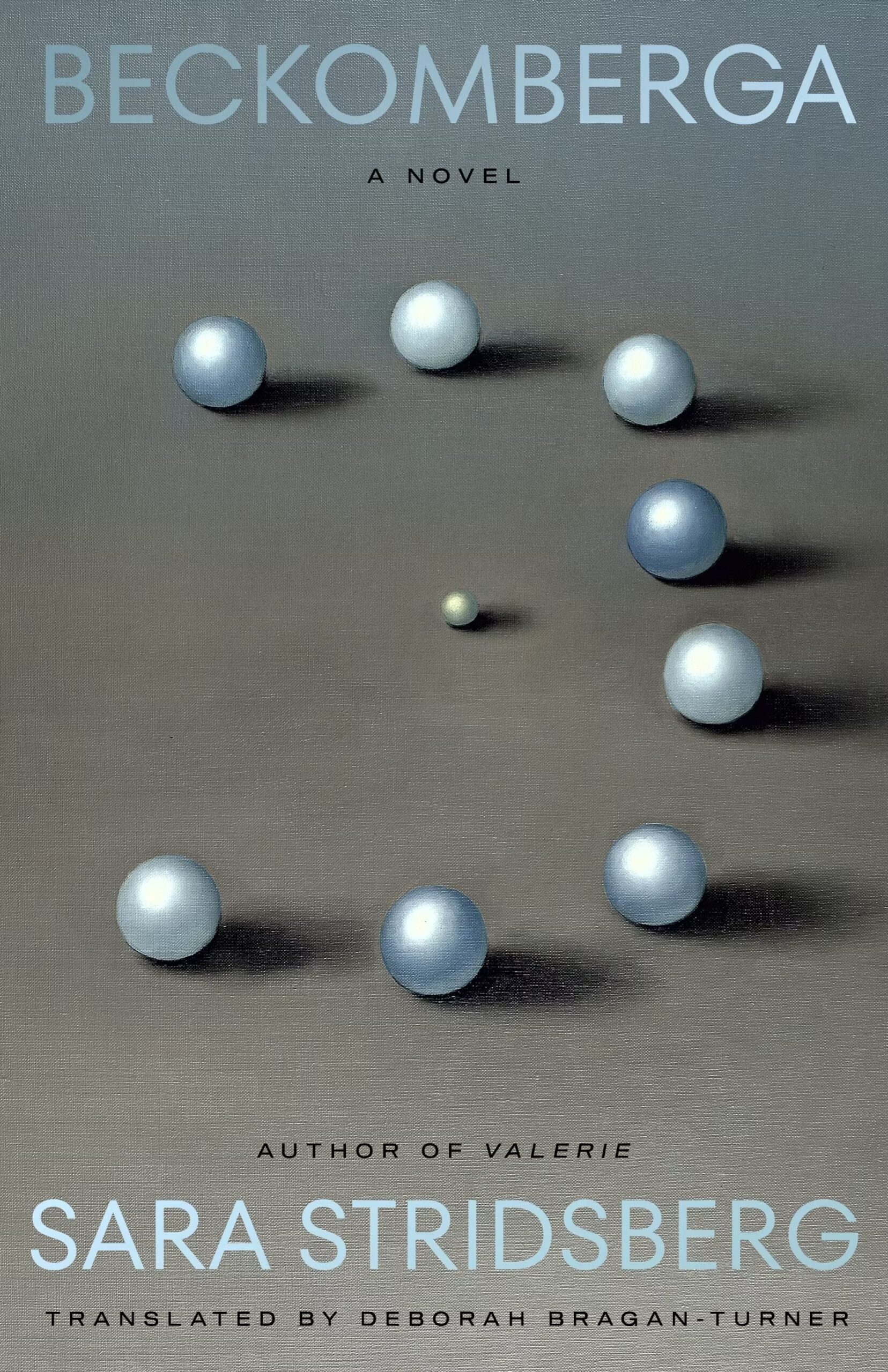
From Beckomberga by Sara Stridsberg (trans. Deborah Bragan-Turner). Used with permission of the publisher, Farrar Straus & Giroux. Copyright © 2026.