They will be rescued. People on the mainland will become worried and someone will ready a ship! But one after the other, the men realize that no-one can possibly rescue them on an uncharted island. The expedition’s other ship returned to Kamchatka in October. The crew of the St Paul had found their way to the south-eastern coast of Alaska. Captain Chirikov sent a group of his men to explore the area, but this group never returned. A search party was sent to look for them, but they too disappeared without a trace, and at this Chirikov abandoned all attempts to go ashore. They added the coast to the map and sailed home, and their accounts did nothing to keep alive the hope that Bering and his crew might one day return. They are declared missing, then dead, and eventually their wives stop waiting for them.
On the map, they name this island after their captain, but for them this place is the blue foxes’ island. These Arctic foxes will not leave them in peace. They burrow their way into the crew’s pits, then scamper away with belts, boots and tools between their teeth, they snatch seagulls roasting on the fire, and the crew turns their attention on the foxes. It is the foxes’ fault that scurvy has claimed half their number, the foxes’ fault that their ship is rotting out in the bay, the foxes’ fault that their captain is decomposing in the cold sand, and they hunt the foxes, catch them but don’t kill them, instead sending them back to their dens half flayed, with no eyes, no tails, their paws singed in the fire. Killing them is insufficient; the men want to hurt them. They need a culprit. But the foxes never learn and return night upon night. Their persistence is staggering, senseless, and Steller allows an unscientific thought into his mind: perhaps the foxes are punishing them, making the crew pay for the popularity of their skins in St Petersburg.
On the ship, Khitrov was responsible for discipline, forcing even those weakened with scurvy to work, but since Bering’s death he has stepped aside. The question of who steered the ship towards this uninhabited shore comes easily to a starving man’s lips, and Khitrov has seen the half-skinned foxes. Their captain commander was a good-hearted man, God have mercy on his soul, and alongside an affable man like him, the job of the fleet master was to crack the whip. These simple souls do not understand that he has done everything for the good of the crew. If he had not forced them from their berths, they would still be drifting on the open seas, their sails torn asunder, and their ship would have become a floating grave where, beneath deck, the rats would feast on their flesh.
After Bering’s death, the foxes’ island changes. Now tasks are divided equally. Every man must take part in the work, and even the officers cover the middens and feed the sick. Steller suggests that he might be allowed to concentrate on his research, but Waxell simply laughs, and the naturalist settles for plucking seagulls, digging pits and disappearing off to watch the sea cows whenever he gets half a chance. This happens less frequently than he would like. There is an endless amount of work, staying alive requires constant, grinding labor, a battle to fend off hunger and misery. The cold has become a garment that they cannot shrug off, they cannot remain still, or their fingers and toes will turn red, then black and begin to smell, and they rub their stiffened limbs to keep warm. Steller bends the surgeon apprentice Konavalov’s fingers, and the man implores him to stop, he no longer cares about his fingers and toes, please, I beg you, but Steller looks away and continues. If he gets off the island alive, he will ask the Academy for a new assignment, a new direction. He yearns for air shimmering in the heat, he longs for the desert, the equator, the tropics, anywhere the wind is warm.
After spending more than enough days tending to the sick, Steller becomes restless. Usually good-humored, he starts snapping at his comrades, and eventually Waxell sends him away to explore the beaches, to find driftwood for their now meagre fires. The task gives Steller the opportunity to examine the animals and the terrain, to choose his direction and spend his days observing the birds and plants, and he learns how to find the sea cows, watches how they swim around the island to shelter from the wind. He was worried that they might leave, abandon the island, but they do not. They never head out to sea but actually avoid the open water, they do not dive but seem to prefer the shallows, they walk along the seabed on their short front limbs, munching on kelp, and if the wind turns, they grip the rocks along the shore and embrace the boulders so as not to be washed out to sea in the waves.
It is true that Steller generally returns from his excursions carrying less firewood than the others, but after days spent wandering the coastline he has the energy to sing again and to tell the others of his observations as they sit around the campfire. The crew has little interest in the cormorants and grasses, but he is not the only one excited about the sea cows. The men are all keen to behold this great mammal, the gentle giant of Blue-Fox Island, and Steller tells them about it like a proud parent. They consider the sea cow, their hungry eyes gaze out at the open waters, imagining what it would be like to sink their teeth into these creatures bobbing beneath the surface – a single specimen would be enough to feed every one of them – and as they speak, the sea cow’s flesh seems like manna from heaven. As they munch on seagulls and the flour left from the ship, they imagine the taste of the sea cow, and as they sleep, with a faint moan they dream of swallowing its blubber.
The crew try to hunt them. They load their rifles and shoot, first taking aim from the shore, then from their boats, but this proves difficult. The sea cow is protected by a hide an inch thick, and under that its muscles and vital organs rest behind a wall of dense blubber a further four inches thick. The ammunition rebounds from the sea cows’ flanks without causing any damage, and Waxell forbids the men from wasting any more bullets, but they continue to shoot regardless. Occasionally a carefully aimed bullet pierces the animal’s pebble-sized eye, and the sea turns red. A cry of joy goes up on the shore, but their elation is short-lived. The herd surrounds their fallen comrade, preventing the men from rowing their boat any closer, and all they can do is lean against the railing of their dinghy and look on as their catch sinks into the depths. But the men do not give up. They shoot again and ram their boats into the animals’ sides, they hit and beat them, gash the sea beasts’ hide with their axes, but their problem remains unchanged: the sea swallows up their catch. They know how to kill the sea cows but not how to get a carcass weighing several tons out of the water and onto the shore, and in the evenings they sit around the campfire drawing up plans and comparing strategies. It is easier to talk about the sea cow than about how they will make their already thin broth last another day.
The sea cows never learn to fear them. They continue grazing, paying no heed to the danger, absorbed in their underwater world, and Steller is able to row the dinghy right up next to them. On one occasion, a young male comes so close that he is able to place his hand on its back. The creature examines their boat, prods its boards with the sensitive whiskers on its snout, and Steller runs his fingers along its hide, its gnarly skin reminds him of the bark of an old oak, and it is warm. He had imagined that a creature swimming in the frigid oceans would be cold to the touch, but beneath his hand he feels the sea cow’s calm warmth and strokes it, examining the bumps on its skin, and he becomes restless. He must get closer, see its organs and bones, he must measure it. A naturalist cannot be content with simply stroking a subject. Only by penetrating the surface can he understand the true nature of the sea cow.
A young female is munching a clump of kelp between her rows of teeth, grinding the tough seaweed into a finer and finer mass and fumbling for more. The forest of kelp sways in the waves, and the female’s lips grope at its rippled surface, hunting for another strip. Suddenly, pain radiates through its flank, an incandescent light flashes through its nerves, and a warm liquid fills its mouth. Midshipman Johann Sind tugs at the rope to make sure the metal is caught fast. The men have come up with a plan. Sind has seen the way the Greenlanders hunt whales with iron spears, and they have prepared a harpoon, stretched a seal skin between two oars and practiced, first on land, then at sea, harpooning seals and improving their aim until the steel tip hits its target, and they gather their number: now they will claim their first sea cow.
Sind gives a sign, and the men gathered on the shore grip the rope and begin to pull. The rope brings the sea cow into the hands of the hungry men, and they do not give in but pull, haul, until the skin is torn from their hands. The sea retreats from around the sea cow. It feels the breeze against its hide and cries out, letting out a sound that startles the rest of the herd into motion. It turns its head, calls its comrades, and Steller listens to its lament. The sound is curiously small; it could be from a child or a bird, but it is hard to conceive that such a sound could come from such a gigantic body. Steller looks on as the sea cow rises out of the sea and becomes wedged against the rocks. They have succeeded. They have hauled a sea monster from its kingdom, and the men behold their catch, raise their eyes and howl like ecstatic dogs.
The sea cow sees something approaching. It distinguishes the shadow from the water but doesn’t understand what it sees. With its tiny eyes it can make out the edge of the forest of kelp and identify those of its own kind, and usually it has no need to see any more than this. It has made do with its other senses, the whiskers around its snout that it uses to sense food and other sea cows, to suckle its mother and to seek out the soft, thick hide of a mate, and with its hearing it perceives the boundaries of it herd, listening to the others’ clicks and moans. Now it tries to save itself using all its senses, but nothing it has ever experienced has prepared it for this. The sea cow has spent millennia doing very little except grazing. It has grown too large to make sensible prey for any of the oceans’ many predators, it has had no need for heightened senses, for claws or teeth, but rather it has been able to think of its surroundings with a tranquil curiosity. Now a faint image of jaws and teeth flickers through its mind, but it abandoned fear so long ago that it does not know how to fight or flee. It tries to wrench itself back into the water, but the rocks along the shoreline press into its hide, the rope pulls it out of the waves, and with every yank the harpoon digs deeper into its flesh. It does not know what to do and freezes on the spot, lets out a small, miserable whimper and listens to the sound of approaching footsteps, stares at the black leather boot, pupils wide, until Sind brings down his axe, and the sea cow’s basin-sized heart twitches one last time.
__________________________________
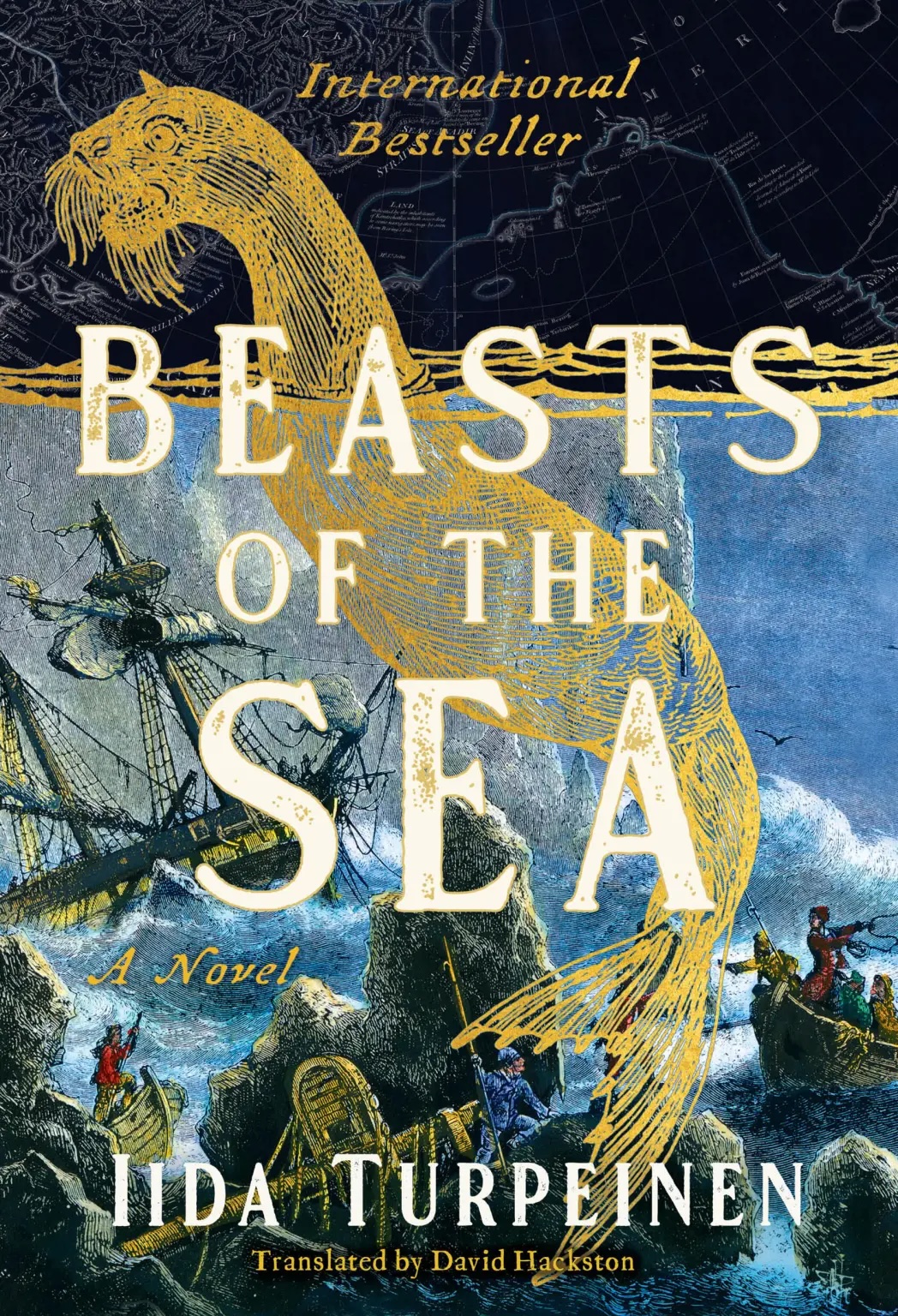
From Beasts of the Sea by Iida Turpeinen (trans. David Hackston). Used with permission of the publisher, Little, Brown, and Company. Copyright © 2025.