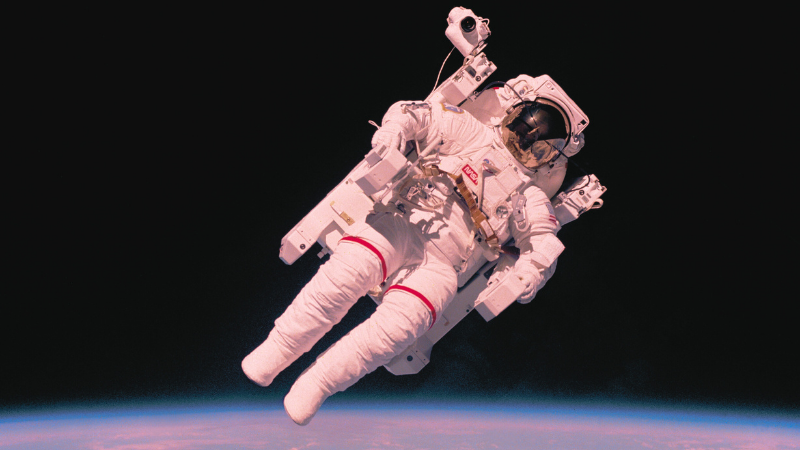
Astrofiction: Seven Novels With Astronaut Protagonists
Cecile Pin Recommends Samantha Harvey, Eliana Ramage, Taylor Jenkins Reid, and More
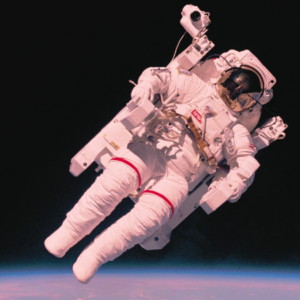
Astronauts are well-represented in popular culture. From songs like David Bowie’s A Space Oddity and Elton John’s Rocketman, to films such as 2001: A Space Odyssey (concurrently developed alongside Arthur C. Clarke’s novel of the same name), Interstellar, Gravity… we are all familiar with the image of a man or woman, engulfed in a spacesuit, lonely and frail against the vast background of our universe.
My new novel Celestial Lights tells the story of Oliver Ines, who grows up to become one of the most renowned astronauts of his time. As he embarks on a landmark, ten-year mission to the distant moon Europa, he finds himself retreating into the past. In-between commanding his crew of four, he looks back at the choices, and relationships, that led him to where he is.
I was particularly interested in the dichotomy of writing a novel that held some speculative, sci-fi elements, while still feeling humane and grounded. While looking for inspiration, I noticed that there were not quite as many astronaut novels as I’d intuited at first glance. Novels set in space, yes; novels with extraterrestrials, or galaxy wanderers, yes – but novels with astronaut protagonists, specifically, is a sub-genre in itself. Here are a few that I have enjoyed.
*

Olga Ravn, The Employees (translated by Martin Aitken)
I love this book for its originality and surprising emotional depth. Onboard the Six-Thousand Ship, the crew – both human and humanoid – have brought onboard unknown objects from a newly discovered planet. The novel takes the form of testimonies of each employee, as they recount to the Board of Directors the deep, strange impact those objects have had on them: a yearning for closeness and connection, a longing for home that many of them have never known.
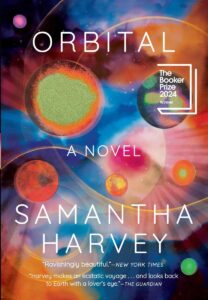
Samantha Harvey, Orbital
Winner of the 2024 Booker Prize, Orbital is a short book that packs a punch. It follows a team of astronauts onboard the International Space Station as they conduct their research. In-between experiments they observe their surroundings, reflect on their fears and dreams, and ponder the fragility of human life and our planet, seen anew from the stars.
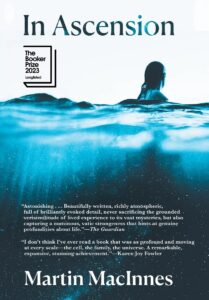
Martin McInnes, In Ascension
I really admire McInnes’s ability to write an other-worldly, imaginative novel, yet that still feels very much grounded and intimate. It tells the story of Leigh, a researcher of ancient algae, who makes a discovery that will propel her on a journey across the universe.
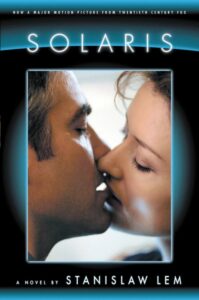
Stanisław Lem, Solaris (translated by Bill Johnston)
Several of Lem’s book could have made this list. Solaris has been adapted twice for the screen, by Andrei Tarkovsky (in 1972) and Steven Soderbergh (2002). It follows Kris Kelvin, who arrives on the planet Solaris to study the ocean that covers its surface. But things onboard the space station soon take an unexpected turn, as Kelvin and the crew are faced with strange, otherworldly encounters. A claustrophobic, mysterious novel, that asks deep questions about human nature.
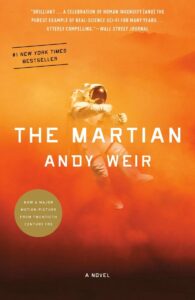
Andy Weir, The Martian
Again, this isn’t the only one of Weir’s book that could have made it onto this list – and many readers might be familiar with Ridley Scott’s Oscar-nominated adaptation of it. Mark Watney, a NASA astronaut, gets stranded on Mars after a dust storm sweeps through the planet. How will he survive against all odds? I particularly admire how well-researched the novel is. Weir, who has a background in computer programming, checked a lot of the maths and science himself, and initially published chapters on his blog, crowdsourcing readers to correct any inaccuracies.
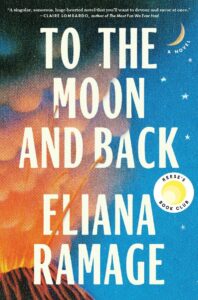
Eliana Ramage, To the Moon and Back
Ramage’s debut novel tells the turbulent journey of Steph Harper, a young woman determined to become the first Cherokee astronaut – but with that dream comes sacrifice. It’s an enthralling and deeply humane novel that explores family bonds, belonging, and the heavy costs of ambition.
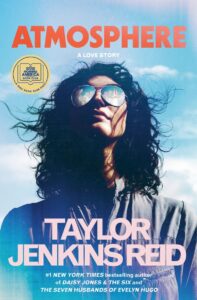
Taylor Jenkins Reid, Atmosphere
As for To the Moon and Back, I read Jenkins Reid’s latest novel once I had finished writing Celestial Lights, and what a joy it was. Set against the backdrop of the 1980s US space shuttle program, Atmosphere is a story of love and human limitation, both epic and intimate in its scope.
Bonus:
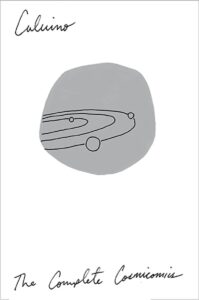
Italo Calvino, The Complete Cosmicomics (translated by Martin McLaughlin, Tim Parks and William Weaver)
I’m cheating here a little bit: Qfwfq, the protagonist of The Complete Cosmicomics, is not exactly an astronaut but rather a ‘cosmic know-it-all’, as old as time itself. But any work by Italo Calvino is worth recommending, and there is something so joyful, so enchanting in those stories about the evolution of the universe, that it felt wrong not to share. It’s the first book I reached for when I began thinking of Celestial Lights, and one I come back to often.
__________________________________
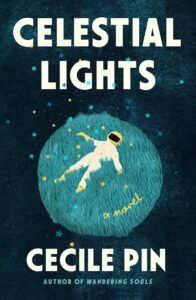
Celestial Lights by Cecile Pin is available from Holt, an imprint from Macmillan.

Cecile Pin
Cecile Pin grew up in Paris and New York City. She moved to London at eighteen to study philosophy at University College London and received an MA at King’s College London. She writes for Bad Form Review, was long-listed for their Young Writers’ Prize, and is a 2021 London Writers Award winner. Wandering Souls is her first novel.