Ashley Shelby on Her Fictional Climate-Grief Drug
In Conversation with Mitzi Rapkin on the First Draft Podcast
First Draft: A Dialogue of Writing is a weekly show featuring in-depth interviews with fiction, nonfiction, essay writers, and poets, highlighting the voices of writers as they discuss their work, their craft, and the literary arts. Hosted by Mitzi Rapkin, First Draft celebrates creative writing and the individuals who are dedicated to bringing their carefully chosen words to print as well as the impact writers have on the world we live in.
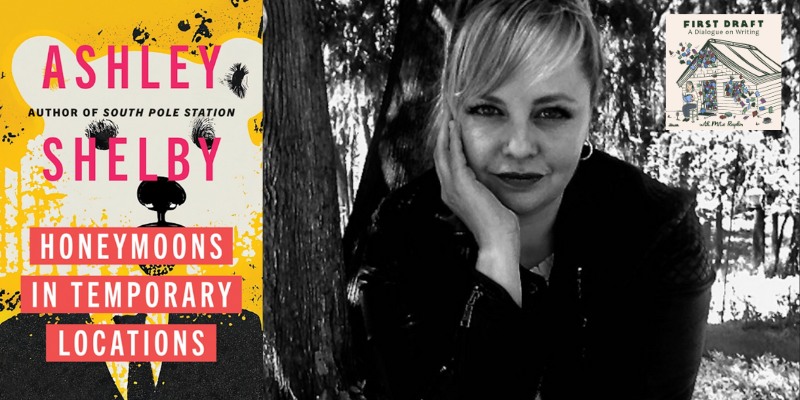
In this episode, Mitzi talks to Ashley Shelby about her latest short story collection, Honeymoons in Temporary Locations.
Subscribe and download the episode, wherever you get your podcasts!
From the episode:
Mitzi Rapkin: Tell me about Climafeel? It’s mentioned throughout the book but is highlighted in the last stories.
Ashley Shelby: Climafeel is the drug that I thought I wanted when I was trying to grapple with my climate grief when I think it was sort of at its at its worst. It’s a pharmaceutical that is in my speculative world, designed to treat solastalgia. So again, in this speculative world solastalgia is a recognized medical disorder, psychiatric disease, but also a physical disease. It manifests physically as well and it has decimated the labor force. And obviously that cannot be allowed to happen. And instead of treating the root cause of solastalgia, the government, and you know, the corporate structures want to treat the disease to get people back to work. And so how better to treat a disease that comes from being distressed about environmental destruction than to make people stop caring? I talk about Climafeet a lot in this book. It’s kind of a through line. But one of the company’s taglines was, have you ever wondered what it might feel like not to care. Have you ever wanted not to care? And that line is something that I told myself many times before I even came up with Climafeel. I think a lot of really sensitive people have half wished that they could do that, like, I don’t want to care so much, because this hurts. This hurts. It hurts to care a lot of the time. I don’t remember the philosopher who said this, but empathy is one of the highly evolved traits in humans. It’s technically not necessary and it causes pain to the person who offers it. It’s very interesting. Not everybody has it, you know, or they have it to varying degrees. But if you have a lot of it, a lot of things can hurt, and yet we persist in it. So, it’s like we have no control over it. But every once in a while, I’m sure other people experience this too, you just don’t want to care. I just don’t want to care so much. So of course, as a fiction writer, I’m like, Well, what if there was a pill that made you not care? If there was the ability to make people not care? I feel very strongly that corporations would jump on that in a hot second. So, I created this pharmaceutical and I write about its development and case studies and the underlying science, but science in quotes that developed it and kind of took it from there.
***
Ashley Shelby’s debut novel, South Pole Station, received praise from The New York Times, The Washington Post, National Public Radio and others. It was also named a New York Times Editor’s Pick and an Indie Next Pick, as well as a Best Book of 2017 by Shelf Awareness, and was awarded the 2017 Lascaux Prize in Fiction. Her 2024 story collection, Honeymoons in Temporary Locations is currently shortlisted for the Janet Heidinger Kafka Prize. Her short fiction, essays, and reviews have appeared in Slate, The New York Times Book Review, LitHub, Salon, Audubon, and other outlets. She is also the author of Red River Rising: The Anatomy of a Flood and the Survival of an American City.
First Draft: A Dialogue on Writing
First Draft: A Dialogue on Writing is a literary podcast produced and hosted by Mitzi Rapkin. Each episode features an in-depth interview with a fiction, non-fiction, essay, or poetry writer. The show is equal parts investigation into the craft of writing and conversation about the topics of an author’s work.