Argentina Through the Eyes of Polish Writer Witold Gombrowicz
Mercedes Halfon on the Experience of Exile, Loss and Finding One’s Literary Voice
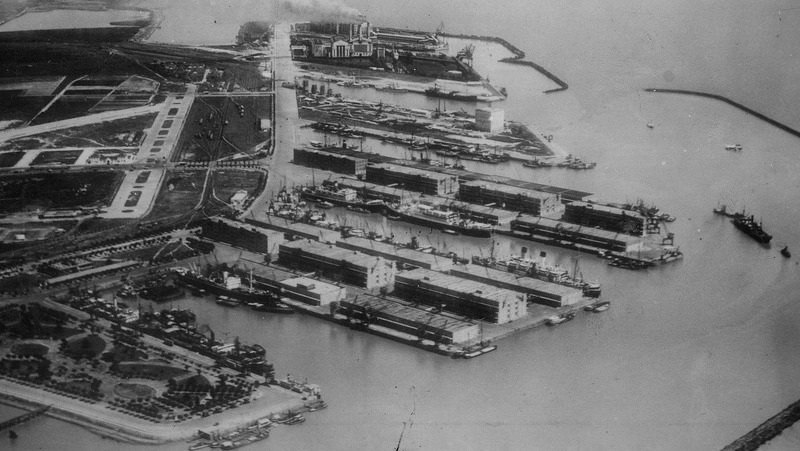
The scene is something like this: one leaden winter morning the Chrobry, a luxury liner that set sail in Poland and has been traveling across the Atlantic Ocean for over twenty days, approaches Buenos Aires. The passengers include diplomats, businessmen, politicians and writers invited by the shipping company to cover the vessel’s maiden voyage. They include Witold Gombrowicz, a young avant-garde writer with piercing eyes and a disdainful grimace. From the estuary of the River Plate, the city looks mysterious, almost smudged, its lines seeming less refined than those of Paris but more modern than Warsaw’s.
The passengers disembark to discover this distant country, cold and damp, their hands in their pockets. Beyond the new port’s small promenade Retiro, the Torre de los Ingleses and Calle Florida appear. Some go back onto the ship, where they are met with multiple receptions laid on for ambassadors and personalities from the Polish and Argentinian community. But not Gombrowicz. He keeps walking. He returns to the ship to sleep before going out again. Over several days, he exhausts those streets, those faces, those features of the men and women of the South. Something opens. Or breaks, perhaps. Something becomes detached.
Much later, in Trans-Atlantyk, he will write: “I was looking as if through a Telescope, and, seeing Strangeness everywhere, Unfamiliarity and Puzzle.”
He said that walking off the ship that afternoon holding his two cases, trying to understand what he had just done, was the most tragic moment of his life.
As the warm welcomes, teas and receptions continue, news comes in from across the ocean. The tension between the major countries is rising. Germany and the Soviet Union sign their non-aggression pact. War seems imminent. The Chrobry is ordered to return to Europe with all its crew. Gombrowicz goes to the port, puts his luggage on the ship, says his goodbyes and boards. But when the alarm sounds, indicating that the ship is ready to depart, he acts on impulse. Carrying his two cases, he quickly descends the gangway onto the dock. He will not return to Poland, to the war that seems so likely. He has 200 dollars and just a few changes of clothes. He hardly knows anyone. And no one knows him.
Some say it was 20th, others 21st, others 22 August 1939. He himself gave different dates in his Diaries, in the book of interviews called A Kind of Testament and in the novel Trans-Atlantyk. The story, which he also told in person to anyone who would listen during his time in Argentina, is that the outbreak of war anchored him to this distant land. But that wasn’t exactly the case. The anchor was dropped on impulse a few days after the war started.
Much later, he wrote in his Diary: “I don’t know if I will be speaking lucidly enough when I say that from the first, I fell in love with the catastrophe that I hated, that, after all, also ruined me. My nature told me to greet it as an opportunity to join with inferiority in darkness.”
Later still, he said that walking off the ship that afternoon holding his two cases, trying to understand what he had just done, was the most tragic moment of his life.
*
That the Second World War started on 1 September 1939 is not in doubt. And that, to be specific, it started when Poland was invaded by the army of Nazi Germany. From a South American perspective, those events must have felt at once terrifying and distant, as if seen through tinted glass. For Gombrowicz, who had left Warsaw almost three weeks previously, the war was a shadow that walked behind him.
Jeremy Stempowiski, director of GAL, the shipping company that brought the Chrobry to Argentina, oversaw the welcome receptions, organizing them with as much pomp as possible. The entire diplomatic corps was present, with even the president of Argentina attending one of the meetings, a fact recorded in all the newspapers, naturally. It was there that Stempowiski met Gombrowicz, who was introduced as the correspondent from a Polish daily. In various testimonies, Stempowiski has told of how he saw him tirelessly wandering the streets, and the enormous sense of curiosity that the city produced in him. He is the closest witness to those confused days of arrival, when Gombrowicz was giving off a sense of increasing nervousness, wavering between returning to Poland or staying and waiting for an end to hostilities. It was also Stempowiski who greeted him at the dock when he came down from the ship for the last time, overwhelmed and alone, before it departed for good. Gombrowicz was shaking, repeating over and over: “I can’t, I can’t.”
The ship set sail and they sat down on a bench at the port and talked about the available options. Stempowiski tried to calm Gombrowicz down. He took him in a company car to a basic, clean guesthouse in the center. He promised to help him over the following days: introduce him to people, find him a modest income. And he did exactly that.
Gombrowicz just had to get through that first night in the city of Buenos Aires, surrounded by an unfamiliar language that filtered in, like the winter cold, through the windows and under the door. The ship that had carried him there was advancing across the ocean, fast and far away, also taking its name with it: Chrobry, in honor of King Boleslaw I Chrobry, which means ‘brave’ in Polish. It’s not much of a prognosis, at least on this night of trembling.
But the decision to remain in Buenos Aires had now been taken. What he doesn’t know, since there is no way of intuiting it yet, is that the war will soon begin and even when it ends he will still not be able to return to Poland. He will spend many other nights there, many, many more, just under half of his life. Twenty-four years in Argentina await him.
*
On 21 August 1939, La Nación newspaper publishes an item with the title “New ship arrives bearing Polish flag.” In it, the Argentinian journalist Pizarro Lastra interviews the three writers who came on board the luxury transatlantic liner. He writes: “Among the travelers who came on the Chrobry was…Witold Gombrowicz, a modern humorist, a man of great learning. He has just had a resounding success with a potboiler entitled Ferdydurke.” Other pieces were published about the ship’s arrival, but this is the only one Gombrowicz mentions in Kronos. He sees it as a first defeat. They call him a “humorist,” his novel a “potboiler.” Gombrowicz was already Gombrowicz when he arrived in Argentina. But over here no one knew that.
*
Gombrowicz never really ‘assimilated’ to life in Argentina, partly due to the unique and unprecedented circumstances that brought him there in the first place, but also because of his naturally irreverent and at times even childish attitude towards literary establishment. Nowhere was this more evident than at his legendary speech, delivered in less than perfect Spanish and which seemed deliberately designed to provoke the literary sensibilities and conventions of the time.
He will spend many other nights there, many, many more, just under half of his life. Twenty-four years in Argentina await him.
On 28 August 1947, Gombrowicz gives a lecture. He considers it a promotional activity for the novel that has just come out and—why not—for himself too. It takes place in Fray Mucho, a bookshop located on Calle Sarmiento, almost at the corner with Callao, at 7 PM.: it’s cold, the city’s lights have been turned on. The venue includes a small café that is crammed full. There are friends, some curious onlookers, intellectuals, a generally bohemian crowd. It is neither the first nor the last lecture he will give in Buenos Aires, but this one is uniquely important. From the title itself, Gombrowicz is on a war footing. He calls it ‘Against Poets.’
Picture him in his threadbare suit, nervously smoking his Tecla cigarettes, his eyes obliquely devouring everything, his notes on a small table that resembles a pulpit. Once the room has settled, he begins to speak in his harsh Slavic accent:
The thesis of the following essay, that almost no one likes poems and that the world of verse is a fiction and falsehood, will seem, I assume, as bold as it is frivolous. Yet here I stand before you and declare that I don’t like poems at all and that they even bore me.
The audience gulps. Isn’t poetry the most noble of arts, the most sacred, the one nobody, far less someone devoted to writing, should question? Gombrowicz continues, proceeds as the audience clear their throats and grumble disapprovingly:
Maybe you will say that I am an impoverished ignoramus. Yet I have labored in art for a long time and its language is not completely alien to me. Nor can you use your favorite argument against me, claiming that I do not possess a poetic sensibility, because I do possess it and to a great degree. When poetry appears to me not in poems but mixed with other, more prosaic, elements, for example, in Shakespeare’s dramas, in the prose of Pascal and Dostoyevski, or simply as a very ordinary sunset, I tremble as do other mortals. Why then does this pharmaceutical extract called ‘pure poetry’ bore and weary me, especially when it appears in rhymed form? Why can’t I stand this monotonous, endlessly lofty singing? Why does rhythm and rhyme put me to sleep, why does the language of poets seem to me to be the least interesting language conceivable?
The whispering gets louder and so does Gombrowicz. He is accompanied by the Cubans Piñera and Rodríguez Tomeu, who read fragments of poems in a flowery, exaggerated way. When he finishes the lecture, the audience is up in arms. Some attendees, caught between shock and annoyance, make comments and ask questions. Even some of his friends, such as Obieta and Pla, disapprove of what he has said. An old bard throws a walking stick at Gombrowicz, which he dodges. He answers the questions in total tranquillity. In a brief testimony collected in Gombrowicz in Argentina, Rodríguez Tomeu said of the talk: “It was very animated. Someone stood up and insulted us. People whistled at us. Gombrowicz was in his element.”
____________________________

From Outsider Everywhere: Witold Gombrowicz in Argentina by Mercedes Halfon, translated by Rahul Bery. Copyright © 2026. Available from Fitzcarraldo Editions.

Mercedes Halfon
Mercedes Halfon was born in Buenos Aires. She has published three novels, six poetry collections and one work of non-fiction. With Laura Citarella, she directed the film Las poetas visitan a Juana Bignozzi (2019), which won the Best Director award at the Mar del Plata International Film Festival and the Silver Dove award at the DOK Leipzig Festival. She curated the theatrical cycle "Invocaciones," held at the Centro Cultural San Martín and the Teatro Nacional Cervantes. She teaches in the Writing Arts program at the Universidad Nacional de las Artes and writes for the Radar supplement of the newspaper Página/12, among other outlets. Outsider Everywhere: Witold Gombrowicz in Argentina is her first book to appear in English.